Friday, August 30, 2019

Rivers Run Deep

An image with commentary from Moser's papers
Long before Robert Redford brought the novella A River Runs Through It to the silver screen in 1992, its author, Norman MacLean, was known to Dartmouth College as a member of the class of 1924. The Iowa-born but long-time Montana resident was, among other things, the editor-in-chief of the campus humor magazine The Jack-O'-Lantern his senior year before handing the reins of the publication to Ted Geisel '25, known more popularly as Dr. Seuss. MacLean was also an instructor of English at the college immediately following his graduation and for several more years before eventually attending graduate school at the University of Chicago.

Here in Special Collections, we are fortunate not only to have a lasting record of MacLean through his alumni file and issues of the Jack-O, but also because of another impressive collection that we oversee, the papers of printmaker and illustrator
A letter from UChicago regarding a certain fishing fly
Barry Moser. In 1989, Moser received a commission to illustrate an edition of MacLean's novella for the University of Chicago. In his papers, there are numerous records that speak to the high level of detail and thoughtfulness that Moser put into his illustrations, as well as the collaborative process between him and MacLean during the design stages of the book. In particular, the correspondence about fishing flies, and who tied them, is fascinating for anyone who enjoys the art of fly-fishing.

To learn more about Norman MacLean '24, come to Rauner and ask for his alumni file. To see the issues of the Jack-O'-Lantern for which he oversaw publication, come into the reading room and take them off of the reference shelf. To explore the negotiations and deep thought that went on behind the scenes of the University of Chicago's edition of A River Runs Through It, ask to see Box 90 from the Barry Moser Papers (ML-39).

Tuesday, August 27, 2019

Finding Greenland in America

Title page of Relation Du GroenlandSomething compelled us to take a look in our famed Stefansson Collection on Polar Exploration for something cool related to Greenland. The oldest book devoted to Greenland that we have was published in Paris in 1647. Relation Du Groenland is pocket sized and our copy is still in its original limp vellum binding. It appears to be a compendium of just about everything that was known about Greenland at the time by southerners, which wasn't a whole lot. The topography, glaciers, and flora and fauna of some of the coastal regions are all described. Typical of the unenlightened time, the peoples living there are described as "Savvages Groenlendois," and seem to be treated as curiosities. The person who wrote the book had a clear interest, but just didn't have all of the facts straight.

Map of coast of Greenland showing it connected to North America
We were particularly intrigued by the map that shows Greenland connected to America just north of Hudson Bay. Weird.

Take a look by asking for Stef G740.L31.

Friday, August 23, 2019

Greet the World from the Hill with a…Bell?

View of the Dartmouth Hall Belfry with bell rope, circa 1880
As we mentioned in a previous post, a visit to Dartmouth isn’t quite complete until you’ve heard the Alma Mater ringing across campus from the majestic bells of Baker Tower. Baker’s bells have served as the heartbeat of the College on the Hill for 91 years, chiming the hours and announcing other events on campus since the famous library was constructed in 1928. But long before the casting of Baker’s bells, an arguably more famous, or at least more notorious, bell greeted Dartmouth students, professors, and visitors from atop another iconic building on the eastern side of the Green - Dartmouth Hall.

The story of Dartmouth Hall’s bell begins with the initial founding of the College. Realizing the need to announce church services, meetings, and class periods in addition to instituting a “town clock” in the woods of New Hampshire, Eleazar Wheelock, Dartmouth’s first president, pleaded with his financial supporters in England to help him raise funds to purchase a bronze bell. At the time, quality bells (i.e., bells that did not crack under heavy use) were extremely expensive, and as such Eleazar was forced to rely upon a large conch shell, which he and undergraduate students blew into, to announce class periods and to call worshipers to prayer.

The first College bell was found to be broken upon its arrival from Whitefield, NH, in 1789, thus marking the beginning of the long line of short-lived Dartmouth Hall bells. On August 8, 1790, then Dartmouth senior William Eaton, who would later become famous Army General William Eaton and Consul General to Tunis during the First Barbary War, was dispatched by Dartmouth President John Wheelock to procure a bell cast at Messrs Doolittle and Goodyear in Hartford, CT, for commencement. The 282-pound bell was hung on August 24, 1790, in the new belfry of Dartmouth Hall, marking the beginning of 138 years of Dartmouth Hall bells ringing across campus. In 1819, during the famous Dartmouth College Case, Dartmouth College and Dartmouth University argued over ownership of the bell, given that its chiming symbolized control over class and religious service schedules. Eventually, the bell was appropriated along with other pieces of college property to the short-lived University, but was relinquished back to the College following Daniel Webster’s successful case.

In October 1819, the Dartmouth Hall bell broke and was replaced by a 299-pound Revere bell (one of only 398 bells produced by Paul Revere’s foundry between 1792 and 1828) brought from Boston. This bell was then traded for a larger 512-pound bell, also from Revere’s foundry, in February, 1821. In 1829, following renovations to Dartmouth Hall, a deeper-toned bell of 726 pounds was installed, where it rang for over 40 years until it cracked in 1867. During the 1850s-1880s, one of the favorite pranks of Dartmouth students was to “steal the clapper off the bell, or ring it before the recitation period was fully over” (pg. 20, A Social & Architectural History of Dartmouth Hall). By the 1870s, the eagerness of students to climb Dartmouth Hall to ring the largest bell before the end of class periods and before sunrise had grown problematic. To prevent this practice, the disgruntled faculty gradually boarded up entrances to the Dartmouth Hall belfry and even posted a guard. Many ingenious devices were thus invented to ring the bell from a distance, one sophomore going so far as to climb the lightning rod with a long stick in hand, having fastened a rope to the eaves as a means of escape. Unfortunately, the rope was discovered by faculty and cut off about 3 feet below the eaves, so that upon using it, the boy dropped three stories to the ground. Our records indicate that the student limped away before the faculty could catch him.

As both the size and reputation of Dartmouth College grew, so did the size and reputation of Dartmouth Hall’s bell. From 1867-1885, Dartmouth Hall went through a succession of four bells which had an uncanny tendency to break shortly after their warranty periods had expired, all the while more than doubling in size from 512 to 1,237 pounds. Despite their growth and the continued importance of Dartmouth Hall as a recitation hall, dormitory, chapel, library, and medical school, the building which supported the Dartmouth Hall bells had fallen into neglect. In 1887, President Bartlett praised the “harmony of the bell” which called him to work in the morning, but described Dartmouth Hall as a “menace” due to its dilapidated state and the infamous “bedbug alley” dorms which occupied the top-most floor. Renovations to the belfry proved short lived however, as the bells melted in the famous 1904 fire which consumed most of Dartmouth Hall.
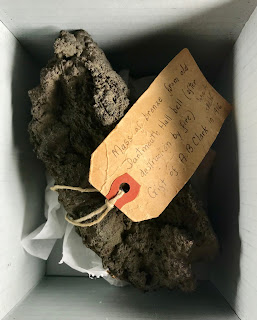
Mass of melted bronze salvaged from the remains of the 1904 fire.
Dartmouth students and alumni had grown so fond of the Dartmouth Hall bells that after melted remnants of the bell were found amid the smoldering timbers following the 1904 fire, hundreds of small replica bells were made from the hunk of bronze. These small souvenir bells were used as watch fobs; given as gifts to alumni, trustees of the college, and local families, often labelled with the inscription: “made from fragments from the eight ancient bells of Dartmouth Hall which called the students together from 1786-1904.” Today, several of these beautiful Dartmouth Hall bell replicas can be heard chiming here at Rauner Special Collections Library, where they are housed in our realia room.
Small Dartmouth Hall replica bell owned by President William J. Tucker
After the 1904 fire, Joshua W. Pierce (class of 1905) gifted the college with a 1,184 pound bell also from Meneely & Co., which was installed on September 27, 1905. The bell continued chiming the hour and signaling class schedules until the construction of Baker Library in 1928, after its role in signaling church services had been passed in 1888 to Rollins Chapel. In a stroke of luck, the Dartmouth Hall bell survived the 1935 fire which consumed the roof of the building, but has remained largely unused.

Despite hanging in silence, Dartmouth Hall’s bell continued to make headlines when news broke in October of 1954 that a group of undergraduates had stolen the 70-pound clapper. The self-declared “Clapper-Nappers” left a ransom note with the college newspaper, stating:
Here are the facts on why the late bell doesn’t ring anymore. We have stolen the clapper from the top of Dartmouth Hall. It is now hidden within two miles of Hanover… we will return the clapper when Dartmouth becomes coeducational.
Aside from using the bell clapper heist as a gesture of frustration over the administration’s inability to move toward coeducation, the Clapper-Nappers also ended their ransom letter on a lighter note, saying “We hope unpunctual students... appreciate our efforts to revive the old College tradition (of stealing the Dartmouth Hall bell clapper).”

1935 New York Times article titled 'Dartmouth's Bell Rings, Surviving Fire in Old Hall"
Today, the bell remains atop Dartmouth Hall; now a silent reminder of Dartmouth’s past. “But can the bell still be rung?” you may ask. The answer appears to be yes and no, depending on to what lengths you are willing to go to ring it. A note in our collection from Dartmouth's events manager dated July 18, 1990, explains that the "Dartmouth Hall bell cannot be rung as there is no rope to pull it… (but) about 15 years ago students attached a rope to the bell and dropped it to the ground and rang the bell from the ground.” Perhaps after nearly 140 years of use and many mishaps, Dartmouth Hall’s bell deserves a well-earned rest.
To learn more about the Dartmouth Hall bells, ask for the vertical file "Dartmouth Hall - Bells", or ask to see our parts and replicas of the Dartmouth Hall bell by asking for Realia Box 26. More images of the various iterations of Dartmouth Hall and the Dartmouth Hall belfry can also be found in the photo file "Dartmouth Hall - Old."

Tuesday, August 20, 2019

Vigilantism at Dartmouth: Dartmouth Women’s Response to Sexual Assault

Front page of "The Shit You Don't Hear About..." flyer
Twenty-two years ago, a flyer was posted all around Dartmouth’s campus with a shocking message. On the flyer, titled The Shit You Don’t Hear About, are articles airing out the transgressions of Dartmouth organizations and members of the community. The flyer was published anonymously, for fear of social and physical retaliation. Its biggest story is a poem performed at Beta Theta Pi (de-recognized by the College following this incident) in its fraternity meetings in the summer of 1995. The poem boasts about the sexual exploits of brothers of Beta Theta Pi. The poem includes racist comments against Native Americans, lewd objectification of the female body, body-shaming, and boasting about rape. Names of real Dartmouth students were used in the poem, as characters with dialogue and descriptions. The publishers of The Shit You Don’t Hear About redacted these names before posting the document. It also includes an article about Alpha Chi Alpha’s “Pledge Banquet Skit,” which features “mastectomy jokes, as well as material sure to be offensive to all women, and Asian/Asian-American students,” an article about intimidation and harassment tactics by the Alpha Delta Fraternity (de-recognized in 2015), and articles about the racist and sexist exploits of other members of the Dartmouth community.

Second page of the flyerWhile it is the only flyer (that I know of) published by this particular group, The Shit You Don’t Hear About does not stand alone. Dartmouth College has a history of women standing up when they feel the administration and community have failed them. Before the flyer went public, its publishers had littered the lawns of Alpha Chi Alpha and Beta Theta Phi with manure in retaliation. In 1989, a rally and campaign were held by an estimated 100 students in response to Dartmouth’s refusal to bring a male student, Kevin Acker, before the Committee on Standards after being accused by two female students of sexual assault. Posters were circulated with Acker’s face on it, warning students to stay away from him. (While not tried before the COS in relation to accusations from these two women, Acker was found guilty of “sexual misconduct” against a different woman at a later date.) In 1996, again posters of a student accused of sexual assault were again circulated around campus, this time anonymously.

In my research of sexual assault at Dartmouth College, again and again I have come across evidence of brave women who take justice in their own hands, not only to punish the accused, but to protect their fellow Dartmouth students. When Dartmouth denies a hearing with the Committee on Standards, or ignores a survivor’s report, or fails to adequately discipline those convicted, a sexual assaulter runs free and the Dartmouth community is put in danger. This type of vigilantism was an effort to curb that danger. Every person who saw one of those posters knew that the person depicted was not safe to hang around, and that sexual assault was not tolerated by this part of the community. That is an important and noble message, even and especially today.

It is sad that so many people, for good reason, have little faith in the judicial procedures concerning sexual assault on campus. It is, however, nice to know that even when Dartmouth does not step up, there are people on campus who do.

To look at the flyer, come to Special Collections and ask to see the Sexual Harassment Vertical File.

Posted for Faydra Richardson ’20, recipient of a Historical Accountability Student Research Fellowship for the 2019 Summer term. The Historical Accountability Student Research Program provides funding for Dartmouth students to conduct research with primary sources on a topic related to issues of inclusivity and diversity in the college's past. For more information, visit the program's website.

Friday, August 16, 2019

Comic Almanacs

Last year we acquired a huge collection of 19th-century comic materials from the collector Joseph Rainone. With Joe's help, we have been busy digitizing an important batch of comic almanacs. Cheaply printed, and marketed to a middle and working-class audience, they supplemented practical information with pioneering comics. The results are a troubling mix of racism and misogyny typical of 19th-century humor, alongside moments of innovation in graphic story telling.

Within the almanacs, seemingly no ethnic group is spared, but the comics are particularly caustic toward African American, Irish, Chinese, and Jewish peoples. We recognize that digitizing these materials and making them widely available could potentially lead to their use in ways that are antithetical to our social and cultural values. We also recognize that making these available opens them to historical critique. While we are uncomfortable with some of the implications of digitizing these materials, we believe that a critical eye turned on the past creates insight that develops avenues for social change.

To judge for yourself, you can see the digital collection evolve at The Joseph Rainone Comic Collection. And, if you search the catalog, you can find them all for use in the Rauner Library reading room.

Tuesday, August 6, 2019

Eastward Ho!

Title page of Eastward Hoe
Here in Special Collections, Shakespeare gets a lot of attention. In particular, our copy of the First Folio is regularly retrieved from the stacks for visitors and students alike to gaze upon in awe and reverence. We've blogged before about how his later folios often get short shrift in comparison. Today, we want to show some love to a contemporary of Shakespeare's whose poetry actually appears in the First Folio. Ben Jonson was an English playwright who is most well-known for his scathingly satirical plays and the numerous masques that he wrote for the entertainment of the English court. Some have argued that he was the first poet laureate of England because of his receipt of a royal pension beginning in 1616. The period between 1605 and 1620 is often referred to as his most successful, when he enjoyed the patronage of the king and court.

However, before he enjoyed the pleasure of King James I, Jonson initially experienced His Majesty's displeasure. In 1605, Jonson collaborated with fellow playwrights John Marston and George Chapman to create a drama titled Eastward Hoe. The satirical comedy presented the exploits of a London goldsmith named Touchstone and his two apprentices; in the process, Jonson and his collaborators cleverly referenced and sometimes parodied numerous other popular plays of the time, such as Tamburlaine and Hamlet. Unfortunately for the men, though, they were also a bit too edgy for the king's liking. The play contains numerous satirical anti-Scottish comments, which ultimately caused a scandal and led to their arrest for insulting His Majesty. After several months in prison, spent furiously writing letters of supplication to various noble patrons, the men were released from jail.

Here at Rauner, we are fortunate to have an early edition (perhaps a first edition!) of the play that caused such a ruckus. To see it, come to Special Collections and ask to see Hickmott 160.

Friday, August 2, 2019

The Co-ed Committees: Bringing Women to Dartmouth

Trustee Study Committee organizational chartImmediately after beginning my research on Dartmouth’s road to coeducation as a Historical Accountability Student Research Fellow for the Summer 2019 term, I realized that I had greatly underestimated the complexity of the issue. The decision to go co-ed was about far more than whether the Trustees thought women were good enough for Dartmouth; it was about logistics. Before anyone could decide whether Dartmouth would go coeducational, they had to decide if it even could, and if it could, then how would they do it? Would they establish a coordinate college for women? An associate school? What would the costs be? Could Dartmouth predict and overcome a reduction in alumni donations? What of the issues of new facilities, greater numbers of women faculty, women’s athletics, housing? There was no immediately obvious answer to all of these questions.

To help sort out the issue, the Board of Trustees of Dartmouth College decided to establish a series of committees that would tackle specific questions. These committees would gather information and then report back to the Board with their recommendations. The first committee the Trustees established was the Trustee Study Committee (TSC), which was created to determine the general feasibility of coeducation at Dartmouth.

The TSC was established in the Spring of 1969 and held its first full meeting on October 1st of that same year. Two weeks later, it established its four subcommittees. These were the Subcommittee on Academic Models, the Subcommittee on Student Residence, the Subcommittee on Non-Academic Activities, and the Subcommittee on the Education of Women. Some of these subcommittees even had sub-subcommittees, so complex were the issues.

Page 11 from the TSC reportOver the next several months of meetings, the TSC brainstormed a handful of potential models for coeducation and questions that needed to be addressed. They investigated alumni, student, and faculty opinion polls on coeducation, the experiences of Yale and Princeton in going coeducational, projected financial impacts of coeducation, ways to increase enrollment without exceeding the college’s capacity, federal discrimination laws, and more.

The TSC continued holding regular gatherings for two years, with the final meeting on April 3, 1971. There, they unanimously voted on several recommendations to the Board of Trustees. These recommendations strongly encouraged the Trustees to vote in favor of coeducation in any form, advising that the College begin admitting women to either Dartmouth College, an associate school, or a coordinate college for women beginning fall of 1972. They suggested a goal of matriculating 800 women. The TSC also discouraged reducing the male population below 3,000 and advised against increasing the on-campus population to more than 3,150 students at a time. To make these contradictory recommendations possible, they suggested that Dartmouth make more effective use of the Summer term. This would allow Dartmouth to have a larger total enrollment without increasing the number of students on campus at any given time.


These recommendations, though fruitful, introduced another level of complexity to the issue of implementing coeducation. The TSC may have encouraged coeducation and provided a series of feasible models, but they hadn’t settled on one idea in particular. The recommendation of year-round operation through the use of the summer term also would require extensive research and discussion. In order to address these two major issues, the Board of Trustees established two more committees: the Joint Committee on the Associated School and the Committee on the Year-Round Operation of the College.

Page 12 from the TSC reportThe Joint Committee on the Associated School was created to explore the possibility of an Associated School for Women at Dartmouth. Of the several academic models proposed, this was initially perceived as the most attractive. There was already an existing framework for associated schools, given the presence of the Tuck Business School and the Geisel Medical School. This would also help prevent the ire of many of the older alums, because it would still provide some separation of men and women. Dartmouth had become the last all-male bastion in the Ivy League, and many wanted to preserve the heavily masculine atmosphere.

The Committee on the Year-Round Operation of the College was tasked with gauging the student and faculty reaction to a summer term. They also needed to examine whether the proposed summer term would be voluntary or mandatory, and if it were voluntary, how many students would participate?

After several more months of debate, these two committees submitted their formal recommendations to the Board of Trustees. The Joint Committee on the Associated School had ultimately decided that an Associated School for Women was not the most attractive option, given overwhelming student and faculty opposition. They suggested that, were the Board to vote in favor of coeducation, it should be a model in which female students were fully integrated members of Dartmouth College. The Committee on the Year-Round Operation of the College submitted a final report encouraging the implementation of a full-parity summer term. There would be a single mandatory summer term for each student, and it would be academically equivalent to the other three terms.

And so, the Board of Trustees finally had the specific recommendations they needed to make an informed decision about coeducation. At an extended meeting on November 21st and 22nd 1971, the Board of Trustees made the historic vote to commit the college to the Dartmouth Plan for Year-Round Operation, with the matriculation of female students at Dartmouth College in the fall of 1972. Dartmouth, which had just celebrated its 200th year of all-male education, would finally be coeducational. It certainly wasn’t an easy or simple process, given the number of people involved and questions to be answered, but the decision was finally made, and the college could move forward into a new, more inclusive, era.

To learn more, come to Special Collections and ask to see Box 7632 of the Dean of Faculty's records (DA-165).

Posted for Grace Hanselman ’20, recipient of a Historical Accountability Student Research Fellowship for the 2019 Summer term. The Historical Accountability Student Research Program provides funding for Dartmouth students to conduct research with primary sources on a topic related to issues of inclusivity and diversity in the college's past. For more information, visit the program's website.