Friday, August 3, 2018

The Great Day

Women students disembarking from bus on the GreenIn 1967, the student-run Committee on Freshman Reading organized a day-long event to bring women from nearby colleges to Dartmouth for a series of book discussions. Based on a small exchange of students from Colby the past December, the event was far grander, bringing nearly 400 women to campus for the day. 72 books were chosen ahead of time, and small groups coalesced over each title in "an informal and relaxed atmosphere." All were invited to dinner, then an evening of events that included a free movie, a hockey game, and a variety show in the Studio Theater. The point was to socialize with members of the opposite sex, but in an environment where intellectual engagement superseded the usual partying of the big date weekends like Winter Carnival or Green Key.

Discussion group in Dartmouth classroom
Despite the alarming headline in The D, "Four Hundred Girls Invade College," the students seemed to approach the day with maturity--reading their Ibsen and Agee and participating in the discussions. The Alumni Magazine was a little less respectful, focusing on the novelty of women on campus and describing the visitors as being "as attractive as they were intelligent." The photographs from the day are a treat, showing an early co-education moment in Dartmouth's history.

Dartmouth student giving directions to a visiting student
The images are all digitized and you can find them in the Photo Files.

Tuesday, July 31, 2018

A Legendary Hero of the Battle of Yashima

A painting of Japanese samura on foot and horseback from within the Nara Ehon
Nara was the first permanent capital of Japan and an important site of cultural development for the Japanese people. The Nara Period, lasting from 710 to 794 CE, saw numerous advancements: the first minting of coins, the establishment of Buddhism as a permanent and state-encouraged religion, and the creation of the first written Japanese literary and historical texts. Subsequent generations of Japanese people looked back on the Nara period as a cultural touchstone and a defining moment in the history of their country. As a result, numerous legends and heroes from that period became enshrined in Japanese literature, and one popular genre was the Nara Ehon, or the Nara picture books. These hand-painted manuscript codices traditionally told the tale of a hero or event from the Nara period or some other legendary moment from Japan's past. Their creators used gold and silver lavishly, as well as a stunning palette of beautiful and bright colors that make the scenes and characters come alive on the page.

Here at Rauner, we have a sumptuous example of a Nara Ehon that is titled Yashima. Our manuscript
A painting of Japanese samura on foot and horseback from within the Nara Ehon, including a decapitated warrior.
was made in the 17th century and tells the story of Sato Tsuginobu. Tsuginobu was a soldier who served in the army of Minamoto no Yoshitsune, himself one of the most famous samurai warriors in the history of Japan. During the naval Battle of Yashima on March 22, 1185, Tusginobu leapt in front of his master, Yoshitsune, and was killed by an arrow meant for the samurai leader. The two-volume story is a masterpiece of Japanese artwork and calligraphic skill that manages to impress even if the language is foreign to its reader.

To see this lovely book, come to Rauner and ask for Codex 002093.

Friday, July 27, 2018

Number by Colors

page showing relationship of anglesYou all know about coloring by numbers. The numbers in the various spaces of a picture cue you into what colors to use, and in the end you get a beautiful image. What we have here is not quite the reverse of that, but still a case of using color coding to execute complicated math to arrive at a number!

Two-page spread showing rows of colored symbolsThis is Oliver Byrne's The First Six books of the Elements of Euclid expertly printed (and it was a tough job!) by William Pickering in 1847. Instead of letters and symbols for shapes, lines and angles, Byrne broke down Euclidean geometry into a color coded schema. Imagine the printer's patience and skill to get the registration right--probably only surpassed by the patience and skill of the reader who tried to learn geometry this way.

Simple proof illustrated with colored shapes
To learn your Euclid by colors, ask for Rare QA451.B99 1847 (while you're at it, take a look at the 1482 edition, Incunabula 52).

Tuesday, July 24, 2018

A Life Made Tangible

Botany class picture from Marine Biological Lab, 1929As a female student who has just finished my first year at the College, the evolution of the role of women in academia—especially at Dartmouth—is particularly fascinating to me. During my time as this summer’s Historical Accountability Student Research Fellow here at Rauner, I’m examining the stories of the very first faculty members here at Dartmouth and hope to tell their stories the way they deserve.

Hannah Croasdale was Dartmouth’s first tenured female professor, a member of the Department of Biological Sciences specializing in algae and desmids, a type of algae found in circumpolar regions. While an undergraduate and graduate student at the University of Pennsylvania, she spent her summers at the Marine Biological Laboratory, Woods Hole, Massachusetts. The experience shaped her life in uncountable ways, and she returned to Woods Hole summer after summer to teach courses there, long before she was permitted to do so at the College. Special Collections has a photo album filled with images from her time there. This album paints a rich and exciting image of the summers that fueled a passion that easily could’ve lost its spark, given the trying nature of the career that ensued. Its pages are filled with pictures of Hannah and her friends and instructors sailing boats, collecting samples, and breaking for lunch on the beach. Underneath each photo, Hannah’s tiny script leaves a caption—sometimes the stuff of an inside joke lost to memory—and details the figures in each photo. The care that went into producing it, with each photo glued individually, shows how important it was to her that these memories be properly archived.

Candid shots of Hannah and classmates collecting algae, Wood Hole, 1930The book shows her attachment to it in tangible ways, too. The binding is markedly lighter than the cover, so it was likely kept on a shelf in prominent view. The edges of the pages appear burned, which could be from the fire she suffered at her Norwich home in 1989. It can be assumed, then, that the book was rescued from the fire. This photo album doesn’t just chronicle the summers she spent at Woods Hole but appears to have been a part of her entire life—some other important events it witnessed just didn’t leave a physical mark on the pages or spine.

It is sometimes easy to let timelines get blurred in history, especially when looking at black-and-white images that have flattened reality into two tones. If we look at this book and then look at samples of algae collected on those trips out to sea, the hours spent laboring over this passion begin to be more fathomable. Holding samples of algae Hannah collected at Woods Hole almost 90 years ago, still impeccably preserved on the page and labeled with her familiar handwriting, makes her joy for biology as contagious now as it must have been when she taught her Phycology course at Dartmouth.
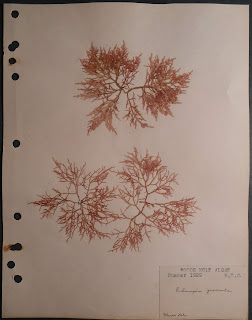
Algae sample from Woods Hole, 1929
Both of these artifacts are a part of the Hannah Croasdale Papers manuscript collection, and there are hundreds of other documents, letters, Christmas cards, algae samples, slides, and photos that only begin to round out the life of an incredible educator and scientist. In the same way, combing through the entire life of this important figure, boiled down into four boxes and roughly two hundred files, feels surreal. It is noteworthy not only what she chose to keep, but also what is missing.

You can look at algae specimens Hannah collected and the rest of her manuscript collection by coming into Rauner and requesting MS-882.

Posted for Caroline Cook '21, recipient of an Historical Accountability Student Research Fellowship for the 2018 Summer term. The Historical Accountability Student Research Program provides funding for Dartmouth students to conduct research with primary sources on a topic related to issues of inclusivity and diversity in the college's past. For more information, visit the program's website.

Friday, July 20, 2018

A Failure of Execution

Woodcut showing corpse draped over a table with half of its head removed to expose brainThis poor guy has had half of his head sliced off. It looks like an executioner swung about eight inches wide and missed the neck, but still did the crucial job. But, that is not what is going on here. This is an image from Charles Estienne's De dissectione partium corporis, an anatomy text from 1545 that was meant to rival Andreas Vesalius's famed De humani corporis fabrica of 1543. The image here shows the structure of the brain in rather dramatic fashion.

If you look a little closer, you'll notice an odd square around the top of the head. The effect is more pronounced in other illustrations in the book. You can really see it here:

Woodcut showing female anatomy with clear marking of inserted woodblock
It turns out that Estienne was dissatisfied with the woodblocks for the book, and had portions of them recut to emphasize crucial anatomical detail. The result is a woodcut inside of a woodcut. He clearly saw the original as a failure of execution--on the part of the woodcut artist.

We are lucky enough to have first editions of both of Estienne and Vesalius. To see them ask for Rare QM21.E82 and Rare QM25.V4.


Tuesday, July 17, 2018

Seeking Perfection from Dross

An alchemical drawing labeled Prima Figura
Well before J. K. Rowling's Harry Potter and the Philosopher's Stone brought alchemy and Nicolas Flamel back into the public consciousness, this pseuod-scientific pursuit had already enjoyed a milennia-old tradition of serious study and experimentation. Alchemy was hardly a European endeavor, either; the Muslim world, India, and East Asia all have stories and individuals about alchemical discovery and exploration that reach back for thousands of years. Ultimately, in the West, alchemy as a viable science fell by the wayside in the late modern period, when the scientific method won out. Still, a distinction between alchemy and chemistry wasn't established in Europe until the early 1700s, and alchemy experienced a 19th-century rebirth as an occult science.

An alchemical drawing labeled Secunda FiguraHere in Special Collections, we have an interesting manuscript codex of various alchemical and astrological tracts that we believe dates from the 17th century. The volume of collected writings has a note in it stating that the book was removed from the Jesuit library at Naples at the confiscation of their property in 1767. Numerous influential authors related to alchemy or its vilification fill the pages of the book, including Ramón Llull, Thomas Aquinas, and Albertus Magnus. The book is mostly handwritten text but there are some beautiful hand-drawn diagrams and illustrations scattered throughout.

To come explore these mysterious markings and scrawled secrets from the dawn of science, come to Rauner and ask to see Codex 001937.

Friday, July 13, 2018

Early Sustainability

The Commons Complaint - title pageIn 1611, after spending four years traveling around England, Arthur Standish published The Commons Complaint in which he laid out two "special grievances." The first was the deforestation of England - "the generall destruction and waste of Woods in this Kingdome." The second complaint was the lack of food - "the extreme dearth of victuals."

Standish lays out the wood issue in pretty stark terms:
Little respect is taken but by your Majesty, for the posterity and prosperity of your Kingdom: to many destroyers, but few or none at al doth plant or preserve: by reason thereof there is no Timber left in this Kingdome at this instant onely to repaire the buildings thereof an other age, much lesse to build withall.
He concludes his opening statement with the ominous "no  wood no Kingdome."

His solution is surprisingly modern. He recommends that new trees be planted and cared for and harvested in a sustainable manner:
And that all such persons as have at this instant their grounds furnished with wood, in such sort as is required, might bee also enjoyned hereafter to plant and preserve so many trees and so much wood, as hereafter they shall fell or waste.
Standish then lists some objections to his proposal and his counterarguments and solutions to those objections. He then goes into detail about the food problem and proposes four common sense. remedies. He again makes it plain that sustainable solutions are much preferred over short term quick fixes.

Ask for Rare Book SD 601 .S82 C6 1611 to read the rest of Standish's solution to the wood problem and his proposals for dealing with the lack of food.