Friday, December 18, 2015

Bored at Home?

cover of Charades bookTry Acting Charades! This 19th century pastime is way more complicated than what we call charades today. There's a whole book dedicated to the proper art of Acting Charades, or, Deeds not Words: A Christmas Game.

The book begins with an introduction to the history of charades (French), so started because of the national "inability to sit still for more than half and hour." As to the actual game, the two "most celebrated performers" choose their teams, then decide upon a two syllable word or phrase. One team then performs a charade -- silently, as "nothing more than an exclamation is allowed" -- "as puzzlingly as possible" in the order of "my first, my second, and my whole." It's somewhat similar to how nowadays, we do "1st syllable" and so on. But these pantomimes are not simple.

Let's follow "Mistletoe."
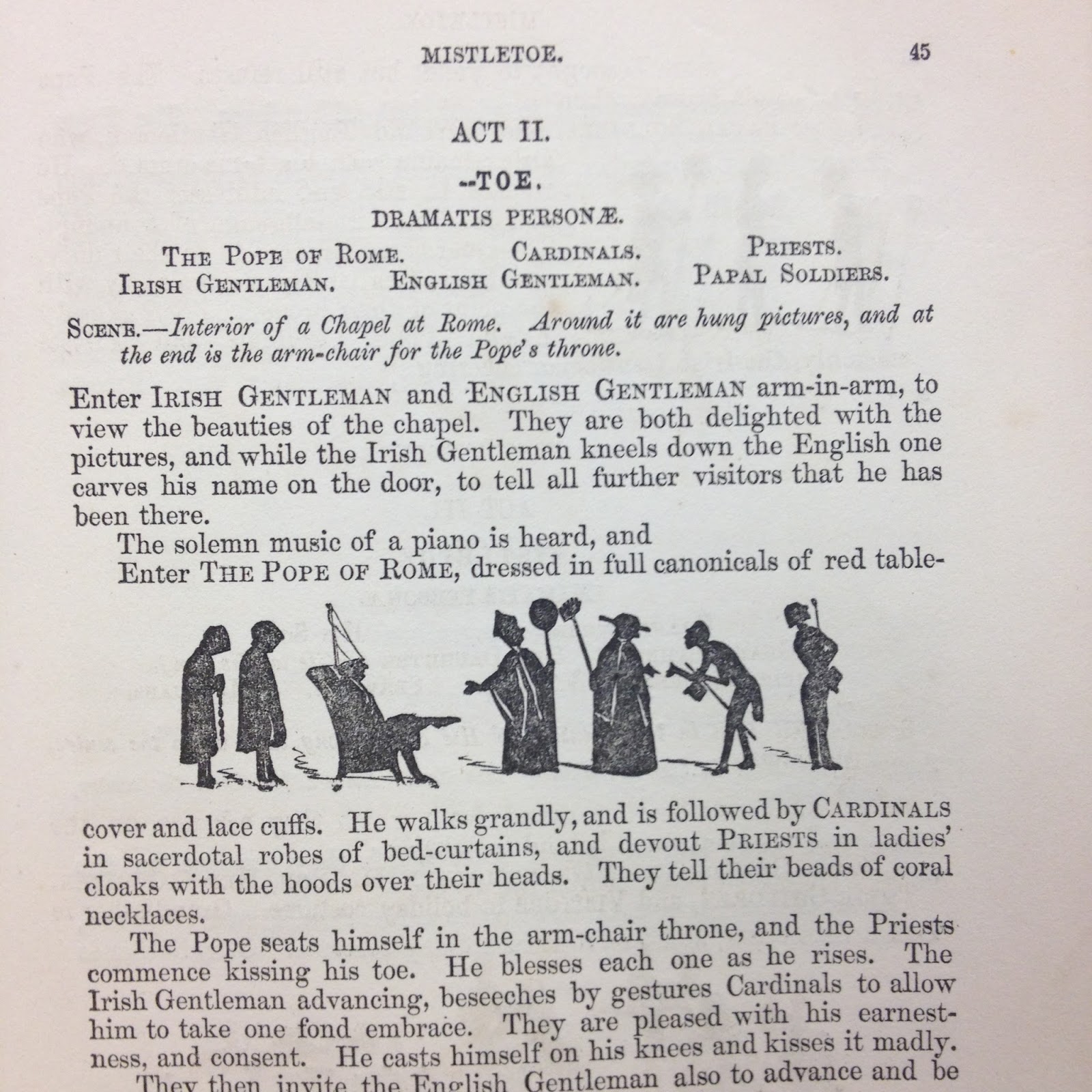
Kiss the pope's toe!Act I. Mistle -- (Mizzle). A Poor Tenant cannot pay his rent; he and his family remove all of their belongings from the home. The Angry Landlord arrives and is angry.

Act II. Toe. An English gentleman refuses to kiss the Pope's toe. An Irish gentleman attempts to help, but when the English gentleman is escorted away at broom-point, he joins the Catholic cheers.

Act III. Mistletoe. A grandfather sets up some mistletoe over the Christmas dinner table. Everyone is delighted at this"wickedness," and many couples embrace theatrically ("by crossing their heads over their shoulders") under the mistletoe. Then they have to get married.

Not sure I'd be able to guess "mistletoe" from that, but that's just my 21st century attention-span speaking. Maybe if I were a Victorian scholar ...

My favorite part is the incredible set-up to the actual action itself. It's not like our version of charades -- this requires costumes. And though they understand their are constraints, they expect "high-pressure ingenuity" to save the day. They have seen a Louis XVI with an "ermine victorine wig for a well powdered peruke, and the dressing-gown for embroidered coat." Let me just go get my ermine victorine wig.

To try a charade of your own, ask for Sine Illus H56act. The British Museum also has provided a scanned version via Google Books if you want to try during the winter holiday.

Tuesday, December 15, 2015

How Monahan Saved Christmas (Trees)

Photo of Robert MonahanHow the Grinch Stole Christmas by Dr. Seuss (Theodor Geisel ’25) and Rudolph the Red-Nosed Reindeer by Robert May ’26 are two of the most beloved Christmas stories of all time. Here at Rauner Library, the holidays are an opportune time of year to celebrate our alumni connection to these holiday classics and to share with you a lesser-known, true story about the pilferage of Christmas trees in New Hampshire.

Letter from MonahanI for one was unfamiliar with this story until I came across a letter in the papers of Robert S. Monahan, Dartmouth College Class of 1929, college forester and member of the New Hampshire House of Representatives. In the letter, dated December 16, 1966, Monahan writes to a Mr. and Mrs. Annis of Millsfield, New Hampshire regarding an ongoing issue of theft:
When we last met you mentioned the problem of Christmas tree pilferage, which you have observed on your own property, and wondered why somebody didn’t try to do something about it. Well, I did, back in 1957!
 It seems that throughout the state of New Hampshire Christmas tree theft was so prevalent that legal support became paramount.

In March of 1957, The Manchester Union reported, “the protection of natural resources has to have legal support. That is because human ‘wild life’ is predatory, because it cares nothing about the rights and property of others, and because it is unconcerned when it leaves havoc in its wake.” Illegally cutting a tree was not only considered an act of thievery but broke trespassing laws and posed an imminent threat to the protection of natural resources.

Newspaper clipping, 'Destruction of Trees'Newspaper clipping, 'Tree Stealers'

Later that year Robert Monahan introduced House Bill No. 254 addressing said havoc and calling for closer regulation of the transportation of Christmas trees.
Anyone apprehended transporting more than three coniferous trees on public highways outside of the compact parts of cities or towns from October 1 to December 23 is liable to a $50 penalty unless he can produce proof of ownership and name and address of seller.
House Bill No. 254In 1959 the bill was amended to decrease the number of trees from three down to “one or more” and increased the fine to $300.00.

Outside of the Dartmouth community the story of Robert Monahan may not be as well known as The Grinch or Rudolph, but at Rauner he will forever be remembered as a son of Dartmouth, college forester and savior of Christmas trees.

If you would like to learn more about legislation related to Christmas trees or Monahan’s forestry career ask for MS-1088 and his Alumni File.

Friday, December 11, 2015

Who Am I?

As mentioned in a previous post, Rauner Library holds Abner Dean's papers. Dean (Dartmouth class of 1931) was a cartoonist whose work appeared in Esquire, Collier's, The New Yorker, and Life magazines. In the collection is a set of masks - one of which we know is of Franklin D. Roosevelt and was used as part of the illustration for the September 1932 cover of Life magazine.

Identifying the other masks is a bit trickier.

For example, this next one is probably Winston Churchill - or perhaps W. C. Fields.

And almost certainly Ed Wynn - the nose helps a lot here.

And we think this might be Truman Capote, though if this mask is a contemporary of the Roosevelt, that would be highly unlikely since Capote would have been 8 years old at the time.

But for the rest...well we're not sure. Let us know what you think!
Ask for ML-44 to see the Dean papers. A guide to the collection is available.

Tuesday, December 8, 2015

Lest Old Traditions...

Editorial Cartoon reading 'An Old Dartmouth Tradition ... Goes to Pot'Doesn't this just scream 1968? The College was cracking down on campus drug use, and a week earlier a student was forced to "resign" from Dartmouth for the "alleged use and sale of hallucinatory drugs." The D responded with an editorial decrying the severity of the punishment alongside this editorial cartoon.

Here in Rauner, we have documentation of many old Dartmouth traditions that have gone to pot--figuratively.

To see the cartoon, ask for The D from February 28, 1968. Issues from the prior week discuss the campus drug controversy (and also feature lots of great materials from the 1968 Presidential primaries).

Friday, December 4, 2015

The Black Box ... of Canada?

outside of box
One of the best parts of being a staff member at Rauner is wandering through the stacks. You come across strange and wonderful items that you have no idea existed -- like this mysterious black box.

I've been eyeing this box for quite some time. It's in our "Illustrated" collection, so I wondered if there were racy images that had to be locked up (I mean, we just did a class using some of our uncatalogued erotica). But no. After struggling with the latches, I was greeted by a serene title page: Canadian Scenery Illustrated, from Drawings by W. H. Bartlett. Not quite what I was expecting, but still cool!
view of Montreal
The box contains a series of magazines published in London in 1842 concerning Canada. During this period, Canada was under British rule. Canadian Scenery becomes a participant in the project of British imperialism, bringing "human interest" scenes of Canada to London homes, from descriptions of Native American life to engravings of Montreal.
advertisement for Shakespeare's playsThe author, Nathaniel Parker Wills (Esq.), also wrote "Pencillings by the Way" and "Inklings of Adventure," two titles with a bit more punch than Canadian Scenery Illustrated. He was one of the highest-paid magazine writers of his day and established the Home Journal, which would eventually become Town and Country. We have a lot of other items in our collection by Wills, including a play titled Bianca Visconti; or, the Heart Overtasked and Hurry-graphs; or, Sketches of scenery, celebrities and society, taken from life. 

But, as in almost all nineteenth-century serials, the most comic part is the advertisements. My favorite advertises an edition of The Works of Shakespere [sic], which includes "the Attributed Plays" -- Locrine, Sir John Oldcastle, Thomas Lord Cromwell, The London Prodigal, The Puritan, and Yorkshire Tragedy. I've never even heard of any of these plays, but it turns out we have several copies of those plays, too -- a future blog entry?!

Ask for Illus B258c to learn more about nineteenth-century Canada.

Tuesday, December 1, 2015

Tour of America

Opening page form John Tawse's journalOn Monday, July 1st, 1839, John Tawse and George Lyon set off from Edinburgh on a journey to America. They were representing the Society in Scotland for Propagating Christian Knowledge and their mission was to investigate Moor's Indian School located on the Dartmouth College campus. The Society had been a major source of funding for the school since Eleazar Wheelock founded Moor's in 1754. The pair produced a published report of their investigation, but it is the unpublished journal kept on the voyage by John Tawse that provides an intimate account of the impressions of the two rather stodgy travelers.

Tawse filled 260 pages in his journal, drew a map of their travels, and even created an index so he could easily refer back on his reflections. Most of the journal is dedicated to describing the places and people they met, but he occasionally launched into impassioned discourses on subjects he found most interesting. There is a diatribe against slavery and another on the treatment of people of color in free states, a long description of the American system of government, a section on the Oneida Indians, and a odd passage about American women's lack of beauty (no symmetry of form!). For the most part he is curious, morally judgmental, and somewhat in awe of the grandeur of the country.

Index to John Tawse's journal
His visit to Hanover gets scant coverage. He arrived quite ill, was treated by Doctor Oliver Wendell  Holmes, who taught at the Dartmouth Medical School from 1838-1841, and then spent the rest of his short stay meeting with President Lord and inspecting the school.

To see his journal, ask for Codex MS 003114

Tuesday, November 24, 2015

Johnny Johnson's Rum and Molasses Fund

Johnny Johnson turkey eats studentRum and Molasses -- what better way to spend a Thanksgiving holiday at Dartmouth? The Rum and Molasses Fund provided turkeys and other delicious foods for Dartmouth Outing Club members staying in Hanover over the break.

We have a few documents from the 1930s and 1940s outlining the festivities. One year, there was the "Thanksgiving feed at Moose" cooked by a member of the class of 1934 at Moosilauk, then the "Annual Thanksgiving Mt. Washington Trip," a trip with members of the Yale Outing Club ("For a real bunch of fellows, a Dartmouth-Yale combination is hard to beat!"), as well as hikes in the Adirondacks, hiking to various DOC cabins, and some cabin work at Jobildunc.

In a letter from 1940 (above), "Sir Robert Montcalm," "Loafing Trips Big-Blowout" and the "Agent Extraordinary of Yhoodi," announces that you can reserve a free turkey and go off and have your own wilderness adventure -- unless, of course, your Johnny Johnson Turkey eats you first!

The Fund was established by "Johnny Johnson '66," also known as John Edgar Johnson, Class of 1866 (picture below).  In 1913, an article by Fred Harris, the founder of the DOC, inspired Johnson to donate a 100-acre farm called Skyline to the DOC. This was only the beginning of his generosity. Johnson was not a wealthy man, but he was a passionate gifter, constantly surprising DOC members with random presents -- from a case of Worcester sauce for one Thanksgiving feast, to 24 scarlet jackets for DOC members during Carnival to a black bear cub. Some of the funds that Johnson established still exist, but the Rum and Molasses fund is sadly defunct.
John Johnson Class of 1866
Johnson described himself as a "wall-flower" at Dartmouth, but he was certainly a passionate and outspoken man later in life. He was a member of Kappa Kappa Kappa, served in the Civil War, and later became a minister. Reverend Johnson also claimed that the Class of 1866 had chosen green as Dartmouth's color. His alumni files is bulging -- come in and check it out!

In all our research, it remains unclear whether the funds were ever used to purchase rum and molasses ...or just turkey.

For more trending Thanksgiving topics, we've blogged about what Dartmouth students in 1946 were thankful for ("I'm thankful that after eating in Thayer Hall for two months I can go home for a decent meal"), early recipes, and the tragic death of Molly Goosey, back before turkey was the Thanksgiving bird of choice. To see the original Rum and Molasses documents, ask for DO-1, Box 6138, Folder 22.