Friday, September 11, 2015

Apple Pie Abecedaries

A apple pie
Fall is in the air, and with it, the beginning of a new academic year and the arrival of apple season. While brainstorming autumnal-themed entries, I came across several books about apples, and eventually realized that there was a strange current running through these books.

They were all alphabet books, or abecedaries, that began with an apple pie and ran through all the letters until the pie was eaten. To my surprise, the  "Apple Pie ABC" is actually a famous nursery rhyme. The first version of the rhyme was published in the late-eighteenth century in England and became wildly popular in English-speaking countries by the nineteenth century.

Tragical death of an apple PYEOne of the earliest versions in our collection comes in the form of a miniature chapbook. The final few pages are dedicated to "the Tragical Death of an APPLE-PYE." Rather dramatic, though I later realized that it would indeed be a tragedy from the pie's point of view.

In this rhyme, all the letters in the alphabet want to eat a single apple pie, but unless they establish an order, there won't be any pie for some of the less-greedy letters. Curiously enough, the rhyme includes "&" as the final letter, for a total of 27 letters, unlike the 26 we think of today.

The late nineteenth century brought a fantastically illustrated version by Kate Greenaway. This edition centers around a group of children, each named after a letter, and their adventures with a massive apple pie. They are alternately polite (D dealt it) and wicked (F fought for It). G is perhaps my favorite letter, showing a boy with a stick beating off the other children, who drop their plates as they run away. Greenaway skimps out on the end of the alphabet, declaring "UVWXYZ all had a large slice and went off to bed."

To read more about the tragic demise of the apple "pye," ask for Miniature 147. We have several versions of Kate Greenaway's book, including a first edition and a 1978 reprint, demonstrating the rhyme's enduring popularity.


Tuesday, September 8, 2015

At the Hop

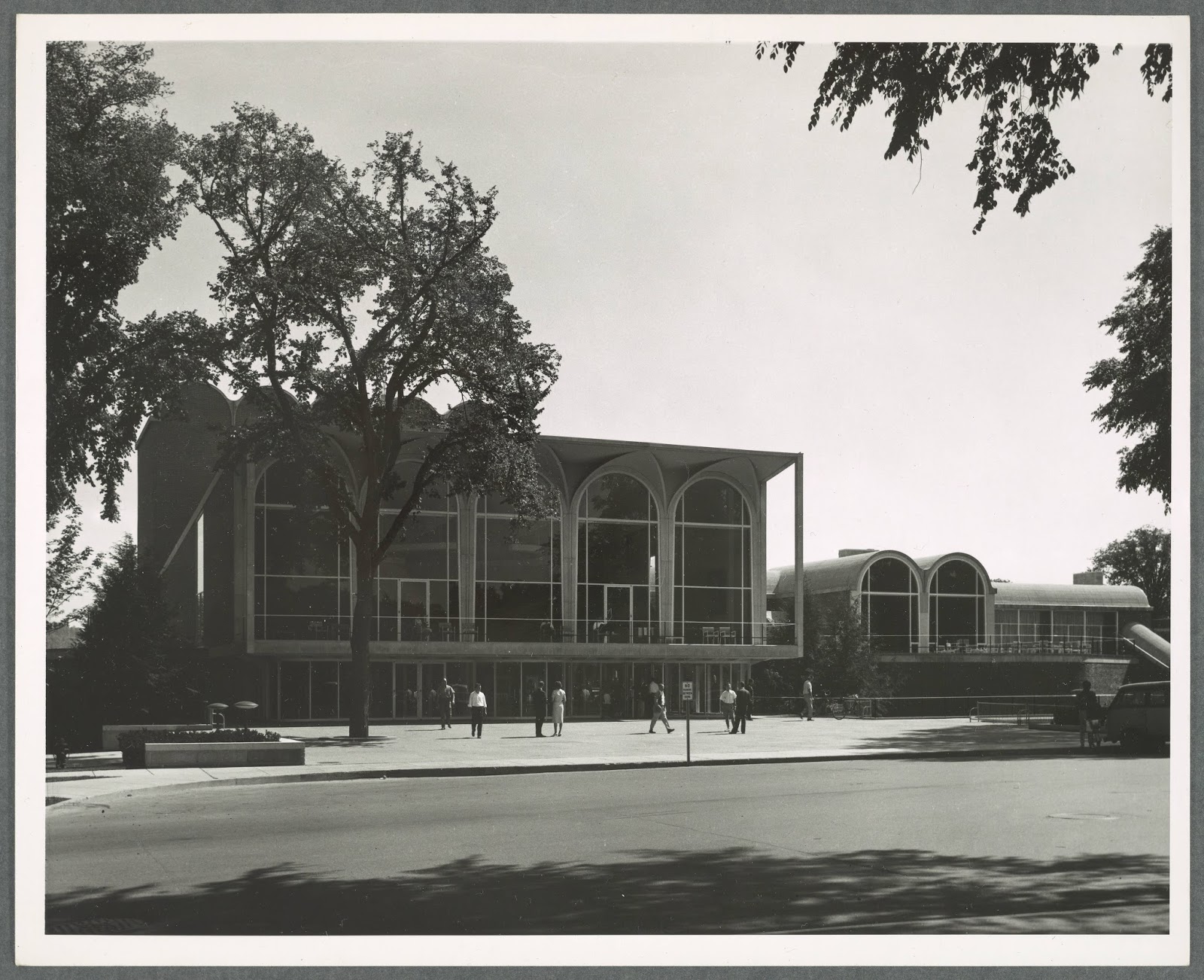
Excavated hole for Hopkins foundation with sign announcing its constructionEvery day, the Dartmouth Coach enters the small town of Hanover and pulls up in front of the Hopkins Center. I remember stepping down the short bus steps and looking around the Dartmouth campus for the first time. As I gazed at its scenic landscape, I obtained a sense of the history that took place here. Across the green from where I stood is Rauner Special Collection Library. Inside, one can find endless documents on the history of Dartmouth College, starting from its origins up to the present day. The evolution of Dartmouth’s campus and its buildings represents the numerous different time periods this College has experienced. Altering one space on this historic campus can change Dartmouth’s “feel”. Until I researched the changes of Dartmouth’s physical plant during World War I for a history class, little did I know that the place I first pulled up to, Hopkins Center, was one of the most controversial buildings to be built.

interior construction shot looking out through the Top of the Hop window openings.As one can see from the photos accompanying this post, the Hopkins Center has a different style of architecture than the rest of the campus. In the late 1920s, Dartmouth College’s Advisory Committee on Plant Development created a plan for constructing a new social center. However, the College needed to overcome some challenges before the plans for the building could be approved. In the late 1950s, the Board of Trustees and Dartmouth community as a whole felt that Georgian architecture was out of style and was no longer suited for its campus. The Advisory Committee on Plant Development asked Wallace Harrison to develop a design for this new social center. Harrison’s design was modern, which resulted in countless debates if this was the direction Dartmouth College wanted to go. The location for the Hopkins Center was another massive issue that resulted in delayed approval, given that the Hanover Green was a highly desirable location in town. However, after many years, the development plans for Hopkins Center were approved and the facility was built in 1961.

bird's eye view of Hopkins Center and surrounding buildings. The Hopkins Center has become one of the key buildings on this campus. It has awakened students' interests in the art community and provides an educational environment that allows students' creativity and passion for art to explode. Information on this building is just a small fraction of the historical documents that the Rauner Library collections contain about Dartmouth’s campus.

For more information on Dartmouth’s historical campus, go to Rauner Library and look at Dartmouth College Historical Evolution and Preservation:Strategies for the Landscape(D. C. Hist LD1422.9 .D334 1996). To see more great photos of the Hopkins Center, and other buildings on the Dartmouth College campus, browse the images in our Photographic Files and Photographic Records collections, many of which are available for free download online.

Posted for Danny McManus '17, HIST 62 class.

Friday, September 4, 2015

Moby-Dick, or, the Plurality of the Whale

Illustration by Rockwell Kent“Call me Ishmael.” Even if you have never read Moby-Dick, chances are you know the first line and something about Captain Ahab’s obsessive hunt for the white whale. The plot and key characters have become part of our popular culture and are referred to by people who couldn’t tell you if Ahab survives his final encounter with the beast that took his leg.

One reason the novel has so thoroughly entered our popular imagination is because it is not really just one novel. Moby-Dick has been repackaged time and time again to serve multiple purposes and satisfy different audiences. It has been a muse for artists, a dry meditation on the human condition for students to suffer through, an exciting story of the sea, and an action story befitting of comic book heroes.

Our latest exhibition, Moby-Dick, or, the Plurality of the Whale --  a riff on the full title of the novel, Moby-Dick, or, the Whale -- opens this Friday, showcasing editions that span centuries, artistic styles, and even genres. We've blogged about our two first editions of Moby-Dick, but now we have a chance to showcase a larger portion of our Melville collection. From the first editions, to the famous Rockwell Kent illustrations (one seen above), to comic books and even a dinner plate, this show has something for all audiences.

Gif of fore-edge painting
This gif shows one of the editions that didn't make it. The gilt edges of this 1923 edition, when correctly manipulated, reveal a hand-painted scene of the harbor at Christiansted, St. Croix, in what is now the U. S. Virgin Islands. You can't view the image without bending the book -- and it would be horrible for the book to be kept like this for the next three months! 

Come see Moby-Dick, or, the Plurality of the Whale, on display from September 4 to November 15, 2015, in the Class of 1965 galleries on the mezzanine level of Rauner!

If you want to see the edition with the fore-edge painting, ask for Rauner Melville PS2384 .M62 1923c.

Tuesday, September 1, 2015

Be a Trip Leader

image of bear tearing heart of Dartmouth TripeeNo, not a Merry Prankster, that is so 1960s. We are talking about the Dartmouth Outing Club Freshmen trips. They are in full swing right now--hikes out into the wilderness and close encounters with wildlife are a great way to transition students into a new life and build early friendships.

Each year close to 200 students lead the trips. This year, they are all coming into Rauner Library in groups of 10-15 to see a room filled with documents from the DOC records that show the history and development of the trips. This year's favorite piece is an application from 1991 to be a trip leader. The student added a cover letter apologizing for turning in his application late, then went on to elucidate his skills on the accordion and bag pipes. "I play a mean polka to Guns & Roses tunes and can play a hellish rendition of the Flintstones on the 'pipes. Of course I can play Dear Old Dartmouth on either instrument.  Might this aid in waking the sleeping freshmen come in handy to you?"  When asked on the application if he would be willing to have a faculty member along on the trip, he answered yes, that he could think of one English Professor who "loves this sort of pseudo-Hemingway adventure."

But it was his idea for the T-Shirt pictured here that must have won him a spot as a trip leader.

The history of the trips is well documented in the DOC Records (DO-1) which are available for inspiration here in Rauner.

Wednesday, August 26, 2015

Anatomy of a Dance Card

Less than one hundred years ago, dances were regimented affairs with a set list of songs. But how were you supposed to remember who you'd promised the third waltz to? Luckily, hosts would print up tiny booklets known as dance cards, listing the order of the dances and providing a little line to write down your partner's name.
Commencement Ball 1902 dance cardThe first time I saw a dance card, I didn't know what it was. We were looking through the membook Howard "Rainy" Burchard Lines (Class of 1912) in preparation for our sophomore summer parents' weekend tour (we've blogged about Lines and his connection to the Titantic before). Flipping through the pages, I noticed that he pasted in a series of little books with pencils attached. Most of them carried fraternity insignia, so I assumed they were address books. But when I opened one, I realized it was actually a memento from a college dance. Lines didn't seem to like to dance the two-step, as it was always crossed out.

Dartmouth Hotel Ball 1884 dance cardMost dance cards contain the title of the event, the date, the location, a list of patronesses (or chaperones, usually married women or professors' wives!), the names of the planning committee, and of course, the list of dances with space to write down names. Some dance cards were probably planned before the evening began, as they were written in pen!

Senior Ball 1914 dance cardMy favorite dance card, from the 1914 Dartmouth Senior Ball, contains a little mirror, perfect for checking your teeth before the the last polka.While some dance cards are elaborately decorated with gilded crests and encased in leather, others consist of a single sheet of paper.

Our collection likely contains hundreds of dance cards, scattered through students' scrapbooks (known as "Mem[ory] Books"), the records of fraternities and other student organizations, and files concerning annual events, such as Winter Carnival, Junior Prom or Commencement. The cards in this post came from the "Dances, Balls and Cotillions" Vertical File and are mementos of: Commencement Ball (June 1902), the Dartmouth Hotel Ball (February 1884) and the Senior Ball (June 1914). Come to Rauner to see this file or the Mem Book for Howard Lines '12.

Tuesday, August 25, 2015

John Hale Chipman '19 Papers, 1917-1919

John Chipman's field artillery group photograph Many American college students crossed the Atlantic to volunteer in the war effort before the US had boots on the ground in France. From among these men, a group of Dartmouth students joined the American Field Service (AFS). Traditionally, these soldiers drove ambulances for the AFS, but some volunteered for a different path. Due to a shortage of munitions truck drivers at the front, the French Army requested American volunteers to join the French Army and drive these trucks. John Hale Chipman '19 and other Dartmouth students rose to this challenge and served the French Army for a six-month tour from June to November of 1917.

Chipman conducting repairs on his transport vehicleChipman recorded this experience in a diary, which he sent home to his friends and family. He later compiled a scrapbook of his entire service, which included a tour in Italy driving ambulances for the American Red Cross and then his training as an artillery officer in the French Foreign Legion. His final days of service were spent in active duty as an officer of France in Belgium. Chipman represents a unique story of Dartmouth. His well-documented diary and photos give a detailed glimpse into one Dartmouth man’s war experience.

Chipman playing a musical instrumentThe diary, in which he wrote almost every day of his first six-month tour, details his complete routine. Included in his notes are morning calls that turned into 14-hour shifts of driving to combat zones, but also lazy days spent at the local YMCA performing music with French and American comrades. Chipman endeavored to provide a complete picture of his war experience, a difficult task given the circumstances, but one he completed with style. His scrapbook, which he compiled later, allows the reader to look into the places and people of war-torn France and Italy through the eye of a young American. Included are: pictures of massive German artillery pieces, photos of POW's, a dashing picture of Chipman in his French officer's uniform with fellow Dartmouth grads, and some very touristy photos of famous Italian sites taken on leave. Chipman's complete records certainly provide an experience in itself for any reader, well worth the time it takes to read every word and look at every photo.

To see John Chipman's diary and photo album, ask for MS-1229 at Rauner. To read a selection of his diary online, visit Dartmouth College Library's Library Muse blog.

Posted for Jake (Lewis) Lee '16, HIST 62 class.

Friday, August 21, 2015

John Buell's Last Will and Testament

image of John Buell's Last Will and TestamentThis past week we acquired two related manuscripts that speak volumes: the Last Will and Testament of John Buell of the Mohegan tribe, dated July 12, 1745, and the execution of his estate from July 11, 1746. In July of 1745 Buell had just become a part of Captain Adonijah Fitch's company in King George's War. He was among the many members of the Mohegan tribe to join the English in the French and Indian wars. These documents are a witness to the uncertainty of his fate as he headed from Connecticut to Cape Breton.

There are a lot of ways to look at Buell's Will. It shows the influence of European colonial law on tribal culture, especially for a "Christianized" Indian. It also documents one Mohegan's worldly possessions and debts as well as his thoughts on their distribution upon his death. He splits his estate between his "squaw Luce Johnson" and his daughter Lydia, while asking for their protection in a troubled time.

image of the execution of John Buell's Last Will and TestamentBut there is a curious addition. The wages he is about to earn as a member of Fitch's unit are to go toward his debts to Jonathan Trumble, and it is Trumble who signed off on the final disposition of the estate. This calls into question the motivation for joining the war and writing his Will. Was he forced into the military to help pay his debts? Or, was the Will written at the self-interested insistence of Jonathan Trumble who wanted to ensure any money Buell earned would go first to pay his debts? Or, should we take it on face value? He says his Will is written "knowing my own Mortality & The Danger into which I am Going."

The documents are now here in Rauner and open for research use. We would love to know more about John, Luce, and Lydia Buell and Jonathan Trumble.