Friday, December 19, 2014

Not So Saintly Patron

A title page for "The Plan of a Dictionary."Samuel Johnson's Dictionary of the English Language (London: W. Strahan, 1755) is an authorial tour de force. That one person could possibly assemble a dictionary basically on his own of such a scope is astonishing. The two densely packed volumes took nine years of his life to write.

Johnson received patronage of a sort for his work. Besides receiving money from a group of booksellers who supported the project, he also secured Lord Chesterfield's support through his Plan of a Dictionary (London: J. and P. Knapton, 1747). Chesterfield wrote an essay in support of the project, but in so doing, offended the sensitive Johnson. Johnson held a grudge and retaliated in a backhanded way in the dictionary itself. His first definition of "Patron" reads:
1. One who countenances, supports or protects. Commonly a wretch who supports with insolence, and is paid with flattery.
The printed entry for "Patron."Johnson buried a few other precious barbs in his text. He defines oats as "a grain, which in England is generally given to horses, but in Scotland supports the people."

To see the Dictionary, ask for Rare PE1620.J6 1755. To see the Plan, ask for Val 825 J63 P69.


Tuesday, December 16, 2014

Aboard the Dartmouth

An 1851 newspaper showing a large illustration of the Boston tea Party.In late November 1773, the Nantucket whaling ship Dartmouth sailed into Boston harbor. Her cargo was tea, brought back from England after sailing there with a load of whale oil. At the time, much of the population of Boston had gotten a tad irritable about British taxation and duties on tea, so the Dartmouth was not allowed to unload her cargo. A few days later she was joined by the Eleanor, also loaded with tea and similarly detained in the harbor unable to unload. On December 15th, the Beaver arrived, and became the third ship that would, the next day, play a role in one of the pivotal events in this country’s fight for independence.

We all know what happened to that tea in Boston harbor on December 16, 1773.

However, I had forgotten from my American history lessons of long ago that one of the Boston Tea Party ships was named Dartmouth. She was the first ship built in New Bedford, Massachusetts, in 1767 for Francis Rotch of Nantucket, and was named for a section of Bedford. Sadly, the Dartmouth was lost at sea on the Atlantic during the summer of 1774.

There have been other ships named Dartmouth, including a brig built by J. N. Harvey in 1768 and listed in Lloyd’s register of shipping for 1776. It was this vessel that caused some confusion over the rigging when Ruth Edwards was researching the Boston Tea party ship Dartmouth for a commission she had been given by the Class of 1907. The class gave the painting of the Dartmouth to the College in 1967 in honor of its upcoming bicentennial.

During World War II, an oil tanker, the Dartmouth, and a victory type cargo ship, the Dartmouth Victory, were launched. About the same time, two liberty cargo ships were launched: the Samson Occom and the Eleazar Wheelock. I suspect there are other ship with Dartmouth connections, but the vessels carrying the name of Levi Woodbury, Class of 1809, and Secretary of the Navy, are too numerous to go into here.

Ask for Iconography 1368 to see the "Tea Party" Dartmouth.

Friday, December 12, 2014

Trial and Conflict

A handwritten page of text.The adage that “all your dysfunctional relationships have one thing in common, you” comes to mind whenever Eleazar Wheelock’s legacy is up for examination. This is particularly the case with a recent acquisition of Wheelock documents (five in his hand) ranging from the time of his calling to the Second Congregational Church in Lebanon, Connecticut, in 1735 to 1771 after his arrival in Hanover.

Most of the documents deal with conflict: a court case, a disagreement between a minister and his congregation or between one minister and another. Others are less controversial and focus on the installment of a minister, or an invitation to Wheelock, a renowned preacher in his time, to give a sermon at another church.

One of the most interesting items in this group of documents is a scrap of well-worn paper in Wheelock’s hand that is coming apart at the creases. Picking through the chicken scratch it becomes evident these are notes that Wheelock took perhaps during the negotiations regarding his ministry in Lebanon, Connecticut. The notes outline what the congregation had agreed to provide Wheelock as compensation for his ministerial efforts, they specifically record that he would be paid £140 per year in public credit or provisions with the types of provisions and amounts carefully noted. The provisions included wheat, corn, oats and pork and beef. The notes also record that Wheelock was to be paid yearly on the first of January. This agreement was drawn up by a savvy group of flinty Connecticut farmers and businessmen who found ways to reinterpret it, or so Wheelock felt, to his disadvantage. It very soon became a source of conflict between Wheelock and the congregation that would plague him until resigned his position.

The crux of the issue appears to have been how these provisions were to be provided based on the rise and fall of their value. The deficit created by the congregation’s interpretation of this agreement was one of the factors that led Wheelock to take on students for tutoring as a way to supplement his income. This in turn led to his tutoring Samson Occom. It was Occom’s success as a scholar that led Wheelock to the idea of educating Native Americans. So, in a sense, this scrap of paper covered in scratchy hand, is the genesis for the eventual founding of Dartmouth College.

To see Wheelock's notes and two later “clean copies” that he made of the specific areas of disagreement, ask for MS-1310, box 1, folders 735227. 1, 735227.2, 735227.3


Tuesday, December 9, 2014

Welcome to Jenny Lind

A daguerrotype of Jenny Lind.In 1850, P. T. Barnum coaxed thirty-year-old Jenny Lind out of retirement for a grand tour of the United States. That tour, which earned Lind over $350,000, caused a popular sensation and exposed the potential force of the burgeoning American mass market. It also generated its share of souvenirs for her adoring public. Besides dozens of pieces of sheet music bearing her likeness, we also have a framed Daguerreotype of the Swedish songstress with a ticket to the June 20th, 1851, concert.

The cover for the sheet music "Welcome to Jenny Lind."
Even the abolitionist singing group, the Hutchinson Family, tried to cash in on her fame with their "Welcome to Jenny Lind." Sung "on the occasion of her visit to America," it was quickly issued as sheet music (Boston: Oliver Ditson, 1850).

A ticket for Lind's Second Grand Concert.To see the Daguerreotype and ticket, ask for Iconography 292. To see "Welcome Jenny Lind," ask for Sheet Music HF 73.

Friday, December 5, 2014

Winter Break

An illustration of well-bundled figures sleeping in their sleds.
Things are pretty quiet here in Rauner Library since the students left for break.  We just have a few folks in doing some research, but the hustle of the term is past and the classrooms are empty. Hanover is cold and grey in their absence, but peaceful, too.

They all seemed pretty tired during finals week--wandering around in a daze, some in their pajamas. We like to imagine they are hunkered down now catching up on their sleep like in this lithographic image from Arthur de Capell Brooke's Winter Sketches in Lapland (London: J. Murray, 1827).

If the Hanover winter gets you too down, come in and take a look by asking for Stef DL971.L2 B7.

Tuesday, December 2, 2014

Oh, No!

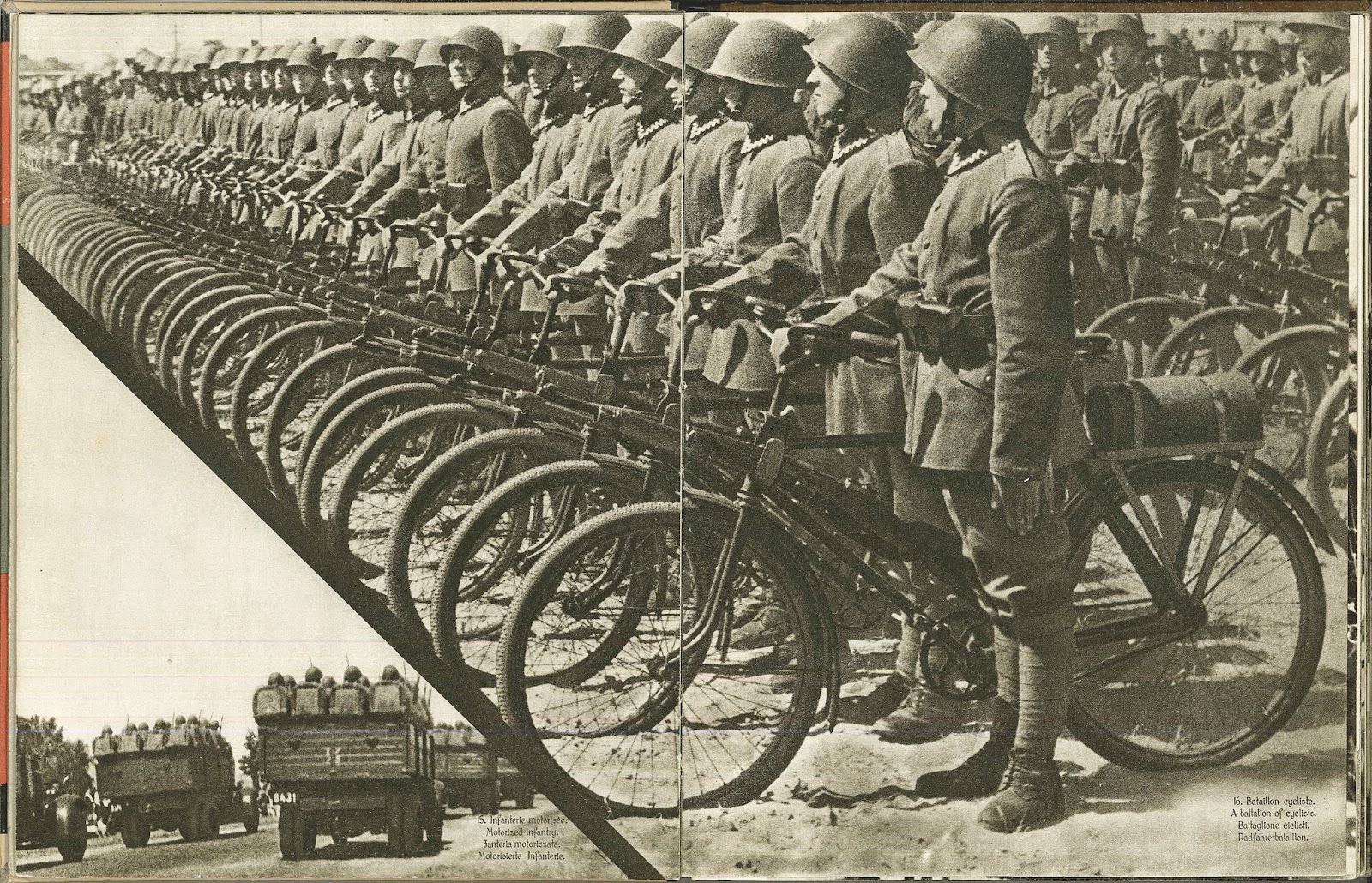
A poster showing tanks and a sky full of airplanes.We have quite a few examples of books and ephemeral material that served as propaganda during the First and Second World Wars. But this one caught us a little off guard. Published in 1939 in Warsaw, L'armée et la marine de guerre Polonaises, looks like a typical 1930s show of military muscle. For the most part, it is images of tanks, airplanes, heavy artillery and troops training. But, timing is everything, so the image of Poland's bicycle brigade stands out. It proudly shows rows of Polish infantry sitting astride bicycles tricked out with rifles in the handlebars.

A photograph showing a line of uniformed men with bicycles. In the lower left corner is a smaller photograph of men in army trucks.
Published just months before Germany invaded from the West and the Soviet Union from the East, the bicycle brigade is now emblematic of just how ill-prepared Poland was to face either military force. It took just five weeks for the Germans and Soviets to seize and divide Poland.

To see the book, ask for Rare UA829.P7 K63 1939.

Tuesday, November 25, 2014

Thanksgiving Tweets, 1946

A black and white photograph of a group of men crowded around a dinner table for a meal.
DOC Thanksgiving Feast, November 1946
Archival Photofiles
November 1946 marked the first Thanksgiving after the end of World War II. It was a time that Dartmouth was returning to some sense of normalcy after becoming a defacto military training ground. No wonder that the students chose something other than war to talk about when the Dartmouth asked them what they were thankful for.  Here are some of their responses from the Tuesday before Thanksgiving:

"I'm glad I won't need to see The Dartmouth until next Monday."

"I am thankful that the New York Rangers beat the Canadians 3-2."

"I'm very thankful that I work for the Jack-o"

"I'm thankful that I go to a liberal arts college where I can learn how to be a liberal artist."

"I'm thankful for Hollywood failures."

"I'm thankful that after eating in Thayer Hall for two months I can go home for a decent meal."

"I'm thankful that I have two classes this afternoon so I can spend an extra day in Hanover."

To read more, take a look at The D on our reference shelves here in Rauner--but not on Thanksgiving. We'll be thankful to not be at work! The photofiles, though, will still be online.