Things are pretty quiet here in Rauner Library since the students left for break. We just have a few folks in doing some research, but the hustle of the term is past and the classrooms are empty. Hanover is cold and grey in their absence, but peaceful, too.
They all seemed pretty tired during finals week--wandering around in a daze, some in their pajamas. We like to imagine they are hunkered down now catching up on their sleep like in this lithographic image from Arthur de Capell Brooke's Winter Sketches in Lapland (London: J. Murray, 1827).
If the Hanover winter gets you too down, come in and take a look by asking for Stef DL971.L2 B7.
Friday, December 5, 2014
Tuesday, December 2, 2014
Oh, No!
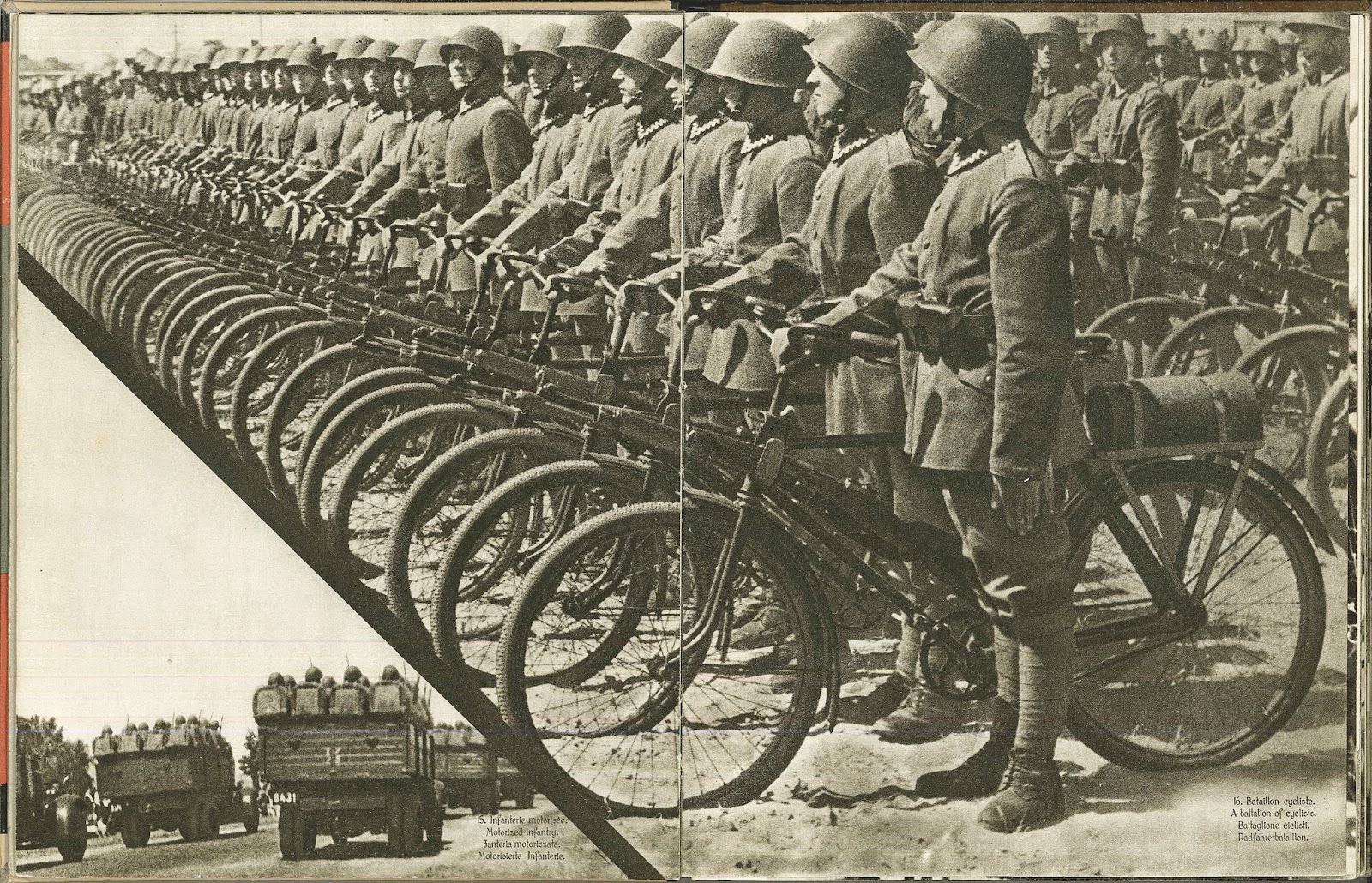
We have quite a few examples of books and ephemeral material that served as propaganda during the First and Second World Wars. But this one caught us a little off guard. Published in 1939 in Warsaw, L'armée et la marine de guerre Polonaises, looks like a typical 1930s show of military muscle. For the most part, it is images of tanks, airplanes, heavy artillery and troops training. But, timing is everything, so the image of Poland's bicycle brigade stands out. It proudly shows rows of Polish infantry sitting astride bicycles tricked out with rifles in the handlebars.Published just months before Germany invaded from the West and the Soviet Union from the East, the bicycle brigade is now emblematic of just how ill-prepared Poland was to face either military force. It took just five weeks for the Germans and Soviets to seize and divide Poland.
To see the book, ask for Rare UA829.P7 K63 1939.
Tuesday, November 25, 2014
Thanksgiving Tweets, 1946
| DOC Thanksgiving Feast, November 1946 Archival Photofiles |
"I'm glad I won't need to see The Dartmouth until next Monday."
"I am thankful that the New York Rangers beat the Canadians 3-2."
"I'm very thankful that I work for the Jack-o"
"I'm thankful that I go to a liberal arts college where I can learn how to be a liberal artist."
"I'm thankful for Hollywood failures."
"I'm thankful that after eating in Thayer Hall for two months I can go home for a decent meal."
"I'm thankful that I have two classes this afternoon so I can spend an extra day in Hanover."
To read more, take a look at The D on our reference shelves here in Rauner--but not on Thanksgiving. We'll be thankful to not be at work! The photofiles, though, will still be online.
Friday, November 21, 2014
Misappropriation
In 1941, Budd Schulberg '36 published his first novel: What Makes Sammy Run? As a child of the studios (his father had been head of Paramount), and a frustrated screenwriter, he unleashed a torrent of criticism on Hollywood in his novel about the rise of Sammy Glick. The novel became a bestseller in the United States and has often been pointed to as the great American novel about Hollywood.Schulberg knew he was taking a risk when he published the novel. It was destined to offend many of the most powerful people in Hollywood. But he did not anticipate that the novel would become fodder for the Nazi propaganda machine. Sammy Glick, the novel's offensive, back-stabbing anti-hero, was Jewish. The Nazis picked up the story and produced a translation edited to highlight the offenses of Jews in Hollywood and portray Sammy as the quintessential American Jew. Then they published it serially in the popular Berliner Illustriere Zeitung where Schulberg's words were turned against the Jewish people.
Ironically, Budd and his brother Stuart were later employed by the U.S. military to splice together film footage to be used against Nazi war criminals in Nuremberg. Their work was made particularly effective by their juxtaposition of Nazi propaganda with scenes of atrocities. For Schulberg, the appropriation of Nazi propaganda must have been a particularly sweet form of personal revenge.
To see how Sammy looked in 1942 Berlin, ask for MS-978, Box 6, Folder 4. And, as a reminder, our current exhibition, Budd Schulberg and the Scripting of Social Change, runs through January 30, 2015 in the Class of 1965 Galleries. And, for more on Schulberg, see these postings from August 9, 2011 and November 4, 2014.
Tuesday, November 18, 2014
In the Best Interest of the College
25 years ago, on November 13th, 1989, the Board of Trustees announced the College’s intention to completely divest the endowment from companies operating in South Africa. This decision was the culmination of almost 20 years of protests and discussion between students, administrators, and community members regarding the propriety of the College’s involvement with companies that were complicit in apartheid.The 1970s and 1980s saw divestment movements arise at many colleges and other institutions in the midst of the public outcry over South Africa’s apartheid system. The College’s first action regarding the divestment question occurred in 1972, when the Trustees voted to form the Advisory Committee for Investor Responsibility, tasked with overseeing the ethical use of Dartmouth’s endowment. In 1977, Rev. Leon Sullivan issued a set of six principles of business ethics for companies operating in South Africa in order to maintain their American backers. Dartmouth and many of its peer institutions pressured the companies in which they had investments to sign on to the principles. However, by the mid-1980s the principles were considered too moderate and many organizations began to consider complete divestment.
To learn more about Dartmouth’s divestment movement, check out the display case in Rauner's reading room, just to the right of the doors. Sources for the exhibit are the Records of the Advisory Committee on Investor Responsibility (DA-328), the Papers of George Bourozikas (DO-55), and archives files on student protests.
Posted for Hillary Purcell '15.
Friday, November 14, 2014
Ciphering Books
![]() |
| Pike's Mathematical text |
Ciphering books were always written in ink, often with calligraphy headings and illustrations. However, the quality of the script varied significantly.
![]() |
| Woodward's "System of Plain Trigonometry" |
![]() |
| Hubbard's "System of Spheric Trigonometry" |
According to a M.A. Clements and Nerida F. Ellerton, mathematics professors at Illinois State University, the use of ciphering books declined after 1840, due to the fact that they were no longer important in evaluating the quality of a student's learning or that of an instructor's teaching. In addition, they argue that state education leaders switched their focus from the individual student to that of a graded class.
To see these ciphering books ask for: MS-1271 (Pike) and Codex 802415.1 (Woodward). Kimball's cipher book is currently being re-cataloged.
Tuesday, November 11, 2014
Dartmouth Vietnam Project
Fifty years ago, Robert B. Field Jr., a newly minted Dartmouth ’64, was nearing the end of Officer Candidate School at Naval Station Newport in Rhode Island. He was two months away from a training assignment in Brunswick, Georgia, and shortly after that, he would ship out of Norfolk, Virginia aboard the USS Long Beach. The Long Beach would travel widely with Field aboard — to Roosevelt Roads Naval Station in Puerto Rico, back to Virginia, through the Panama Canal, up the West Coast to its namesake city in California, a stop at Pearl Harbor, another at Subic Bay in the Philippines — but by the close of 1965, it would be en route to the Gulf of Tonkin, Vietnam.
As Field’s military service was unfolding, two Dartmouth ’68s were just beginning their studies. John C. Everett Jr. and John G. Spritzler both arrived on campus in the fall of 1964, and over the next four years, their paths would take markedly different turns. By 1969, Everett would be bound for Cam Ranh Bay, Vietnam, aboard the USS Gallup. Spritzler would be a committed anti-war activist and a central figure in a protest that defined an era in Dartmouth history: the seizure and occupation of Parkhurst Hall on May 6, and the ensuing standoff with police that lasted well into the night.
Decades after the last American troops withdrew from Vietnam, all three men sat down with a member of the Class of 2016 to share their memories of the war. Their conversations were audio recorded, and along with three others, now comprise the first products of the Dartmouth Vietnam Project. The DVP, a collaborative effort involving Dartmouth students, faculty, and staff, seeks to preserve and share the stories of alumni and other members of the wider Dartmouth community who experienced the Vietnam War years firsthand. Students specially trained in the art of oral history conduct the interviews, and the resulting audio and text transcripts become part of a growing oral history collection at Rauner.
As of Veterans Day 2014, the first six interviews — Field, Everett, and Spritzler among them — are available on a dedicated DVP website (http://www.dartmouth.edu/~dvp). In the coming months and years, more and more interviews from veterans, activists, and those with memories of the impact of the war on Dartmouth and American society in general will join the original six. If you or somebody you know has a story to share, visit http://www.dartmouth.edu/~dvp/participate.html.
Subscribe to:
Posts
(
Atom
)