Friday, January 24, 2014

"Stinking" Haggis

A printed verse on haggis.Burns night is upon us--when all good Scots toast the great Bard and recite "To a Haggis" before plunging a knife into the "Great Chieftan o' the Puddin-race!" Among the most recited of Burns's poems, "To a Haggis" did not appear in the the famous Kilmarnock edition of Poems, Chiefly in the Scottish Dialect (Kilmarnock: John Wilson, 1786). It first appeared in the Caledonian Mercury, but then was collected into the second and third editions of Poems in 1787.

A printed page of verse with the title "To a Haggis."The type for the third edition was completely reset. In the process, a curious typo appeared. In "To a Haggis," the word skinking (meaning watery) was changed to "stinking." Surely not what Burns had in mind, but fitting to those of us less accustomed to the pudding. To quote the glossary to the third edition: Haggis, a kind of pudding boiled in the stomach of a cow or sheep."

A title page for "Poems Chiefly in the Scottish Dialect."
To see the famous Kilmarnock edition, ask for Burns PR4300 1786 .K4 Copy 2. For the "stinking" Haggis, ask for Burns PR4300 1787 .E42.

Tuesday, January 21, 2014

Not the Pumpkin

A cover for the Jack-O-Lantern, showing a cartoon of Diogenes.The Jack-O'-Lantern is Dartmouth's long running humor magazine. First issued in March 1909, the magazine's alumni include notables such as Ted Geisel (before he was Dr. Seuss), Buck Henry, Budd Schulberg and Chris Miller (of Animal House fame).

According to a letter from founding member William Atwood (class of 1909), at the time that the Jack-O was established, "Dartmouth was a small but rapidly growing institution, perhaps feeling in its adolescence a bit of unadmitted awe - 'inferiority complex' had complexes then been invented." Atwood goes on to write that "no doubt it was a spirit of emulation that prompted us to establish Jack-O'Lantern, as well as the fact that since Hanover was devoid of movies, television, radio, autos and other forms of vicarious self-improvement, the students were of necessity forced to create their own entertainment."

Rauner holds a complete run of the Jack-O, including the famous first issue of Stockman's Dogs from 1934 - the image of two dogs talking to one another has become a staple of the magazine and appears frequently, though the caption changes with the times. In addition to the print version, Rauner has a selection of original artwork by Jack Rose (class of 1928) from the mid 1920s including covers, inserts, and other images that have graced the pages of the Jack-O. We also have Dudley Redfield's artwork for the masthead from 1910.

A cartoon of a tall man in a coat and a short man in a dark fur.
"Campus Smoothie and Loaded for Bear"
March, 1926
A cartoon of a smoking man walking outdoors with a second man in a Dartmouth sweater.
"After Class"
Bim - What Day is Today?
Bo - Monday, Wednesday, Friday.
November, 1924
 Ask for the Vertical File "Jack-O'-Lantern" and Iconography 302, 1407 and 1589. The print editions are available in the Rauner Reading Room (Ref LH1.D3 J3).

Friday, January 17, 2014

Going Local: Desegregating Dartmouth's Fraternities

A copy of The Dartmouth, with the heading "Point One Ekes Out Majority By Four Votes; Amasses 1,128."In March 1954 something rather extraordinary happened at Dartmouth. The undergraduate council, led by future Dartmouth President David McLaughlin, put before the entire student body a referendum to end discrimination in the fraternities. 86.5% of the student body voted, and the measure passed by a thin majority of just four votes. The referendum required that by April 1, 1960, "any fraternity with a written or unwritten nationally imposed discriminatory clause that restricts, or can be interpreted to restrict, membership because of race, religion or national origin shall cease to be eligible to participate in fraternity activities on this campus." In other words, fraternities could no longer blackball prospective pledges based on race, religion or nation origin.

A typed list of fraternities and their discriminatory clauses.
A page of typed minutes from a Board of Trustees meeting.A 1956 document shows what the fraternities were up against. The national chapters of many of the organizations restricted membership to "white Christians" and even some without formal policies had unwritten understandings that had to be adhered to by the local chapters. The result of the referendum was that many fraternities broke their national affiliations and "went local." It is interesting to think that one of the driving forces that created Dartmouth's distinctive Greek system was a majority vote by students in the 1950s who were committed to equal rights for a minority population on campus.

A printed pledge for fraternity presidents declaring their chapters have no discriminatory clauses.
A different kind of "pledge"
In addition to documents related to the decision to end the discriminatory clauses, we have a fraternity ballot box which once could have been used to blackball a non-white or non-Christian pledge.


To learn more, ask for the vertical file "Fraternities, 1950-1979."

Tuesday, January 14, 2014

The Unpredictable Joyce

A title page for Joyce's "Ulysses." Imagine setting the type for James Joyce's Ulysses.... There is one 43-page run of text that consists of a only six paragraph breaks and no punctuation. Scattered through the book is music, headlines, and a made up word here and there. So it should be no surprise that the first edition ran a little behind schedule.

Laid into our first edition is concrete evidence of Sylvia Beach's frustration: the original prospectus from Shakespeare and Company. "The Autumn of 1921" is mostly scratched out and corrected by hand to read January 1922. Inside, the physical description of the book has been modified from 600 pages to 800 pages (it comes to 732 in the final version).

A set of printed advance press notices.A printed edition note.

A printed order form.The order form would appeal to any book collector. It advertised the price of 350 francs for the deluxe version on Dutch hand made paper. As of this writing, there are two copies available priced over $200,000. Our copy is the pedestrian 150 franc version on hand made paper.

To see it with the first edition, ask for Val 827J853 X71.

Friday, January 10, 2014

Proper Motivation

A photograph of a man with cloth draped around his shoulders.On May 15th, 1872, Charles Edwin Hall, Class of 1870, petitioned President Asa Dodge Smith for mercy. At the end of the winter term in 1870, Hall had been expelled after standing before the faculty to answer for his participation in what he calls "the mock programme affair." Hall had apparently written a scurrilous essay about a fellow Dartmouth student that had then been published and distributed widely among the student body without Hall's knowledge. In his letter to President Smith, Hall acknowledges that he was at fault for writing the essay but states that he was unable to defend himself fully before the faculty. He now writes to clear up his involvement in the matter, with the hopes of finally receiving his degree.

As he describes the limits of his participation in the affair, Hall repeatedly underscores the fact that he is suffering from "mental discomfort" as a result of his lack of Dartmouth credentials and that the punishment has been "very hard" to him. He asserts that he would do almost anything to be a graduate of the class of 1870. Finally, after much handwringing, Hall divulges his true motivation for seeking a presidential pardon: he is engaged to a woman whose father belongs to the class of 1843 and won't let him marry her until he has been enrolled as an "honorable graduate" of Dartmouth College.

A page from a handwritten letter.A page from a handwritten letter.

Faced with such a powerful plea, President Smith relented and Charles E. Hall was granted his diploma from Dartmouth College within the month. He went on to marry Nellie A. Barnard, daughter of Rev. Pliny F. Barnard, '43, three years later and moved to Greenville, NH, where he worked as a physician and pharmacist. Hall took to heart the hard lesson he had initially received at the hands of Dartmouth: he became a public servant, acting as the superintendent of schools for more than a decade before joining the New Hampshire state senate, where he served as chairman of the Committee on Education.

To learn more about Charles Edwin Hall, class of 1899, ask to see his alumni file at Rauner Library.

Tuesday, January 7, 2014

Gatsby--Not So Great

A Modern Library edition of The Great Gatsby.F. Scott Fitzgerald's The Great Gatsby has become a classic in American literature. It is taught in classes from high school to graduate school, has been adapted multiple times for film, and is lauded by many as the best singular expression of the Jazz age. But, it was not always so well received. In fact, it completely fell out of print for a period.

The Promethean trademark.We recently acquired a minor rarity to accompany our first edition: the 1934 Modern Library reprint. At the time, the Modern Library was the premier publisher of inexpensive reprints of popular literary novels. Their famous Promethean trademark usually assured solid sales. But it couldn't work its magic for The Great Gatsby, a novel of 1920's excess that lost its glamor during the Great Depression. The Modern Library printed only 5,000 copies. After five years, the initial printing still has not sold out, and they reluctantly discontinued the title.

Our copy is unusual because it appears to have actually been sold--it lacks the "Discontinued" stamp usually found on Modern Library editions of Gatsby.

The dust jacket for The Great Gatsby.
Come see it alongside the first edition by asking for Rare PS3511.I9G7 1934 and Rare PS3511.I9G8 copy 2.

Friday, January 3, 2014

Fabulous Fables

An illustration of a series of animals and figures surrounding a man's bust.This past year we were able to acquire a spectacular edition of La Fontaine's Fables Choisies. Published in Paris between 1755 and 1759, the four volume set is one of the most lavishly illustrated literary texts of the 18th century. It is a testament to La Fontaine's standing in French culture at the time.

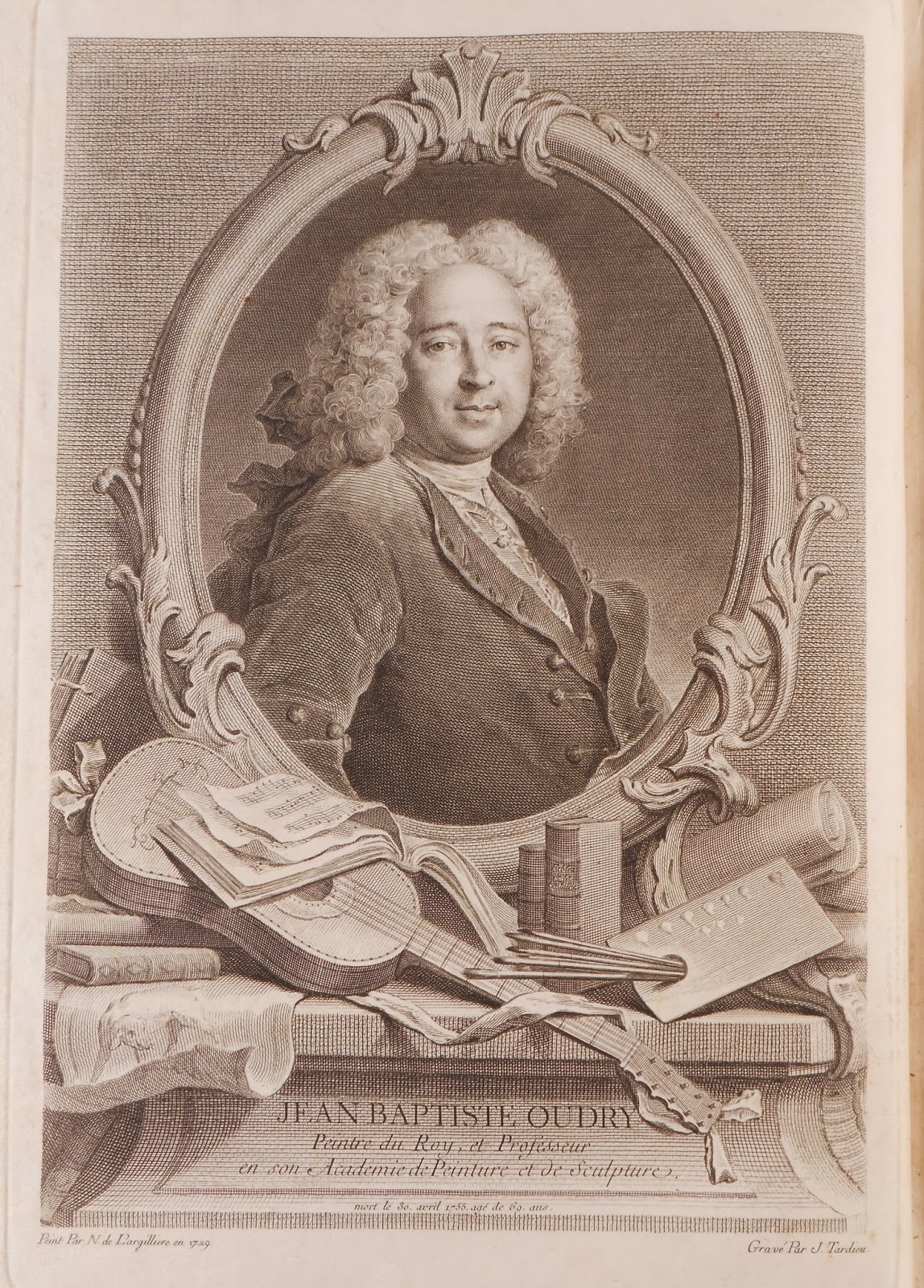
An illustration showing a portrait of a man within a decorative frame.The illustrator, Jean Baptiste Oudry, gets almost equal billing in the first volume. While the title page only mentions La Fontaine, Oudry gets his own frontispiece alongside one of a bust of La Fontaine being unveiled by Aesop. Oudry was a natural choice. A Rococo painter fashionable at the time, he specialized in paintings of animals and nature scenes. He must have found particular inspiration in La Fontaine's fables with their talking animals and pastoral settings.

An illustration showing a crowned man seated on an eagle's back among clouds. On the ground are several other animal, including an elephant and lion.
The books is wonder to behold. The 280 full-page plates carry you into the extravagance of 18th century France while providing a suitably fabulous accompaniment for La Fontaine's texts.

Ask for Rare PG1808.A1 1755