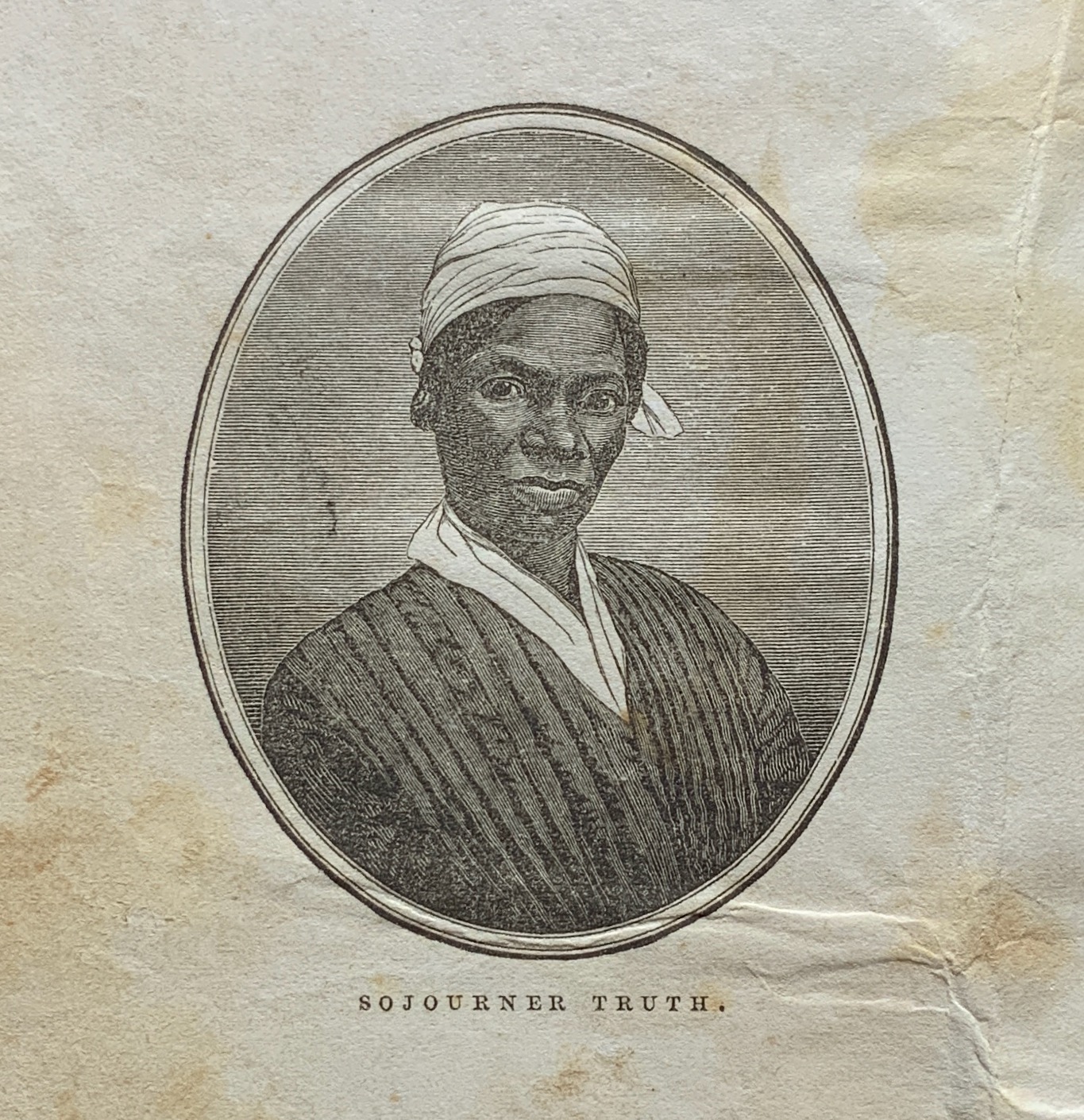

Come be confronted by Sojourner Truth yourself by asking for Rare E185.97 .T87 1850.
Come be confronted by Sojourner Truth yourself by asking for Rare E185.97 .T87 1850.
 This week we stumbled upon a charming little photograph album in our Codex collection. The contents are very niche and extremely fabulous: signed publicity photos of opera singers who performed during the 1899 season for the Metropolitan Opera Company. The book was compiled by a young Edith Lauterbach, whose father, Edward Lauterbach, was legal counsel for the Met as well as a member of the Board of Directors. As such, Edith knew many of the world-famous performers personally. The book came to us through the generous donation of Edith's husband, Clarence "Mac" McDavitt, a member of the class of 1900.
 Each photograph of a performer in the album, usually in costume, is accompanied by a brief biography along with their notable areas of expertise and, in some cases, their birth name. For example, the renowned American soprano Lillian Nordica, who slayed as Brunhilde, was born Lillian Norton and hailed from the rural hills of Farmington, Maine. Our favorite fashion statements from the season are Jean de Reek, a Polish tenor who is rocking the thigh-high boots with a pair of short shorts, and Andreas Dippel, a French tenor who somehow manages to project a convincing "legendary warrior" vibe despite his lace-up heels.
To explore the world of opera costumery at the Met in 1899, come to Special Collections and ask to see Codex 003337.
 William H. Gilder wrote to the U.S. Navy on February 26th, 1883 following two letters demanding his report on recent activities in the Arctic. "I would respectfully ask the acceptance of my resignation... I beg leave further to state that the delay in forwarding my report to the department has been owing to an ailment contracted in the north, and resulting from a diet of raw meat, which has incapacitated me from thoughtful labor." Gilder had traveled on the U.S.S. Rodgers up to the Bering Strait in 1881, part of one search effort for the missing Jeannette Expedition.
Early in the trip, Gilder was stationed on the Siberian coastline with a few other men and a cache of supplies while the Rodgers moved on in its search. He and his compatriots would establish one potential refuge for the survivors of the missing expedition, should they be found. As such, he wasn't on the Rodgers when it caught fire and was destroyed, forcing the rest of the crew to abandon ship. He did, however, hear of the event soon after from another crew member. Gilder had previous experience with long-distance sledge journeys in the Arctic, having once covered 3,251 miles during a search for the lost Franklin expedition, so it made sense that he was the man to make the long journey to the closest telegraph station, notifying the Navy of this most recent disaster.
To get Gilder's account of that journey, you'll just have to come in and read his report for yourself. There are other items stored with it, including a sketch of the Rodgers burning, diagrams of sledges, and a rough map of the bodies eventually recovered from the Jeannette expedition. Ask for Stefansson Mss-45, Box 2.


The Daniel Oliver Associates were kind enough to donate copy number one of their book to the Library and Frost inscribed the book to Baker Memorial Library on the title page. You can see the signed copy by asking for Frost PS3511 .R94T5 1935. There is also some correspondence between Harold Rugg and Frost in our Robert Frost Papers, MS-1178, Box 9, Folder 30. The minutes and constitution of the Daniel Oliver Associates in DO-67, Box 6600.

While at Dartmouth, he would develop a small-scale project with a group of students: a scene from Ursula K. LeGuin's Earthsea Cycle. LeGuin's classic fantasy series was one that Powell had been interested in adapting previously, and it made for a good opportunity to give students hands-on experience with the film-making process under the guidance of a seasoned director. The final film is lost, but you can see pieces of it, along with behind-the-scenes footage and Powell's own thoughts on the series and film-making in a brief documentary from our collections, digitized here.
For the Earthsea fans, you can read the script for the film, adapted from a scene in The Tombs of Atuan, in the Film and Media Studies records. Ask for DA-815, Box 31316, Folder 9.
 Special Collections is more than just old books and dusty manuscripts. We also actively collect books created by contemporary artists who use the format of the book as their medium to explore deeper concepts while challenging societal expectations of how information is disseminated and received. One such book is The Business is Suffering (2003).
Made by Maureen Cummins, with typographic assistance from Kathy McMillan, this sobering project was inspired by a collection of letters found by the artist in the archive of the American Antiquarian Society. The letters are part of their Slavery in the U. S. collection and are concerned with the profitable business of trafficking humans between 1846 and 1863.
Cummins's artistic reproduction of the texts, one per folio, is juxtaposed with an image of human silhouettes whose numbers are inexorably diminished with each turn of a page. The silence of the enslaved is deafening when contrasted with the brisk and commonplace tone of the mirroring correspondence.
To sit down with this moving and disturbing work, come to Special Collections and ask to see Presses C915cubu.

One of our latest additions is a brag book about the Soviet steel industry. Kachestvennai︠a︡ stalʹ SSSR (Moscow, 1935) makes its point immediately. It is bound in two sheets of high-quality steel engraved with the title. You open it up, and there, silhouetted with another sheet of steel between two cut sheets of paper, is Stalin admiring an info-graphic showing the impressive growth of steel production between 1927-1934.

You have to see it to believe it. Come in and ask for Rare Z246 .T45 1935.
