Tuesday, April 9, 2019

On Translating the Divina Commedia

"James T Fields From the Translator" in Longfellow's handWe made another nice find this week in the collections. For a class on Dante in translation, we were digging around our various English language editions of Dante. The catalog record for the first printing of Longfellow's translation tipped us off that it would be something special.

Our copy was one of the first ten printed and belonged to Longfellow's publisher, James Fields. It has a little inscription "from the Translator" in one volume. That is pretty impressive, but it has a bonus feature: a holograph copy of Longfellow's sonnet, "On Translating the Divina Commedia," laid in and dated March 29, 1864. Longfellow didn't publish the poem until December of 1864, so this manuscript is an early one that he wrote out for Fields.

It shows Longfellow's stance toward Dante. He compares himself to a laborer, and Dante's work a cathedral. As he works, he stops to pray:

Oft have I seen at some cathedral-door
Text of sonnet in Longfellow's handA laborer, pausing in the dust and heat,
Lay down his burden, and with reverent feet
Enter, and cross himself, and on the floor
Kneel to repeat his pater-noster o'er;
Far off the noises of the world retreat;
The loud vociferations of the street
Become an undistinguishable roar.
So, as I enter here from day to day,
And leave my burden at this minster-gate,
Kneeling in prayer, and not ashamed to pray,
The tumult of the time disconsolate
To inarticulate murmurs dies away,
While the eternal ages watch and wait.
If you want to have your own little holy moment with Dante and Longfellow, ask for Fields 16.

Tuesday, April 2, 2019

The History of Lapland

Frontispiece to History of Lapland
This book is just so cool. It is the first English translation of John Scheffer's The History of Lapland (1674). The frontispiece shows the title printed on an unfurled reindeer skin flanked by two Laplanders in their exotic headdress with their even more exotic modes of transportation (skis!). Below, another figure sews together a skin boat. The book is filled with early ethnographic information and woodcuts illustrating the customs and manners of a people that the author finds far more interesting than those newly encountered peoples of America.

Woodcut of a man and woman leading a reindeer
We won't vouch for its accuracy, but the book boasts of its scholarly credentials. Written by a "professor of law and rhetoric" at Uppsala and based on his direct observations and interviews, it is an example of early anthropology. But, it has a second claim for scholarly significance: the imprint is "At the Theater in Oxford." Purportedly, this the first anthropological text published by Oxford University Press.

It is a beautiful book that is worth your time. Come in and ask for Stefansson DL 971.L2 S5 1674.

Friday, March 29, 2019

Charles to Wilkie

For a class today we were looking at how nineteenth-century novels were serialized in popular periodicals. One of the examples we had out was All the Year Round, edited by Charles Dickens, because the early volumes featured his A Tale of Two Cities. Well, what else did we find? Right after the final installment of A Tale of Two Cities in the November 1859 issue was the first chapter of Wilkie Collins's The Woman in White. They were friends, so it is no surprise that Dickens would find space in his magazine for Collins.

What happened next was a bit of magic. Seeing the first chapter of The Woman in White reminded us that we had a letter from Dickens to Collins in the collection. We plucked it out and discovered it was from the "Office of All the Year Round," and was written in late August 1859. For the most part, it is a chatty letter about the business of writing, but two things jumped out. First, the line:
Wills has shown me your note received this morning. I have not the slightest doubt that The Woman in White is the name of names and the very title of very titles.
Pretty cool, as this is the letter that confirms the title of what would become a classic. But then we read another bit where Dickens says that he had just "slided back in the Tale of Two Cities and [had] been doggedly at it." What? A Tale of Two Cities started serialization in April, and it wrapped up in November! Dickens was still finishing it in August.

Can you imagine the stress of finishing a novel four months after you published the first chapter?

Oh, by the way, the letter also discusses the details of a proposed American tour--it is a good one.

To see the letter, ask for MS 001151. To see volume 2 of All the Year Round, ask for Rare AP4.A4 v. 2.

Tuesday, March 26, 2019

Twisted Travels

frontispiece with an image of CervantesMost of us who were educated in the West will recognize at least the name of Don Quixote, the titular character of Miguel Cervantes's monumental novel. Published partially in 1605 and then completely in 1615, Don Quixote is arguably one of the most important works of literature in the Western canon. Cervantes's influence stretches beyond the debt owed to him by other later writers to affect vernacular vocabulary: words like "quixotic" and "Lothario" have their origin in this Spanish masterpiece. As we've blogged before, Special Collections has a world-class Quixote collection, and so we are always finding new amazing little treasures within its rows upon rows of books.

map of Quixote's Spain that has a red line showing the character's travels across the country.This week, Professor Paul Carranza, a senior lecturer in in the Spanish and Portuguese deparment, shared one of his recent finds with us: a beautiful map of Spain tipped into a late 18th-century edition of Don Quixote. Although we all may be aware that the beleaguered man from La Mancha traveled a long and sometimes tortuous path across Spain in pursuit of chivalric glory, it's not often that one sees the fictional character's route marked out in detail on a contemporary map of the Iberian peninsula. The thin red line that traces the knight errant's course though his country is a wonderful and vivid complement to the long and engaging text of the novel that relates his doomed adventures.

To see the map, ask for volume one of Quixote PQ6323 .A1 1787.

Tuesday, March 19, 2019

The Hand of Lincoln

Sheet of nineteen Abraham Lincoln signatures on White House stationary from 1861
We had the distinct pleasure of welcoming the administrative unit from the Thayer School of Engineering to Special Collections this week. In the process of looking for materials that might be of interest to them, we discovered a thrilling item that we hadn't previously realized was in the stacks: nineteen original signatures by Abraham Lincoln. The autographs are written consecutively on a sheet of stationery from the "Executive Mansion" in Washington, D.C., and date from December 20th, 1861. At the top of the page is written the statement, "I certify that the signatures written below are genuine. John Hay."

John Milton Hay served as one of Lincoln's private secretaries and personal assistants for the entirety of his presidency, and it is likely that this sheet of signatures was generated at Hay's request to fill a high demand for the president's signature by autograph-hunters. Autograph collecting was a hugely popular pursuit during the 19th century; famous people in particular were asked for their signature ad nauseam. John Hay not only had the distinction of serving as a private secretary to Abraham Lincoln until the bitter end. He also served under President Garfield as Assistant Secretary of State and under both President McKinley and Theodore Roosevelt as Secretary of State. This career statesman's long tenure in the corridors of power finally ended in the summer of 1904, when he died in Newbury, New Hampshire.

To see Abraham Lincoln's signature nineteen times in a row, come to Special Collections and ask for Codex 002138.

Friday, March 15, 2019

Dressed to Distress

Dartmouth student cheerleader in redface and wearing deerskin leggings at a football game."At football games, some Dartmouth students have been known to go barefoot and wear nothing but red war paint on their upper torsos, whooping it up on the sidelines with a jug marked XXX as a joke" – John McCallum, Ivy League Football Since 1872.

For much of the college's history, Dartmouth held a connection with Native Americans based more in fascination than in fact. Inspired by real historical students enrolled in Eleazar Wheelock's short-lived Indian Charity School but with very few contemporary Native American classmates, Dartmouth students began creating "Indian" traditions and symbols around the turn of the 20th century. The rise in popularity of college sports became a particular catalyst for this type of branding, as newspapers in Boston started calling Dartmouth teams "Indians" in the 1920s. From gracing official college letterheads to serving as the inspiration for the popular "Wah Hoo Wah" call, the symbol pervaded every facet of college life. Nowhere was the "Indian" more visible than when used as a costume during sporting events.

Cheerleader costume consisting of leggings and moccasins.Two of these wearable "Indian" symbols are housed in Rauner Special Collections. The first is a set of costumes worn by Dartmouth cheerleaders from the 1950s to the early 1970s. Meant to represent the popular image of an Indian, the costumes are made from deerskin leather and include leggings, loincloths, and raccoon-fur hair pieces. Cheerleaders (all male at the time) would have worn these costumes during sporting events at the college, performing halftime imitation "war dances" for the crowd.

Fans followed the example of these official cheerleaders, often creating their own costumes for the game and reenacting a popular college song about Eleazar Wheelock bringing education – and alcohol – to the local Native Americans.

The blatancy of costume caricatures was undoubtedly part of the catalyst for Native American Dartmouth students to publish a petition in 1968 calling for the removal of the Indian symbol from college life. The petition specifically mentions halftime war dance imitations as a point of grievance.

Bill Yellowtail, a Native American Dartmouth student in 1971, sums up the position of the petition, which successfully convinced the college to abolish use of the symbol: "We feel we did our part in eliminating another false illusion. Too many people in this country still think of Indians as savages doing war dances and wearing feathered headdresses and having two-word vocabularies: 'how and ugh'."

large paper mâché "indian" head.
Hover to view image.
The second related item at Rauner is another of these unofficial "Indian" costumes – a paper mâché head dating to the late eighties, most likely repurposed from a Carnival devil costume; one can see where the horns have been cut off and the holes patched over. The head is a strikingly abrasive caricature that sports bright red skin and an exaggerated, contorted expression. Found discarded behind a fraternity after a football game, the head might have been worn to the sporting event or used only in the context of the fraternity. The head represents a resurgence in the unofficial use of the Indian symbol long after its abolishment. An alumnus donated the item in 2005.

Proponents of the "Dartmouth Indian" argued for decades that the mascot was, among other things, a respectful representation of Native Americans – a symbol that reflected Dartmouth's origin as a charity school for native students in the 1750s. One cannot help but be skeptical of this claim when considering these two costumes and their uses.

To see the cheerleading costumes, come to Rauner and ask for Realia 82. The Indian head is in our Realia 545 collection, and the cheerleading photographs are in the Cheerleaders II Photo File.

Posted for Savannah Eller '22, recipient of a Historical Accountability Student Research Internship for the 2019-2020 academic year. The Historical Accountability Student Research Program provides funding for Dartmouth students to conduct research with primary sources on a topic related to issues of inclusivity and diversity in the college's past. For more information, visit the program's website.

Tuesday, March 12, 2019

"Crank Letters"

A crank letter accusing the dean of having Murder in the curriculum “Five or six undergraduates on a Saturday night got to house-hopping, as they called it. Going around to houses that were having beer parties or liquor available, and getting free beer and free liquor, moving from house to house until they were, if not drunk, at least, well, intoxicated, if there’s a distinction....Somebody in the group decided they would go and challenge some undergraduate. His name was Cirrota....Well, they got into a fistfight in the boy's room. He was knocked to the floor, and got...a brain hemorrhage, and died.” -- Former College President John Dickey

This "incident," as it was often called by College administrators, took place on the night of March 18th, 1949. Raymond "Ray" Cirrota '49, the victim of the attack, was taken to Dick's House after complaining of a headache and then died that same night. The story quickly got picked up by the state and national newspapers, putting Dartmouth at the epicenter of a sensation: a murder on campus, alcohol abuse, debauched soirees at fraternities, stars of the football team implicated, an unclear motivation, and a College administration that kept its mouth shut. As the case went to trial, this setup was clearly hospitable for misinformation and an intense if ungrounded response by the larger public. Cirrota’s killing remains
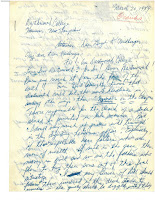
Page one of the letter reproduced in the post tragic and certainly called for deeper investigation at the time. However, the true details of it remained murky for a while after the fact, while speculation on the part of the media and the general public was profuse from the get-go.

A folder in Dean Lloyd Neidlinger’s records on the case testifies to the stormy backlash directed at the College. This folder, titled "Crank letters," has letters of discontent that were sent to the dean's office from all over the East Coast after new of the Cirrota incident were made public. Some letters were made with a typewriter and others were scribbled down by hand. The people who wrote them were locals, alums, teachers, the Society for the Prevention of the Cruelty to Animals, and other concerned citizenry, including the aunt of a certain delinquent in New York and a couple who preferred to remain anonymous and with good reason, considering the spite in their writings.

The earliest letter arrived on March 22nd from Oranger, New Jersey, from an outraged alumnus:

"My dear Dean Neidlinger:

Fie! Oh Dartmouth College! Long live Dartmouth? Lo Sin! Down Dartmouth! Burn and scorch it from the face of the earth!! Even God Almighty knows that Dartmouth could hit the news headlines in many other ways than “Murder on the Campus.” Those responsible for the death of a student should be punished in like manner. But, I doubt very much if justice will triumph in this disgusting heinous affair. Especially, if those responsible have fathers who are men of wealth. If such is the case, then money is evil and so are the fathers who plan to buy their sons out of this foul situation. I say, curses of hell should follow those involved in this dead student’s murder- the guilty should be dogged until they draw their last breath, whether it be the beaters of death regarding Cirrota or those seeking light punishment or exoneration of the guilty involved. 

You, Dean Neidlinger, are in part, responsible also. Isn’t it odd that you know nothing about the drinking brawls and excessive drinking that prevails on your campus? What kind of a college Dean are you? Look into your filthy campus and weed out the foul human elements who thrive on prejudices, hatred, acts of anti-everything that’s not decent and against the whole social order of man.

Dartmouth, a center of learning, distinguished etc. ??? No, my dear Dean, Dartmouth has become a degrading ugly, institution of baseness. The devil himself is dean of Dartmouth, not you!!! 

Erase the besmirched name of Dartmouth, if it’s at all possible. Personally, I don’t think you are capable. I prefer to remain anonymous and forget I ever went to Dartmouth. And- may God deal with the guilty and take a hand in the course of Dartmouth.

Sincerely, a shocked individual"

page two of the letter reproduced in the post The anger vented by this letter sets a tone which borders the absurd and invites ridicule from readers. Yet, the assumptions the writer made are by no means counter-intuitive. The dean and the administration could not escape the fact that a student had died on their watch and that some of the suspects came from affluent backgrounds that were handy when those men later applied for jobs or admission at other colleges in the aftermath of the judicial proceedings. For the man who wrote the text, Dartmouth is a symbol of depravity and the case itself justifies the violent rooting out not only of the men involved in it but of all “vile elements” from the school. Another distressed citizen wrote to the Dean condemning “alcoholism and fraternity snobbishness”, and establishing that certain characteristics of the campus culture paired well with murder. A Mr. Drew from Lowell, Massachusetts, underscored the widespread alcoholism that prevails at Dartmouth by providing a list of criminal cases involving students from the College, of which the Cirrota case was only the latest and most disturbing.

After the Grand Jury of New Hampshire returned the first verdict in the trial, a $500 fine and a Two short responses to the Cirotta death that were sent to the dean suspended sentence, the public was outraged once more. A Ms. Mc Dough of New York accused the school of bribing the local police and the district attorney. An anonymous postcard from D.C. described the verdict as an indication of great problems within the community where the case was prosecuted. The last letter that received a response from Neidlinger’s office alleged indifference on Dartmouth’s end with regards to the trial and an institutional failure with regard to the teaching of moral values. The dean’s response did not address these accusations directly but instead argued that the lady who sent the letter was greatly misinformed. Other responses that the Dean wrote in defense of the school claimed that these accusations concerned issues that affected American youth overall and couldn't be resolved by the administrators at any single institution. Either way, the "Crank letters" in the Cirrota case capture not only the history of that case but also a cultural moment in US history.

To explore the Raymond Cirrota Case records, come to Rauner and ask for DA-46, Box 3139.

Posted for Veselin Nanov '20, recipient of a Historical Accountability Student Research Internship for the 2019-2020 academic year. The Historical Accountability Student Research Program provides funding for Dartmouth students to conduct research with primary sources on a topic related to issues of inclusivity and diversity in the college's past. For more information, visit the program's website.