Tuesday, November 6, 2018

First Frost

“This is the very first I ever had published …” reads Robert Frost’s words penned atop this newspaper. On November 8, 1894, The Independent, a New York newspaper which ran from 1848-1921, became the first professional publisher to feature poetry by Robert L. Frost.

However, The Independent was not the first to print Frost’s poetry, or even “My Butterfly.” Frost worked with a printer in Lawrence, Massachusetts to self-publish two copies of a collection he called Twilight, one for himself and one gifted to his future wife, Elinor. Only Elinor’s copy of Twilight survives today –  after personally delivering Elinor’s copy to her at St. Lawrence College and perceiving rejection, Frost destroyed his copy.

While Elinor's copy of Twilight is housed in special collections at the University of Virginia, Dartmouth’s Rauner Alumni Collection features an original copy of the Independent, issue number 2397. This particular copy features a brief note penned by Frost dedicated to one Earle Bernheimer. Bernheimer, it turns out, was a patron of Frost who supported him financially in exchange for bits of writing from the poet. Their letters suggest that, at least for Frost, the relationship was more business than friendship, and that he got Bernheimer to progressively pay him more and more for less and less. Ultimately, Bernheimer had to sell his collection of Frost’s works during a divorce settlement. It is quite possible that this piece was part of that very collection.

The poem, “My Butterfly” itself was written by Frost at eighteen and was also featured in his first commercially published book of poems A Boy’s Will. Another thing that stands out about the poem is its use of poeticisms – formalistic flairs like thee, tis, and o’er – which slowly fled Frost’s work as he progressed as a poet. On January 30, 1895 Frost composed a letter concerning “My Butterfly” to Susan Hayes Ward, an editor for The Independent, “If it is seriously I must speak, I undertake a future. I cannot believe that poem was merely a chance. I will surpass it.”

The rest of Frost's inscription quoted above is "...unless you count the three or four I had in the Lawrence High School Bulletin when I was at school." We have one of those, too. To see "My Butterfly" ask for Alumni F9296my; to see the Bulletin, ask for Frost LH1 L285 H54 1892.

Posted for Bradford Stone '19.

Tuesday, October 30, 2018

Going Back to the Well

Page opening of Jenson's edition of Pliny.We have blogged before about Nicolas Jenson's obsession with the perfect page and his devotion to an austere typography, so we don't have much to say about this book, except to exclaim, "Damn, look at that page!"

This is Jenson's 1476 printing of Pliny's Natural History, translated into Italian by Christophoro Landino. The size of the book is daunting, then you open it up and see the luxurious margins Jenson provided to set off his unrelenting text block. Purity of form.
Person holding book to show scale.

To see it ask for Incunabula 137.

Friday, October 26, 2018

Translating Tamil

First page of a letter from Levi Spaulding to his nephew Lyman Spaulding, August 22, 1863.
In June of 1819, a young man named Levi Spaulding embarked on a trip to South Asia that would ultimately lead him to the island country of Ceylon, now known as Sri Lanka. The small nation had just been colonized by the British in 1818, and Spaulding's intent was to serve as a minister of God to its indigenous people. Spaulding had originally intended to be a farmer in Jaffrey, New Hampshire, where he was born in 1791, but his father's death in 1809 changed the trajectory of his life. Instead, he enrolled in Dartmouth College as a member of the class of 1815 and had a spiritual awakening there after several years of religious indifference. After graduating, he promptly attended Andover Theological Seminary and received his degree in 1818. Only a short year later, Spaulding was on a ship headed for India. He would return only once to his native country for a two-year furlough and spent his life ministering to the Tamil people of Sri Lanka and southern India. He died in Uduvil, a town at the north of the island, in 1873 at the ripe old age of 82.

The title page from Spaulding's Tamil translation of the New Testament (vol. 2).One of the most daunting initial challenges for Spaulding was a lack of suitable religious texts. When he wrote to his nephew in 1863 to describe his early days as a missionary, Spaulding mentioned that upon his arrival he discovered that there were only two grammars in the mission, no dictionaries, and no Christian texts. There weren't even enough English Bibles for the missionaries. Spaulding dedicated himself to translating various tracts, sermons, and other religious texts into Tamil, including Pilgrim's Progress. Spaulding recounted in his correspondence that he would often pick up new words during his conversations with the local community and then immediately pencil them on his shirt sleeves for later transcription. Eventually, the fruit of his labors was both a Tamil-English dictionary and a Tamil translation of the New Testament.

To see a volume of Spaulding's Tamil New Testament, come to Rauner and ask for Alumni S7393t v.2. To read his correspondence with his nephew, ask for MS 838563.1.

Tuesday, October 23, 2018

Doctor Franklin and Lord Dartmouth

Engraving of the 2nd Earl of Dartmouth, William Legge
This week, we welcomed to Special Collections a visiting delegation of Rotarians from the United Kingdom. First editions of works by Austen, Dickens, and Shakespeare were on display for them, as well as historic Rotary Club publications and a few items connected to the college's namesake. William Legge, the second Earl of Dartmouth, was the leading trustee for the English trust that funded Eleazar Wheelock's initial educational venture, Moor's Charity School. In an an effort to drum up financial support for the founding of Dartmouth College, Wheelock named the school after Legge. Wheelock hoped that the nobleman would be flattered and respond with a generous donation; Lord Dartmouth declined the invitation to contribute.

In addition to his connection to America through Moor's Charity School, the Earl of Dartmouth had
Engraving of Benjamin Franklin
another important tie to the colonies. From 1772 until 1775, he served as the United Kingdom's Secretary of State for the Colonies; the position had been newly created in 1768 to bring the American colonies to heel after the passage of the controversial Townshend Acts in 1767. Among the items we had on display for our British guests was  a letter written (or, at least, dictated) by Benjamin Franklin to Lord Dartmouth in December 8th, 1772. In his letter, Franklin states that he would like to share his perspective on the general sentiments of "leading people in America" with Dartmouth, particularly their concerns about recent measures taken by the British government. Franklin suggests that Dartmouth may not be receiving a true account from his official government representatives in America.

At this time, Franklin was living in London. He had originally moved there as a representative of the Pennsylvania Assembly to protest the influence of the Penn family. However, over the two decades
Manuscript text of the letter from Franklin to Dartmouth
that he was there, his role soon morphed into a defender of the colonies at large, including the Massachusetts Colony. He became well known in London political circles in particular for his vehement rejection of the 1765 Stamp Act. In 1772, Franklin was writing to Lord Dartmouth because he had recently come into ownership of a packet of letters written by the current Governor of Massachusetts, Thomas Hutchinson, that both recommended strengthening executive power in the colonies and asserted that colonists would never have the same full rights that they would enjoy if they still lived in England. That very same month, Franklin would send those letters to the Massachusetts Assembly. Six months later, they were published widely in America and served to fuel the fires of rebellion.

To read Franklin's letter to Lord Dartmouth and see the engraving of him, come to Special Collections and ask for Ticknor 772658.1. To see the engraving of Lord Dartmouth, ask for Iconography 741.

Tuesday, October 16, 2018

A Simple Cobler

Title page of "The Simple Cobler"Some title pages are just irresistible--you know from the start of this pamphlet that nothing is likely to be as it seems. The title reads:
The Simple Cobler of Aggawam in America. Willing to help 'mend his Native Country, lamentably tattered, both in the upper-Leather and sole, with all the honest stitches he can take. And as willing never to bee paid for his work by Old English wonted pay. It is his Trade to patch all the year long, gratis. Therefore I pray Gentlemen keep your purses.
It was written by Nathanial Ward, a minister in Ipswich, Massachusetts, and author of the first law code for New-England. In this work, printed in London in 1647, tattered shoes are just a metaphor for the moral depravity of both England and New England under Charles the I. The metaphor of a Simple Cobler is so quaint, and so utterly inadequate for what was about to transpire. Less than two years later, Charles the I was beheaded and England thrown into civil war

To give it a read, ask for McGregor 182.

Friday, October 12, 2018

Illustrated Rose

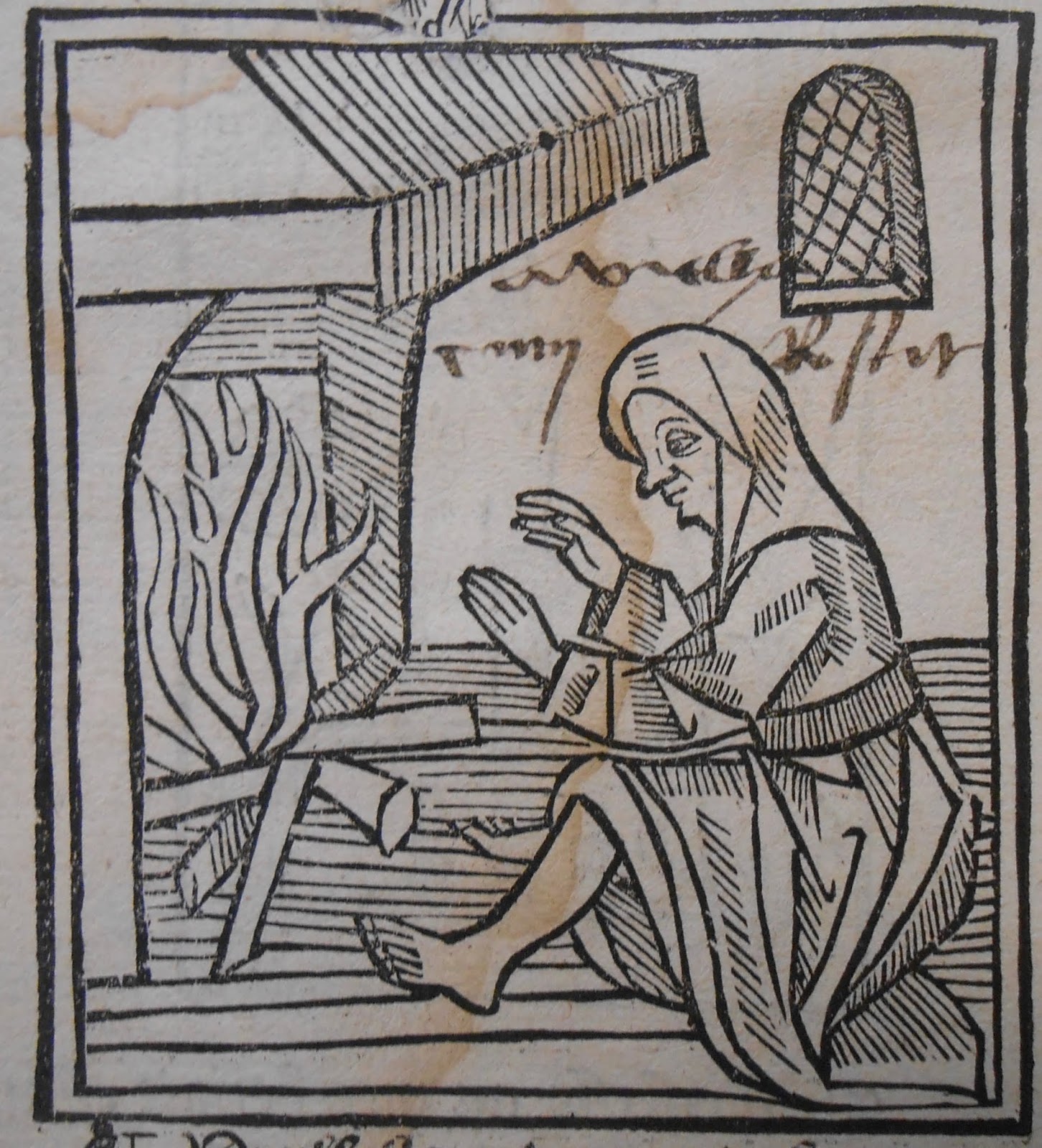
Poet entering the gatesWe just picked up a beautiful early edition of the Romant de la Rose (Lyon, 1503). It is the perfect complement to our early 14th-century manuscript of the poem. This copy has a series of woodcuts that enliven the text, add an interpretive layer, and evoke the manuscript tradition of our earlier copy. But, while our manuscript has only seven images, this copy is illustrated throughout with 140 woodcuts, many with manuscript notes from an early reader.

Man and woman entering a castleWoman warming herself by fire

Man speaking to an angel
It is a stunner, so come in and take a look by asking for Rare PQ1527.A1 1503.

Tuesday, October 9, 2018

The Dartmouth Commercial Crisis of 1903

Broadside announcing the Tuck School - Thayer School baseball game scheduled for April 4 1903 While preparing for a Tuck Reunion event that occurred this last Saturday, we stumbled upon a fascinating broadside announcing a "Great Commercial Crisis!!" Intrigued, we read on. "Capital vs. Labor," the flyer declared, before then going on to describe an upcoming baseball game between the Tuck School of Management ('Capital') and the Thayer School of Engineering ('Labor'). The program lists all of the players by position, complete with nicknames and dubious monikers: 'Jaygould' Brown, the Man without a Country; H. E. Plumer, the Mud Pie Mixer; and 'Monsieur' Murray, Le Professor, to name a few.

The Tuck School was a fledgling institution at the time, merely two years old to Thayer School's thirty-three years of existence, but clearly it didn't take the two schools long to form a collegial relationship. The Special Code of Rules at the end of the broadside declares that the defeated team will be responsible for setting up drinks at Deacon Downing's bar. A Tuck School class photograph for the 1903 graduates doesn't give any hint of the sort of humor clearly evident in this printed promotion for a casual ball game held during the Easter break. Although it was doubtless easy for the students to joke about the conflicts between capitalists and the work force, given their privileged station in life, it is also nice to have a perspective that contrasts with their formal appearance in their group photo. It's also interesting to note that the entire class could just field a nine-man baseball team.

Group photo of the nine members of the Tuck School class of 1903

To see the baseball broadside, come to Rauner and ask for Broadside 903254. To see the group photograph of the Tuck class of 1903, ask for the "Tuck School -- Students" photo file or download a copy yourself from the Dartmouth Photo Files database online.