Saturday, February 4, 2017

When Two Worlds Meet

East Asian and Asian-American students have been the most rapidly growing minority groups at Dartmouth College since the mid-20th century. However, archival records on the communities' experiences are scarce; it was only around the 1970s that these students began to organize collectively around their shared ethnic and cultural identities. 

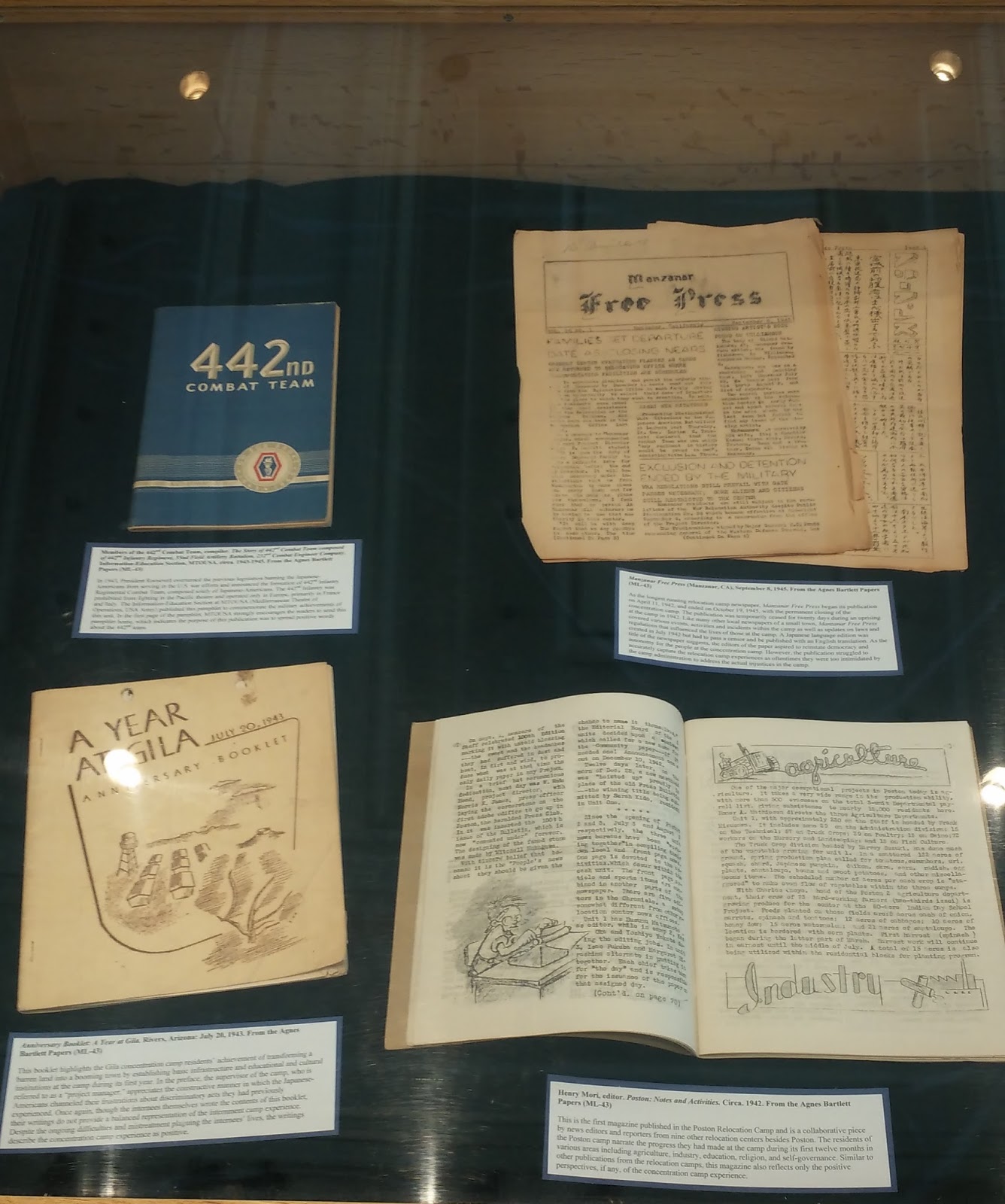
At Rauner, we are currently displaying an exhibit, "When Two Worlds Meet," which provides perspective on East asian and Asian-American student experiences on campus by looking at the archival records of some of the very first students of Asian descent at Dartmouth. To contextualize these students' experiences at Dartmouth, the exhibit also presents glimpses of larger historical conversations between East Asia and the West. These conversations include attempts by East Asians to document and communicate their cultural heritage and life experiences to Western audiences. The other side of the conversation consists of Western perceptions and interpretations of East Asian civilizations, whether accurate or not.

Several of the books published by Homer B. Hulbert, who was
featured in our last blog post, are included in this exhibit. An illustrated travel log of China written by a Dutch traveler, various pamphlets and publications from the Japanese internment camps during the World War II, and wartime propaganda graphic novels from China are also featured in the exhibit. The exhibit will be installed from now through March 17th in Rauner Library's Class of 1965 Galleries on the mezzanine floor of Webster Hall.

To read more about this exhibit online, visit the Exhibitions at Rauner webpage.

Tuesday, January 31, 2017

Portrait of a Senator

Daniel Webster sitting in a chair with his legs crossed, looking at the viewer. There is a large globe in front of him to his left and over his right shoulder is a writing desk with a pen and other accessories on it.
The national news these days has some of us thinking about the power and long history of the United States Senate. In particular, Massachusetts Senator Elizabeth Warren's concerns about the Emoluments Clause reminds us of another constitutionally-minded lawyer who previously sat in her seat when our current government was less than forty years old. Daniel Webster, the 19th-century lawyer and politician, is arguably one of the most famous sons of Dartmouth. A member of the class of 1801, Webster was a masterful orator who successfully argued before the Supreme Court on several occasions and was deeply respected for his eloquence among his fellow senators. His speech in response to Robert Hayne of South Carolina, delivered before the Senate in 1830, has been recognized as one of the best
A black-and-white salted paper photograph of an elderly Daniel Webster.
ever given within that august body. He also had a reputation for being a rallying figure for political opposition to President Andrew Jackson, who rode an uprising of populist sentiment into the White House in 1829. Nearly a century after his tenure ended, Webster was recognized by the Senate in 1957 as one of the greatest senators in the country's history.

An engraving of Daniel Webster looking off to his left.Given Dartmouth's connection to Webster, including the fact that Rauner Library is in Webster Hall, it's not surprising that we have a strong Webster collection. Silk socks, a top hat, a pocket watch given by him to someone else, and a set of wine glasses and accompanying decanter all reside here at Rauner. We also have his handwritten notes from the Dartmouth College Court Case; a number of fascinating original letters to and from him; and his personal but incomplete copy of John James Audubon's Birds of America.

Perhaps the most exhaustive collection of material related to Webster at Rauner, however, is the numerous images that we have of the man. It's safe to say that we have more impressions of Daniel
A silhouette cut-out of Daniel Webster in profile facing left.
Webster than any other dignitary or individual associated with the college. What is most fascinating about this gathering of likenesses, moreover, is how each of them is different from the other, sometimes in very striking ways. Still, the unmistakable gravitas of the Massachusetts senator seems to be present in every instance. Although a great statesman, Webster's legacy has been tarnished somewhat by his desire to maintain national unity by any means necessary, including his support of the infamous Fugitive Slave Act of 1850. A little more than a decade later, despite Webster's questionable decision to sacrifice the moral imperative in order to appease the Southern states, the country inevitably descended into civil war.

There are too many Webster images to list them all here (more than a hundred!), but you can start by coming to Rauner and asking for Iconography 933, Iconography 944, Iconography 1429, and Iconography 1649.


Friday, January 27, 2017

Homer B. Hulbert

A portrait of a white man with well-combed hair and mustache, wearing a suit.Yesterday marked the 154th anniversary of the birth of Homer B. Hulbert, Class of 1884. Little had anyone known then that this second child of a Congregational minister in New England would become fluent in the Korean language -- fluent enough to pen scholarly articles and books -- and fight for the independence of a small country on the other side of the planet. How did Hulbert come to learn about the small country unknown to most Westerners at that time and become so attached to it?

After graduating from Dartmouth in 1884, Hulbert decided to become a minister like his father and began his studies at Union Theological Seminary. That same year, Gojong, king of Korea, asked the U.S. government for three Americans to teach English to the children of the Korean royal families. John Eaton, who worked for the Department of State and was a close friend of Hulbert's father, asked whether one of the Hulberts would be willing to go. Unlike his reluctant brother, Hulbert enthusiastically agreed to join the crew, even though he didn't know much about the country other than a brief mention of it during his geography class at Dartmouth. With two other American missionaries, he departed to Korea in 1886, where he worked at Royal English School in Seoul until 1891.

A page from a book, written in classical Korean alphabets. The words are written vertically, from top to bottom. There is a divider in the middle of the page.
Saminpilchi
During his time at Royal English School, Hulbert sought to make up for the lack of scholarly resources and felt an urgent need to publish a textbook written in Korean. At the end of that effort came the publication of 사민필지(Saminpilchi), or Geographical Gazetteer of the World, in 1889. In the preface to the book, Hulbert notes that, nowadays, it's not sufficient for a nation to manage and understand only what lies within their physical borders. An efficient governance under the new order requires nations to constantly interact with different states. Therefore, leaders of a nation ought to understand the culture, customs, history, and geography of different countries in order to thrive. The first chapter explains the concept of the planet Earth. The following chapters each introduce a continent and countries within that continent. Colored maps are attached to each chapter to provide a visual aid to the text.

Circle-shaped atlas of the Earth in a white background. The oceans are in sky blue color, African continent in green, Asia in yellow, Europe and Australia in pink.
An atlas within Saminpilchi
Towards the end of the preface, Hulbert highlights that he wrote this textbook in Korean to make this information available to a greater portion of the Korean population. In fact, the publication of this textbook in Korean language was unusual in that, despite the existence of the Korean language, scholarly works in Korea to that date were written exclusive in traditional Chinese characters. The Korean language, Hanguel, was perceived as a language for the lowly and common people, whereas traditional Chinese was thought to be the language of the upper class and of scholars. Hulbert had a different opinion. In The Korea Review, an English-language magazine produced by American missionaries and teachers in Korea, he published several articles praising Hanguel for its intricacy and scientific mechanism. His appreciation of Hanguel evolved into a passion for Korean folklore and traditional literature, and he translated several Korean folktales into English, including Omjee the Wizard.

Cover of the book Omjee the Wizard. An old man with white beard and purple turban is at the top right corner of the cover, looking down into an orange and yellow carpet with red fringes. Within the carpet are creeks and green leaves where little children with fairy wings are running around.
Omjee the Wizard
Hulbert expressed a deep interest in the history of Korea as well. In The History of Korea, which was published in both English and Korean, he covers the time span ranging from 2300 BCE, when the first nation-state was founded in the Korean peninsula, to the 14th century CE. Another history book he penned, The Passing of Korea, presents a detailed analysis of various aspects of Korean society leading up to Japanese control of Korea during his own lifetime.

Cover of an traditional Korean book, bound by tiny ropes. The title is on the top left corner of the cover, written vertically from top to bottom in black.
The History of Korea
Initially, Hulbert thought it would be inevitable for Korea to fall under foreign control and, in that case, he preferred Japanese control to that of the Russians. However, after the Treaty of Portsmouth in 1905, Hulbert changed his stance as he realized that Japan would never grant Korea the political autonomy that it had promised. The Treaty served as a turning point for Hulbert as he began to involve himself politically on Korea's behalf. In November 1905, he delivered Korean Emperor Gojong's letter to the Secretary of State, in which the king pleaded fruitlessly with the U.S. government to halt Japanese aggression. However, Hulbert was not discouraged by the U.S. government's disinterest and continued his advocacy for Korean independence.  In 1907, he assisted confidential emissaries from Korea to the Second International Peace Conference in The Hague. Hulbert tried to create an opportunity for the Korean delegates to speak at the Conference, but they were prohibited from entering the hall. Upon learning about Hulbert's attempt, the Japanese Empire increased its scrutiny of foreigners in Seoul, which eventually led to Hulbert's expulsion from Korea in 1907.

Even after his exile form Korea, Hulbert didn't cease his efforts and continued to contribute articles to various American magazines and newspapers about his adoptive nation. After more than forty years away, Hulbert finally got a chance to return to Korea in 1947, when the first president of the Republic of Korea, Syngman Rhee, invited him back. In August of 1949, he arrived back at the country he had been longing to return to for decades. Shortly after, his return, Hulbert died and was buried in Yanghwajin foreigners' cemetery in Seoul. After his death, Hulbert has continued to live in the memories of Koreans; he was conferred the Korean Order of Taiguk in 1950 and, in 2013, he was selected as an "independence activist of the month." One reason for his persistent presence in Korean culture is because, until World War II, colonial aggression in East Asia was the least of concerns for Westerners. Within such a context, Hulbert's opinions and actions stand out as a special case worthy of remembrance.

Rauner holds several of Hulbert's works. To see Saminpilchi, ask for Alumni H877p; The Korea Review, Alumni H877k; The History of Korea, H877h for English H877hi for Korean; The Passing of Korea, H877pa and Omjee the Wizard, Alumni H877o.

Tuesday, January 24, 2017

A New England Girlhood

Image of cover and spine of A New England Girlhood as described in the text. The cover is dark blue with black lettering and floral design on front cover. The spine is stamped with gold lettering.Forget the proverb – a book’s cover can teach us quite a bit, especially when its appearance illuminates deeper discussions in the text. Such is the case with the first edition of A New England Girlhood, an autobiography by American poet Lucy Larcom. Published in 1889, the volume physically embodies the themes of individuality and intimacy explored in the narrative.

Larcom was commissioned to write her autobiography for a series called The Riverside Library for Young People. The cover of A New England Girlhood notably markets the series as prominently as the text itself - the series name is stamped in large lettering across the top, while the book’s title and Larcom’s name are centered in the middle, in slightly smaller lettering. The spine and title page follow suit. This distinctive feature characterizes the relationship between text and series. A New England Girlhood both builds and is built by the Riverside series. It does not stand alone, but must be understood as part of a whole. This relationship dynamic extends from the text itself. Larcom’s narrative revolves around exploring the importance of context in individual development. She defines an autobiography as “a picture of the outer and inner universe photographed upon one little life’s consciousness.” The influences of people, places, literature, and nature collectively shape her existence. Larcom also understands her individual significance in terms of her membership in various communities, such as her family, workplace, literary societies, and God’s universe. Like the relationship between text and series, her individual life both constructs and is a construction of her surroundings.

Image of the typographic title page reading "A New England Girldhoo/Outlined from Memory/By/Lucy Larcom/[Printer's mark]/Boston and New York/Houghton, Mifflin and Company/The Riverside Press, Cambridge/1889This dynamic creates a thematic emphasis on relationships that is mirrored by the volume’s unassuming size. Its compactness and ability to fit comfortably in the reader’s hands imbue it with a sense of intimacy. The size also implies humility in its appeal to readers, as if the book is designed to resonate with individuals rather than attract a worldwide audience. Larcom, in fact, actively limits her audience, specifying that her story is for girls, women, and those who appreciate them, and that “all others are eavesdroppers, and, of course, have no right to criticize.” In doing so, she carves out an intimate space for an audience that in her time was rarely prioritized: young women. Here, the silenced and ignored narratives of women thrive. It is a space of expansive confinement - the closer its quarters, the greater the opportunity for empathetic story sharing. The volume’s physical dimensions contain and activate this intimate space.

Object and text thus form a coherent package, tied together by these thematic-aesthetic parallels. But it is not enough to simply observe the parallels. Following Larcom’s philosophy, their significance cannot be understood without context. A New England Girlhood was written about female experiences, by a female author, in a patriarchal society that systematically silenced female voices. This context limited the range of choices available to Larcom, constricting the autobiography both internally and externally. Examining the thematic-aesthetic parallels suggests that each is a manifestation of this constriction. For example, Larcom’s narrative may have been published and marketed as part of a series because it was not considered ubiquitous enough to stand on its own. The volume’s small size may have resulted from the publisher’s assumption that the book would only attract a humble, self-selecting audience. Larcom’s thematic focuses likely originated from similar constraints. In her time, women were confined to the private sphere. Her emphasis on intimacy and privacy suggests her internalization of this confinement. Larcom also expresses a discomfort with the concept of autobiography – “I do not know that I altogether approve of autobiography myself” – revealing her uncertainty that her individual story is worth documenting. Her humble and relational attitude towards her life may reflect how societal concepts of female versus male individuality were disproportionately invested in relationships and family.

This analysis suggests that oppressive forces may have played a role in molding A New England Girlhood, both externally and internally. Yet this is not meant to discredit Larcom’s agency as a writer or the integrity of the themes she explores. Within the confines of a society that silenced her, Larcom found a space for her voice, strong and critical and true to her experience, if not completely unfettered. Understanding this allows readers to truly understand the threads of individuality and intimacy tying together text and object - not as face-value parallels, but as the productive interplay of tensions between constriction and resistance.

To see the book, ask for White Mountains PS2223.A3 1889a.

Posted for Elizabeth Klein '17

Friday, January 20, 2017

Byron to Hunt to Fields

Image of engraving of a young couple dancing outdoors with a throng of lounging onlookersPrepping for this week's class on British Romanticism helped us "discover" the Wordsworth Sonnets edition we just blogged. It also turned up a pretty cool double association copy. Our copy of the four volume Works of the Right Honorable Lord Byron (London: John Murray, 1815) came to us as one of one-hundred volumes from the library of James T. Fields bequeathed to Dartmouth by his widow in 1915. Fields was a partner in the legendary Boston firm Ticknor and Fields, the primary publisher of books from the nineteenth-century American Renaissance. Field's hobnobbed with the literati on both sides of the Atlantic, and his library is a stunner. Just having been owned by Fields makes this a pretty good association copy.

Image of inscription on flyleaf of the Works of Lord Byron. The inscription reads: "To Leigh Hunt from his friend the Author. June 1st, 1815.But there's more! This copy was a presentation copy from Lord Byron to the poet, journalist, and critic, Leigh Hunt. Hunt was a champion of the romantics and helped to popularize Byron, Keats, and Shelley (though he disliked Blake). So it is no surprise that Byron would grace him with a copy of this works. Interestingly, the book was presented to Hunt on June 1st, 1815. That was shortly after Hunt had been released from prison where he had served a two-year sentence for having slandered the Prince Regent, who would later be crowned George IV.

There are lots of markings in the book and some corrections. We think they are Leigh Hunt's hand, but they may be Fields's notes.

To see it ask for Fields 13.

Tuesday, January 17, 2017

Scorn Not the Sonnet

An image of a two-page spread of Wordsworth's 1838 first edition of "The Sonnets of William Wordsworth." On the left-hand side, a handwritten note by Wordsworth that reads, "The Lady Frederic Benti[nck?] from her friend William Wordsworth. On the right-hand page, "The Sonnets of William Wordsworth / Collected in one volume / with / a few additional ones, now first published / London: / Edward Moxon, Dover Street. / MDCCCXXXVIII"
 Every now and then, we stumble upon a oft-overlooked gem upon our shelves and marvel that, until that moment, we had not previously discovered it. One of our recent thrilling finds is the 1838 publication of The Sonnets of William Wordsworth. In this humble little first edition, the poet has inscribed a dedication to his friend, the Lady Frederic Benti[nck?], on the flyleaf. At the risk of sounding overly spoiled, a presentation copy of Wordsworth's poetry wasn't the real reason why this particular volume excited us.

A two-page spread of the inside back cover of the book of poetry. On the right-hand side, a list of various works published by Edward Moxon, Dover Street. On the right-hand side, Wordsworth's handwritten sonnets with notes as outlined in the actual blog post.In addition to his personal note to his friend, inside the back cover Wordsworth has written out two sonnets from his Memorials of a Tour in Italy 1837: "Under the Shadow of a Stately Pile" and "I Saw Afar Off the Dark Top of a Pine." After the first one, he has written "October 14, 1839" (presumably the date of the inscription). After the second sonnet, he includes the clarification that the pine in question stands upon Mount Mario, the highest hill in Rome. This is exciting stuff, but the little book has yet more secrets to reveal. On pages 34, 301, and 405, Wordsworth has made corrections by hand to three of his printed sonnets. One can almost imagine the revered poet turning slowly through the pages as he deliberately and carefully annotated this volume for a close friend.
A two-page spread of pp. 34-35 of the book of sonnets. Wordsworth's Sonnet XXX, "It Is A Beauteous Evening Calm And Free," is on the left-hand page. He has corrected the first line to read as the title, replacing the words "Air sleeps, from strife or stir the clouds are free;". The ninth and tenth lines are altered to read "Dear Child! Dear Girl! That walkest with me here, / If thou appear untouched solemn thought,". On the right-hand page is the sonnet "Composed at ____ Castle," that begins with the line, "Degenerate Douglas! oh, the unworthy Lord!"
To see this exciting book for yourself, which was a gift of John W. Little, class of 1940, come to Rauner and ask to hold Rare PR5866 .A1 1838.

Friday, January 13, 2017

Polarizing Debate

Image of dartmouth students protesting George Wallace's speech outside of Webster Hall. A student in the foreground holds a sign that reads "Free Men All."In 1967, here in Webster Hall, a group of Dartmouth students stood up during a speech by Alabama's segregationist governor, George Wallace, and vocally protested. They disrupted the speech and turned the campus on its head. A raging debate ensued over the nature of civil discourse and protest on a college campus. Emotions ran high, and the campus was polarized. It sounds kind of familiar....

Image of cover of the May 1967 Conservative Idea. The cover image shows five African American students standing up in the crowd.Last week we found two student-run magazines that give us a look into the debate. The Conservative Idea, which had been around for about a year, devoted it's May 1967 issue to the controversy. The cover dismissed the validity of the protests by quoting Napoleon: "Vanity made the revolution; liberty was only a pretext."
Cover of Balckout magazine showing memebrs of the Afro-American Society holding up signed that spell out BLACK POWER NOW. They are on the steps of a campus building.

The newly created Blackout, published by the Dartmouth Afro-American Society, countered with their Fall term, 1967 issue. The cover sports the members of the Afro-American Society holding signs spelling out "BLACK POWER NOW." Presumably, these are some of the same students who shouted down Wallace and are pictured on the Conservative Idea cover. The issue is devoted to discussions of civil rights and protest--it leads not with a quote by Napoleon, but by Thoreau: "A minority is powerless while it conforms to the majority; it is not even a minority then; but it is irresistible when it clogs by its whole weight."

To see how the debate played out in these two partisan magazines ask for DC History LH1 .B55 for Blackout, and DC History LH1 .D3C6 for the Conservative Idea. They are practically right next to each other on the shelf. Have they found peace by being so close together for the past 50 years?