Tuesday, June 25, 2013

Judging an Author by His Covers

A cover for "God's Little Acre," featuring the title, author name, and a stylized sun over hills.Over the past year, Shan Williams '12 has been processing our extensive collection of Erskine Caldwell's papers. This is the last week of her internship, so in her honor we look at the ups and downs of Caldwell's career as reflected in his book covers.

When God's Little Acre came out in 1933, it was packaged as serious literature. Viking treated him as a brave voice in American letters on par with Ernest Hemingway, Sherwood Anderson and Mark Twain. His proletariat fiction resonated with the left-leaning literati and critics loved his stark realism.

By the late 1950s, Caldwell's star was dimming. His books were still known, but had become more famous for the violent sexual scenes that got them banned in many localities. The covers reflect the change by accentuating the raging passions in lurid covers. And, of course, there was a chance for a movie tie-in (yes, that is Ginger from Gilligan's Island).

A cover for "God's Little Acre," featuring a photograph of a woman standing in water. The image is blocked in by an author biography and positive descriptions of the text.A pulp cover for "God's Little Acre," featuring a man grabbing a woman about the waist amongst hay while another man looks on disapprovingly.
A cover for a Norwegian printing of "God's Little Acre," featuring a man grabbing a woman from behind in a field. A cover for "God's Little Acre," showing a man and woman kissing passionately in hay.
By the 1970s, Caldwell's books had slipped into the past for most Americans, though they maintained a worldwide audience. It was not until the 1990s that the resuscitation process began when the University of Georgia Press reissued his most famous works. Gone were the flashy covers and sensational blurbs: they were replaced by Walker Evans's photographs and statements like "What William Faulkner implies, Erskine Caldwell records."  What had been a dirty book transformed again into high culture.
A cover for "God's Little Acre," showing a black and white photograph of a fenced-in patch of land.

Come in and take a look by asking for
God’s Little Acre (New York: Viking, 1933) Caldwell 182
God’s Little Acre (New York: Signet, 1958) Caldwell 180
God’s Little Acre (London: Pan, 1960) Caldwell 172
Guds Lille Åker (Oslo : Ernst G. Mortensens Forlag, 1982) Caldwell PS 3505 .A322 G66 1982
God’s Little Acre (Athens: University of Georgia Press, 1995) Caldwell PS 3505 .A322 G6 1995

Friday, June 21, 2013

Bookending Dartmouth Row

An illustration of Wilson Hall.
On July 25, 1884, the cornerstones for two buildings were laid during a long afternoon ceremony. The first was for Rollins Chapel, just to the North of Wentworth Hall, the other was for the new library, Wilson Hall, just across Wheelock Street from Reed Hall. Together they bookend the Classical Dartmouth Row with their Romanesque arches.

A black and white photograph of Rollins Chapel.
The two buildings symbolically and physically defined a space for learning. They framed the main classroom spaces with a site for the mind on one side and a haven for the soul on the other: somewhere between was where "learning" happened. One year after the cornerstones were laid, alumni, students and "friends of the College" assembled for the dedication of the two buildings. The glory of the new chapel was celebrated with prayer and song, and the new library was extolled for its modern, fireproof stacks. But nothing was said about the space between.

A great way to start exploring the history of these building is by asking for their archival vertical files, but also be sure to see the Dedication of Rollins Chapel and Wilson Hall (Hanover: Printed for the College, 1886) by asking for DC History LD1440.R6 D3.

Tuesday, June 18, 2013

South Vietnam Land and People

A simple portrait of a young person.
We recently acquired an interesting example of propaganda produced by the North Vietnamese in 1967.  Mien Nam Viet Nam. Cat Nuoc, con Nguoi [South Vietnam Land and People] was published by the Liberation Publishing House in Hanoi and distributed to western visitors. It consists of three portfolios of images produced by North Vietnamese artists.

An illustration of a crouched man with a gun.
The message celebrating the "Resistance War" is clear:
Napalm, phosphorus, rockets, super-bombers, expanding bullets, toxic gasses--the American command in South Vietnam recoils from none of these and any other means of extermination.... Against such unbridled barbarism, the Vietnamese people have successfully defended their freedoms. Against one of the most colossal war machines ever known to history, "people's war" is being fought with valiance and creativeness, combining bamboo spears with anti-tank guns--a war in which a young mother's persuasive voice just as a ten-year-old boy's inquiring looks, also are weapons.

The portfolios were printed in bulk, but few complete copies have survived. Our prints are still housed in their original portfolios.

A portrait of a young woman.
To see it, ask for Rare DS557.72.M54 1967.

Friday, June 14, 2013

Romance of the East

An illustration featuring a man on an elephant, surrounded by other figures. A banner reads "Asia."A while back we blogged about a Unicorn sighting recounted in John Ogilby's America. We recently acquired another book from the series, Ogilby's Asia, the First Part: Being an Accurate Description of Persia, and the Several Provinces thereof: the Vast Empire of the Great Mogol, and other Parts of India : and their Several Kingdoms and Regions: with the Denominations and Descriptions of the Cities, Towns, and Places of Remark therein Contain'd: the Various Customs, Habits, Religion, and Languages of the Inhabitants: their Political Governments, and Way of Commerce: Also the Plants and Animals Peculiar to Each Country (London: John Ogilby, 1673). Despite it's long-winded title, it is a fairly concise description of Persia and India with a focus on the customs and mores of the peoples.

An illustration taking up a two-page spread, showing a caravan moving towards a distant city.
While America highlighted the exotic and fantastic, here Ogilby is more concerned with exhibiting the region's allure. The scene of a party of travelers coming over a ridge as they approach Soltanie captures England's romantic view of the East. The frontispiece, pictured above, shows a handsome man of wealth and power riding an elephant and surveying his realm. A mélange of adventure, intrigue and beauty invites the reader to tour the East through the book.

To see this early example of English Orientialism, ask for Rare DS257.O47 1673.

Tuesday, June 11, 2013

Mother Goose - The B Sides

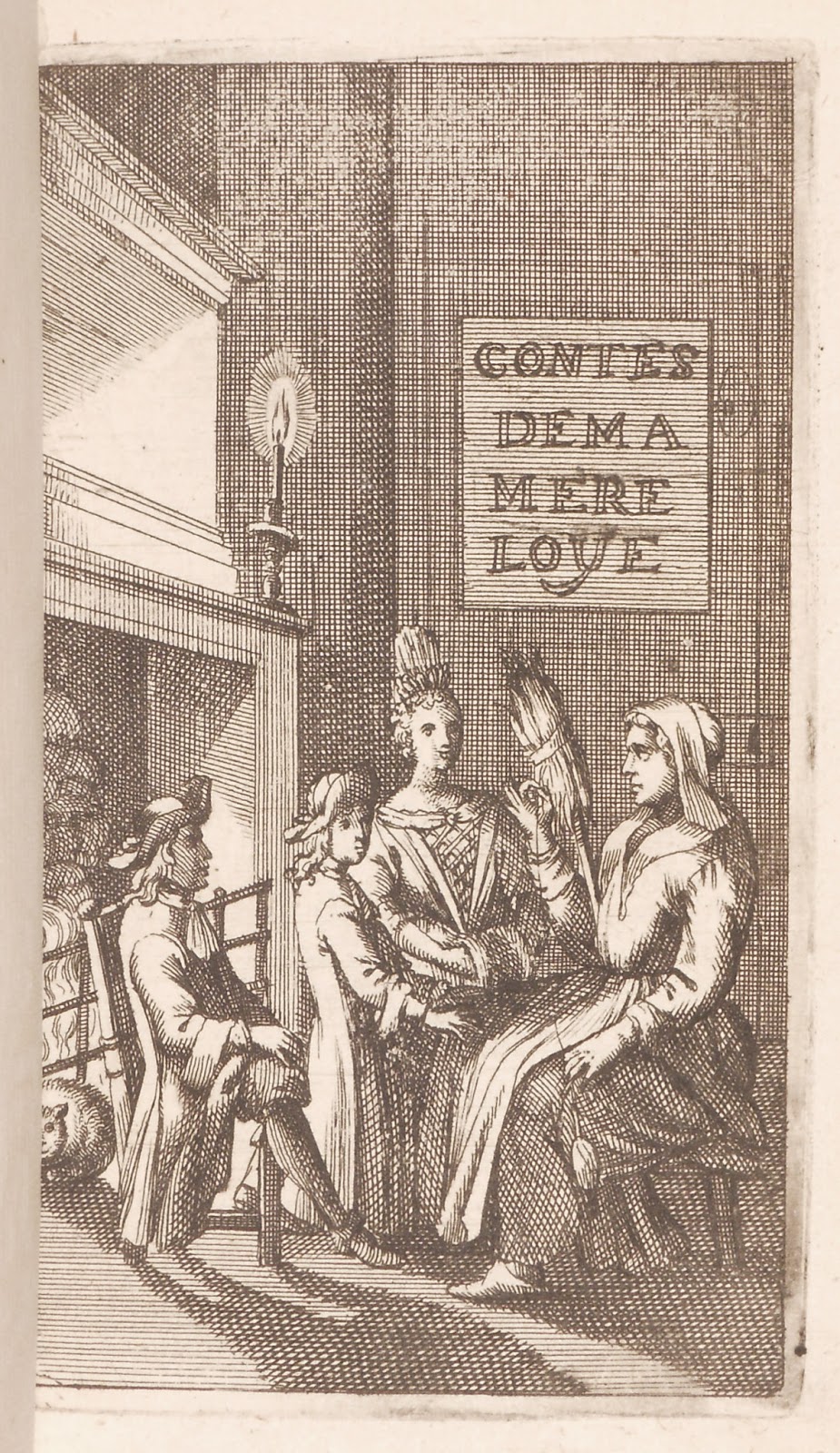
An illustration of four figures gathered around a fire.Almost everyone knows the stories of Cinderella, Bluebeard, Sleeping Beauty, Puss-in-Boots, and Little Red Riding Hood. But do you know the stories of Diamonds and Toads or Ricky? Despite their current obscurity, these two tales were included in Charles Perrault's Histoires ou Contes du Temps Passé - better known today by its subtitle Les Contes de Ma Mère l'Oye or Mother Goose Tales.

A page of printed text in French, accompanied by an illustration for the story "Diamonds and Toads."Certainly Andrew Lang thought "Diamonds and Toads"- published as "Les Fées" or "The Fairies" in Perrault - was of interest as he included it in his Blue Fairy Book (London, New York: Longmans, Green, 1889). It tells the story of two sisters who encounter a fairy at a well. One sister is kind to the fairy and the other is insulting. The kind sister is granted the gift of having a precious object - a jewel, diamond or flower - fall from her mouth whenever she speaks. The rude sister is cursed with toads and snakes whenever she utters a word. A classic tale with the standard moral of "be kind to strangers as you never know who they might be."

A printed page of text in French, accompanied by an illustration. So why have these tales faded while the others have stayed in the mainstream? Were they like the b-sides or deep cuts from the days of vinyl -  interesting to the hard-core fan, but not really the main attraction? Or have other tales with similar stories and morals eclipsed them?

Our earliest copy of Mother Goose is from 1697 and maintains that it was printed in Paris. However, the catalog record indicates that it was printed in Amsterdam and was essentially an unauthorized pirate copy of the real Paris edition.

Ask for Rare Book PQ 1877 .C513 1697 to read this early Mother Goose - in French of course! The Blue Fairy Book can be had by asking for Sine Illus F66blu.

Friday, June 7, 2013

We Blogged 'em, Now Come See 'em!

A photograph showing a long table of book and manuscript materials.
For Class Day, Saturday, June 8th, we will have an array of very cool items from Rauner set out for graduating seniors, their families, and members of the Class of 1963. Each of the items have appeared on this blog, so it is a great chance to see some of these materials up close and personally. If you are on campus between 10:00 and 5:00 on Saturday, please drop by and take a look.

A poster for "The Pajama Game."
We also have a special exhibit for the Class of 1963 that is on display Friday, June 7, from 8:00-4:30; Saturday from 10:00-5:00; Sunday from 12:00-4:00; and Monday, June 9, from 8:00-4:30.

All of the fun is open to the public, so come on in and enjoy the Commencement Weekend festivities.

Tuesday, June 4, 2013

"Who is the Honorable Robert P. Bass?"

A flyer printed mostly in Hebrew characters. In English, it reminds the reader to vote for Robert P. Bass."Robert Bass was a young man from a wealthy family who entered politics through his interest in the New Hampshire forest conservation movement. He was elected to the House of Representatives in 1905, and in 1909, to the New Hampshire State Senate. During that time he was chairman of the New Hampshire Forestry Commission. According to James Wright, author of The Progressive Yankees, Bass was guided not by "simple political ambition" but rather "by a desire for public service."

Though relatively unknown at first, Bass's involvement with the Committee of Retrenchment and Reform led him to be noticed by the progressive Republicans in the state. These reformers wanted to curtail the influence of lobbyists on state politics, in particular the influence of the Boston and Maine Railroad. They also sought and eventually were able to pass a direct primary law, partial tax reform, and a law requiring lobbyists to register. Bass was the first to benefit from the direct primary law when he ran for governor in 1910 on the progressive platform.

During his campaign, according to Wright, Bass "was a model of superior organization [working] from lists of supporters and potential supporters in each town." An example of this dedication to reach every single voter in the state is this flyer, which was intended for Jewish voters, even though, according to the American Jewish Year Book, New Hampshire's Jewish population was only 1000 in 1907. The flyer is in Yiddish but is written in Hebrew and is "A Call to All Jews in New Hampshire." In it Bass introduces himself and his political positions. He states that he is 38 years old and a Harvard graduate from 1896. He then proclaims that he is a "friend to all people, rich or poor," and "does not play the political game." He is also proud of being "endorsed by Dartmouth president Tucker and  Winston Churchill [the writer]" He promises that if Jewish people vote for him, "the railroad will be cheaper," but if they do not vote for him "everything will get more expensive." Bass won the election and was governor from 1911-1913.

To learn more about Robert P. Bass and his politics take a look at his papers for which an electronic finding aid is now available. The campaign flyer can be found in ML-31, box 63, folder 19.

James Wright's book The Progressive Yankees: Republican Reformers in New Hampshire, 1906-1916 can be found at Rauner D.C History F39. W75 1987 c.2