Friday, June 14, 2013

Romance of the East

An illustration featuring a man on an elephant, surrounded by other figures. A banner reads "Asia."A while back we blogged about a Unicorn sighting recounted in John Ogilby's America. We recently acquired another book from the series, Ogilby's Asia, the First Part: Being an Accurate Description of Persia, and the Several Provinces thereof: the Vast Empire of the Great Mogol, and other Parts of India : and their Several Kingdoms and Regions: with the Denominations and Descriptions of the Cities, Towns, and Places of Remark therein Contain'd: the Various Customs, Habits, Religion, and Languages of the Inhabitants: their Political Governments, and Way of Commerce: Also the Plants and Animals Peculiar to Each Country (London: John Ogilby, 1673). Despite it's long-winded title, it is a fairly concise description of Persia and India with a focus on the customs and mores of the peoples.

An illustration taking up a two-page spread, showing a caravan moving towards a distant city.
While America highlighted the exotic and fantastic, here Ogilby is more concerned with exhibiting the region's allure. The scene of a party of travelers coming over a ridge as they approach Soltanie captures England's romantic view of the East. The frontispiece, pictured above, shows a handsome man of wealth and power riding an elephant and surveying his realm. A mélange of adventure, intrigue and beauty invites the reader to tour the East through the book.

To see this early example of English Orientialism, ask for Rare DS257.O47 1673.

Tuesday, June 11, 2013

Mother Goose - The B Sides

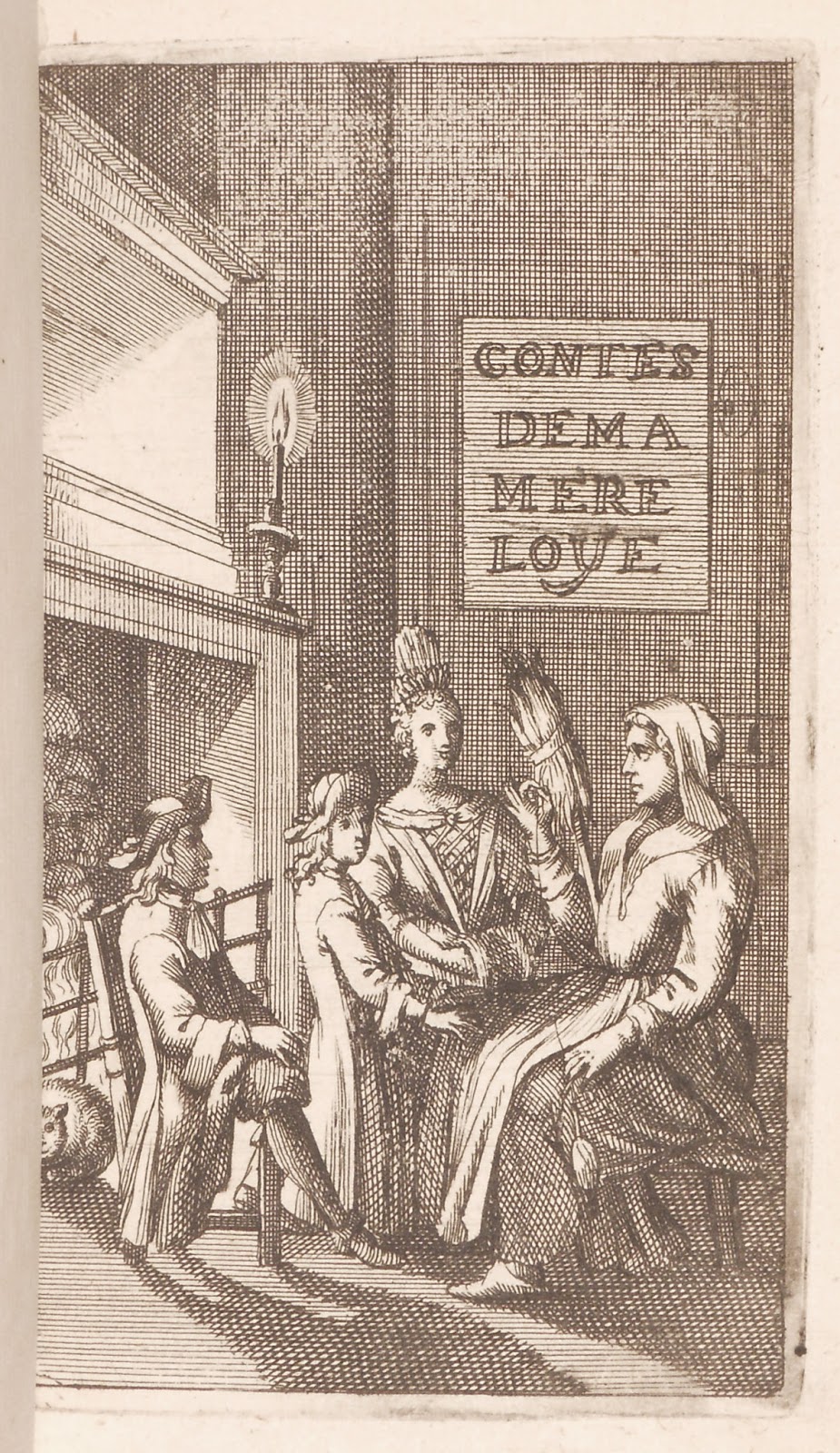
An illustration of four figures gathered around a fire.Almost everyone knows the stories of Cinderella, Bluebeard, Sleeping Beauty, Puss-in-Boots, and Little Red Riding Hood. But do you know the stories of Diamonds and Toads or Ricky? Despite their current obscurity, these two tales were included in Charles Perrault's Histoires ou Contes du Temps Passé - better known today by its subtitle Les Contes de Ma Mère l'Oye or Mother Goose Tales.

A page of printed text in French, accompanied by an illustration for the story "Diamonds and Toads."Certainly Andrew Lang thought "Diamonds and Toads"- published as "Les Fées" or "The Fairies" in Perrault - was of interest as he included it in his Blue Fairy Book (London, New York: Longmans, Green, 1889). It tells the story of two sisters who encounter a fairy at a well. One sister is kind to the fairy and the other is insulting. The kind sister is granted the gift of having a precious object - a jewel, diamond or flower - fall from her mouth whenever she speaks. The rude sister is cursed with toads and snakes whenever she utters a word. A classic tale with the standard moral of "be kind to strangers as you never know who they might be."

A printed page of text in French, accompanied by an illustration. So why have these tales faded while the others have stayed in the mainstream? Were they like the b-sides or deep cuts from the days of vinyl -  interesting to the hard-core fan, but not really the main attraction? Or have other tales with similar stories and morals eclipsed them?

Our earliest copy of Mother Goose is from 1697 and maintains that it was printed in Paris. However, the catalog record indicates that it was printed in Amsterdam and was essentially an unauthorized pirate copy of the real Paris edition.

Ask for Rare Book PQ 1877 .C513 1697 to read this early Mother Goose - in French of course! The Blue Fairy Book can be had by asking for Sine Illus F66blu.

Friday, June 7, 2013

We Blogged 'em, Now Come See 'em!

A photograph showing a long table of book and manuscript materials.
For Class Day, Saturday, June 8th, we will have an array of very cool items from Rauner set out for graduating seniors, their families, and members of the Class of 1963. Each of the items have appeared on this blog, so it is a great chance to see some of these materials up close and personally. If you are on campus between 10:00 and 5:00 on Saturday, please drop by and take a look.

A poster for "The Pajama Game."
We also have a special exhibit for the Class of 1963 that is on display Friday, June 7, from 8:00-4:30; Saturday from 10:00-5:00; Sunday from 12:00-4:00; and Monday, June 9, from 8:00-4:30.

All of the fun is open to the public, so come on in and enjoy the Commencement Weekend festivities.

Tuesday, June 4, 2013

"Who is the Honorable Robert P. Bass?"

A flyer printed mostly in Hebrew characters. In English, it reminds the reader to vote for Robert P. Bass."Robert Bass was a young man from a wealthy family who entered politics through his interest in the New Hampshire forest conservation movement. He was elected to the House of Representatives in 1905, and in 1909, to the New Hampshire State Senate. During that time he was chairman of the New Hampshire Forestry Commission. According to James Wright, author of The Progressive Yankees, Bass was guided not by "simple political ambition" but rather "by a desire for public service."

Though relatively unknown at first, Bass's involvement with the Committee of Retrenchment and Reform led him to be noticed by the progressive Republicans in the state. These reformers wanted to curtail the influence of lobbyists on state politics, in particular the influence of the Boston and Maine Railroad. They also sought and eventually were able to pass a direct primary law, partial tax reform, and a law requiring lobbyists to register. Bass was the first to benefit from the direct primary law when he ran for governor in 1910 on the progressive platform.

During his campaign, according to Wright, Bass "was a model of superior organization [working] from lists of supporters and potential supporters in each town." An example of this dedication to reach every single voter in the state is this flyer, which was intended for Jewish voters, even though, according to the American Jewish Year Book, New Hampshire's Jewish population was only 1000 in 1907. The flyer is in Yiddish but is written in Hebrew and is "A Call to All Jews in New Hampshire." In it Bass introduces himself and his political positions. He states that he is 38 years old and a Harvard graduate from 1896. He then proclaims that he is a "friend to all people, rich or poor," and "does not play the political game." He is also proud of being "endorsed by Dartmouth president Tucker and  Winston Churchill [the writer]" He promises that if Jewish people vote for him, "the railroad will be cheaper," but if they do not vote for him "everything will get more expensive." Bass won the election and was governor from 1911-1913.

To learn more about Robert P. Bass and his politics take a look at his papers for which an electronic finding aid is now available. The campaign flyer can be found in ML-31, box 63, folder 19.

James Wright's book The Progressive Yankees: Republican Reformers in New Hampshire, 1906-1916 can be found at Rauner D.C History F39. W75 1987 c.2

Friday, May 31, 2013

For Men Lonely

The green cover of "For Men Lonely."For Men Lonely is a guide to twelve women's colleges on the East Coast that was written by three Dartmouth students in 1947 before the college went co-ed. The book was inspired by one too many uncomfortable nights in the Northampton jail (for lack of better lodging). It is filled with useful information for sketchy college men seeking college women, specifically: maps of campus; the locations and contact information for local florists, liquor stores, and nightspots; and a listing of the annual social event dates and curfew times for each college.

Some of the general descriptions contain moments of wry humor, such as this guide to the area near Bryn Mawr: "Most of the college crowd leaves Philly to the Quakers… and sticks pretty much to the suburban spots. If you know Philadelphia, you will too." Other entries are less endearing, such as a hopelessly misguided attempt to compliment Skidmore women by comparing them to racehorses at the local track.

A table of contents.An entry for Skidmore College.

One can only imagine the desperation that would drive a young man to walk up to the bookstore counter with For Men Lonely in one hand and money in the other. Thankfully, having a look at the book nowadays doesn't require you to navigate any morally questionable landscape. Instead, guide yourself to Rauner and ask for Alumni J7278f, complete with the authors' autographs on the flyleaf.

Tuesday, May 28, 2013

Hanover's Favorite Recipes

A paper booklet cover with the title "Recipes" and sketch of a church. Dartmouth has long been a respected academic institution, rewarding its students with knowledge, new experiences and even some enjoyable social events. However, food may be the unsung hero of the Dartmouth experience. Hanover has created dozens of cookbooks over the last century, providing crucial instructions on how to feed the ever-hungry college student or Dartmouth-graduate.

The White Church Women's Association in Hanover published the first Hanover cookbook, Recipes, in Rauner's collection in 1928. The 1920's woman was more resourceful than the twenty-first century cook, with an entire section dedicated to the uses for sour milk. Still, quality and ingenuity can go hand in hand. I would personally advocate for the increased twenty-first century consumption of "Rinktum Tiddy" and a dessert called "Hermits," based on their names alone.

Typed text reading "'If civilized man wants his wife a good cook, Present her today with this Grange Cook Book.'"
A page of typed text.By the 1950s, Hanover had apparently taken a turn for the health conscious. The 1950 cookbook of Hanover’s Favorite Recipes, compiled by the Grafton Star Grange, dedicates a large section to weight control. While the "Eighteen Day Reducing Diet" and the "Body Building and Weight Gaining Diet" don’t exactly fit modern day nutritional guidelines, they show a college town increasingly concerned with their waistlines. The cookbook even contains a weight chart, showing the correct correlation between "Weight in Pounds (With Regular Clothes)" and "Height (with shoes on)."

A typed foreword.

In the 1960s, Dartmouth began to celebrate its perceived culinary expertise. The Dartmouth Women's Club wrote in the introduction of Favorite Dartmouth Recipes that, "much of the excellence that is Dartmouth is largely due to the fact that the wives and mothers of Dartmouth men are superb cooks." Viewing the recipes from the 1960s, a modern reader may question this claim. While many of the food creations in the 1961 College Town Cook Book and 1967 Tuck-Thayer Wives Club are likely delicious, a distinct handful would likely not agree with the stomachs of Dartmouth students in 2013. One major objection: the incredibly common use of Jell-O in any dish. From salads to meal loafs, gelatin seems to have been the go-to ingredient in Hanover and Dartmouth kitchens in the 1960s.

A typed recipe for jellied salad.
Cookbook creation has lagged in recent years. With coeducation, the College began to emphasize women's roles outside of wives, mothers and chefs. Nonetheless, there continue to be notable contributions to Dartmouth's cookbook collection. One such example is the Handel Society’s Culinary Notes, published in 1987. Each recipe in the book, published to support the musical ensemble founded in 1807, specifies not only the hometown of each recipe's author, but also his or her vocal part.

Posted for Kate Taylor '13
   

Friday, May 24, 2013

Introducing Edna St. Vincent Millay

A page of typed text with heavy, handwritten annotations.Introducing a speaker is always tricky. You want to be witty and urbane, but at the same time honor the seriousness of the moment. All of the attention must be deflected to the honored guest, but if you give a bad introduction, everyone will remember. It is trickier still if you are introducing a great poet known for her attentive use of language while you yourself are famous for your way with words.

Among our small collection of the Papers of Aldous Huxley, is a heavily annotated, undated, draft of an introduction that Huxley once gave for Edna St. Vincent Millay. The draft shows Huxley's struggles to get the tone just right--making small changes like substituting "impetuous current" for "onrush" and revamping entire sentences then rejecting them altogether. His final version captures the force of Milley's poetry and then summons her to the stage:
Like the Elizabethans, she seems constantly on the verge of being swept off her feet by the impetuous current of her own eloquence; but just as it seems inevitable that she should fall, the headlong movement is miraculously transformed before your eyes into a figure of the Dance, into some beautiful gesture, entirely unexpected and novel, and entirely satisfying.
A page of typed text with heavy, handwritten annotations.A page of typed text with heavy, handwritten annotations.

The same could be said for Huxley's introduction--a beautiful work in itself.  Come read it and see all of his changes by asking for MS 286, Box 1.