Tuesday, December 11, 2012

Friday, December 7, 2012
“… i will burn your building so help me god”
 Sometime during the mid-1800's, a distraught wife wrote this brief note to Albert Dewey, a mill owner in Quechee, Vermont, begging him not to buy any more rum for his workers. In 1882, the New Hampshire Temperance Union urged farmers to raise better apples that were a "blessing not a peril," and to avoid making hard cider because it made "men cross, ferocious, bloodthirsty." Alcohol, its use, abuse and prohibition, does tend to evoke strong and, sadly in some cases, violent responses.
 |
| Broadside 000064 |
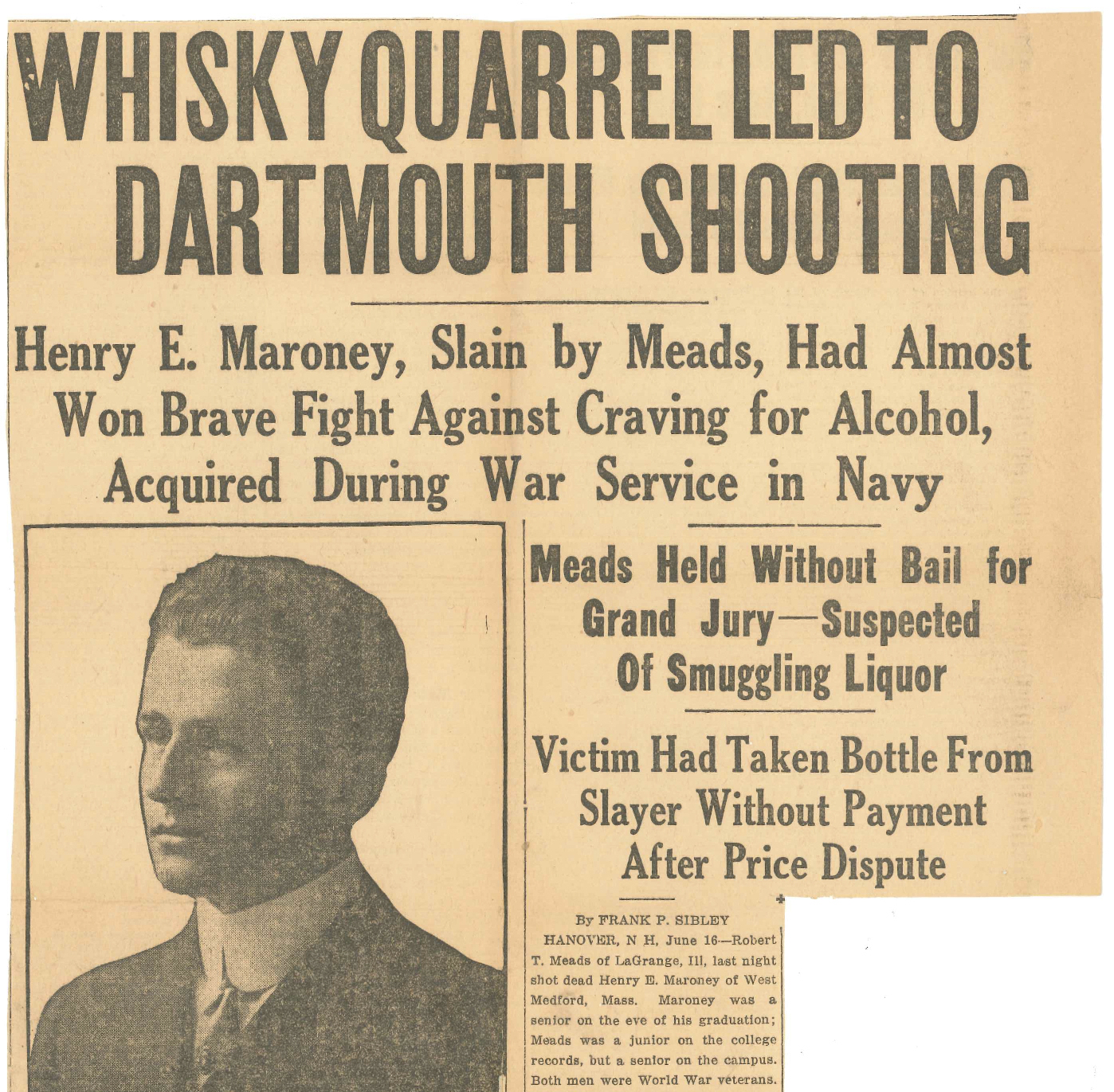 Two days later, Dartmouth President Ernest Martin Hopkins made a formal statement to the press, denying that there had been any general system of smuggling of liquor into Hanover, and that the College authorities had, by every device available, kept watch and checked every known source of supply. He was loath to state this much, in case such diligence on the part of the College would imply an overwhelming need for such oversight, or that specific incidents would cast a bad light on the majority of students who did not partake of illegal drink.
However, in May the following year, President Hopkins was forced to admit in a letter to Matt Jones, Class of 1894, that the campus was in great trouble due to gallons of bootleg alcohol coming into town from Rutland and White River Junction, Vermont, and from New York. "I would like some real he-men with automatic revolvers and backbone who would hold up some of the suspicious automobiles that are floating around here…"
 |
| Broadside 001374 |
Ask for ML-61, box 23, folder 25 to see the letter from the Dewey papers, Broadside 000064, Broadside 003174, and Henry Maroney's 1919 Alumni file.
Tuesday, December 4, 2012
By the Author of 'Jane Eyre'
 A while back we blogged about the first edition of The Tenant of Wildfell Hall. The publisher promoted the book with the suggestion that it was written by Charlotte Bronte (rather than Anne). Well, we just acquired the first American edition of Wuthering Heights (New York: Harper and Brothers, 1848) and find that the confusion over the Brontes extended into the United States. The title page of Wuthering Heights clearly states "By The Author of 'Jane Eyre.'"
The publisher had a good excuse. All of the Bronte novels were published under pen names: Acton, Ellis, and Currer Bell. Since this edition is pirated, Harpers had no contact with the Bronte sisters. The English publisher was also working to conflate the three "Bells." Harpers may not have known, or they may have been trying to cash in on the success of Jane Eyre which they had already brought out in a pirated edition.

Ask for Rare PR4172.W7 1848 for Wuthering Heights and Rare PZ3 .B790J for the first American Jane Eyre.
Friday, November 30, 2012
De architectura
 Marcus Vitruvius Pollio was a Roman of the first-century B.C. He served in several of Julius Caesar's campaigns, most likely as an engineer responsible for the construction and maintenance of the army encampment. Little else is known about his life save what is revealed in his only surviving work De architectura, a treatise on architecture which detailed then current Roman practices as well as methods and designs from Greece and earlier cultures. His philosophy on design is often summed up by his statement that a structure should incorporate elements that make it solid, useful and beautiful. Rediscovered in the 15th-century, De architectura had a profound effect on Renaissance design and served as inspiration for Da Vinci and others.
De architecura is divided into ten books and is commonly known as the Ten Books on Architecture. Each book focuses on a related subset of design and construction methods or decorative motifs. These include sections on temples (book 2), water and aqueducts (book 8) and Roman engines - primarily military in nature (book 10).

Ask for Red Room 871 V92 1511 to see the first illustrated edition. Other editions can be found by searching the catalog.
Tuesday, November 27, 2012
The Real Little Women
 It's no secret among Little Women fans that Louisa May Alcott based her beloved novel on her life growing up with three sisters. However, fewer people know just how much of the Alcott family's work lies within the walls of Rauner Library. Though we are missing works from Abigail May (the wise mother) and Lizzie (who, like her Little Women representation Beth, died young), Rauner has works of the other three sisters and their father: controversial transcendentalist Amos Bronson Alcott.
Amos Bronson Alcott's role as "Father" in Louisa May Alcott's fictional books is mostly off-stage, either due to his fighting in the Civil War or extended recovery from injuries. In reality, Bronson was a huge and active part in the Alcott sisters' lives. The Alcott girls were Bronson's four most consistent pupils. Bronson's innovative and controversial method of teaching art, music, nature study and a curriculum of social reform led many students to withdraw and forced the family to move twenty times in thirty years. However, Bronson's views remain documented in Observations on the Principles and Methods of Infant Instruction. He became well known for his work across New England, forming a Concordian community with transcendentalists such as Ralph Waldo Emerson and Henry David Thoreau. In addition to published works by Bronson, Rauner has one of his private letters of recommendation for a young woman pursuing a musical education, showing just how far-reaching the Alcott family's influence was by the 1890s.

True Little Women fans will remember Amy March's artistic aspirations (as opposed to Jo/Louisa's literary ones). In light of her fictional counterpart, May Alcott's representation in Rauner is unsurprising: a book of sketches of the Alcott's home in Concord and a copy of Little Women illustrated by May. Like her fictional counterpart (Amy), May became a moderately successful artist in Europe. However, while Amy returned to America married to Laurie (to the fury of fans who predicted his eventual pairing with Jo), May Alcott married a Swiss violinist fifteen years her junior at age 38, then died in childbirth in Paris.
Rauner has – of course – a number of writings by Louisa May Alcott, including numerous copies of Little Women, but also lesser-known works, like Louisa's Hospital Sketches and A Free Bed. Come peruse a copy of Little Women, then read more from the family that inspired the novel!
Ask for Mss 872554 for Bronson's Letter; 1926 Collection A39 for Little Women (Illustrated by May Alcott); Rare PS1019.A2 C65 for Concord Sketches: Consisting Of Twelve Photographs From Original Drawings; and Rare PS1017.C6 1893 for Comic Tragedies, written by "Jo" and "Meg" and acted by the "Little Women."
Posted for Kate Taylor '13
Friday, November 23, 2012
Wheatley's Iliad
 Phillis Wheatley was the first African American poet: born in West Africa in 1753, brought to America on the slave ship, The Phillis, she was sold into slavery at age eight to the Wheatley family in Boston. The Wheatley children provided her with a solid classical education and she began writing poetry. Her Poems on Various Subjects was published in London in 1773, and she became a celebrity in Europe and America.
We have several important pieces by Wheatley, two manuscript poems in her hand, a presentation copy of her first book, and her 1770 Elegy on the Death of George Whitefield, but the object that often stands out is something she did not write.

 It is a memento of her 1773 trip to London where she was presented to London society and even invited to visit King George III. During the trip she met Lord Dartmouth, yes, our Lord Dartmouth, who offered her a gift of an edition of Pope's translation of the Iliad. The gift must have had a certain resonance for Wheatley: according to most accounts she had studied Pope and read Virgil in Latin. Holding the book forces you into a very foreign world, one where a young woman could be feted in London and held up as a celebrated poet, yet remain a slave to a Boston family.
You can see all of these pieces: ask for DC History PA4025.A2P6 1771 for The Iliad; Ticknor PS866.W5 1773 for the Poems; Ticknor 772501.1 for the manuscript poem above; and Rare PS866.W5 E5 1770 for the Elegiac Poem.
Tuesday, November 20, 2012
Trendy in Rauner
 Looking through the glass case from the reading room, Rauner seems to be filled to the brim with rare books and manuscripts. While the library has its fair share of those, its shelves hold more than books. Our Realia collection, which supplements collections of books and manuscripts, has enough clothing to fill a walk-in closet. Unsurprisingly, with the number of free T-shirts Dartmouth doles out, one of the most popular items of clothing to enter Dartmouth's historical record is the humble T-shirt. What better to serve as a snapshot into the mindset of the students than the messages in words and images they have chosen to wear on their bodies at different points in time?
Marysa Navarro, among the first women professors at Dartmouth, has an extensive manuscript collection in Rauner that includes a wide range of materials: correspondence, newspaper clippings, reports, proposals, committee meeting minutes, pamphlets, videotapes, photographs... and two T-shirts. Dartmouth feminist groups created the shirts soon after co-education in the 70s. One has "Women of Dartmouth" inscribed on a drawing of a woman. A more elaborate black shirt reads "Pyro Feminism" with a picture of two women charging around the Homecoming bonfire. On the back is the abbreviation "B.T.M.F.D.": "Burn The Motherf***ers Down." The mental image of young women at Dartmouth in these shirts defines a historical moment in a very different way than a paper on radical feminism on college campuses would.

The College's two sets of workout gear offer a way to compare gym time at Dartmouth that could be alternatively titled "Tanks Through the Ages." A wool knit tank top with a "D" sewn on the front, paired with knit sweatpants show the promise of a more formal (and sweatier) uniform for physical education in the early 1920s. The 1990's tank sold by the Dartmouth Review is closer in style and fabric to what most of students expect to see on treadmills in 2012. Featuring the "Dartmouth Indian" lifting weights on the back, the shirt serves as a glimpse of Dartmouth's former mascot's role in campus life. While the Indian stopped being used officially by the college in the 70s, the Dartmouth Review has continued the promotion of the mascot since the publication's founding in 1980. Though Native Americans at Dartmouth have protested the formal and informal use of the stereotypical "Indian" as a mascot since the 70s, the Review defends its continued use, producing T-shirts and referring to sports teams as the "Indians" in the publication.
 Other shirts in Rauner's collection have a less obvious message than "Pyro Feminism" or the use of the Dartmouth Indian. Where did a Dartmouth Lorax shirt from 1991 come from? What does a Tucker Foundation shirt from the 70s reading "Visit beautiful downtown New Jersey" mean? Kappa Kappa Kappa has five shirts from the 1980s in Rauner. Are the similarities between these shirts and those seen on Tri Kap's around campus in 2012 mark of tradition or just a pattern?
Viewing these T-shirts is a reminder that books are not the only way to understand the past. What people wore every day bears marks of the ideas, values and norms of a certain point in time. What would your T-shirt collection tell future generations at Dartmouth if they show up in Rauner in a few decades?
For the Old school gym uniform, ask for Realia 65; the Dartmouth Review shirt is Realia 212, and the Lorax T-shirt is Realia 222
Posted for Kate Taylor '13
Subscribe to:
Posts
(
Atom
)