Tuesday, March 20, 2012

Palatino

A page of printed text.Palatino--you know the "font" on your computer, but do you know its source? The typeface was developed by Herman Zapf in 1948, but Zapf's inspiration goes back to Renaissance Italy. In 1550, master calligrapher Giovanbattista Palatino wrote the second great treatise on handwriting. Our 1578 edition titled Compendio del gran volumede l'art del ben et leggiadramente scrivere tutte le sorti di lettere et caratteri (Venice: Appresso gli Heredi di Marchio Sessa, 1587) is part of our Ray Nash Calligraphy collection.

Palatino is a serif font with the characteristic small details on the ends of some of the strokes that make up the individual letters. Used primarily for printed materials, Palatino and other serif fonts have fallen out of favor in online media as sans-serif fonts such as Arial are thought to be easier to read on screen.

An open book of printed text.
Interestingly, Nash, who ran Dartmouth's Graphic Arts Workshop and inspired a generation of typographers, brought Zapf to Dartmouth several times, though we don't think we can make any claim that Nash's book collection inspired Palatino, the typeface.

To learn to write beautifully, ask for Callig Z43.A3P3.

Friday, March 16, 2012

Transfer of Power

A deed of indenture. In 1536, the See of Rome Act was passed which effectively removed the last traces of Papal authority in England. This act followed the Act of Supremacy (1533) and the Treasons Act (1534) which first declared Henry VIII to be head of the Church of England and then made it treason to deny any of the king's titles including that of head of the Church of England. Many properties owned by Rome or those associated with the Catholic Church were abandoned or seized by the crown.  These properties were in turn presented to various members of the court as rewards or incentives for continued loyalty.

Both sides of a wax seal.
This document is a deed of indenture from November, 1537 transferring the former priory of St. Mary and St. Sexburgha (dissolved in 1536) and a portion of the associated properties to Sir Thomas Cheney in exchange for his manor of Leigh, with Baron's Grange, in the parish of Iden, Sussex.  Affixed to the document is Henry VIII's standard Great Seal, showing him enthroned on one side and on horseback on the reverse.  Cheney was a powerful member of the court and served as Lord Warden for the Cinque Ports among other responsibilities.  He was also reported to be a favorite of Anne Boleyn, whose marriage to Henry precipitated Henry's break with Rome.

Ask for Lansburgh 13 to see the deed.

Tuesday, March 13, 2012

Mathematical Principles

A full page illustration of two figures in the clouds.
Isaac Newton's Principia is arguably one of the most important books in the history of science. Originally written in Latin for a learned audience, it was translated into English in 1729. Our copy of The Mathematical Principles of Natural Philosophy (London: Benjamin Motte, 1729) has had a long and varied life. It has four different owner marks (besides Dartmouth's bookplate) and once was part of the "Cambrian Cocoa Room Library," a 19th-century subscription lending library.

An open book of printed text with a fold-out diagram.
The book's content was revolutionary, but on a much smaller scale, the book offers a clever innovation in design. If you have ever struggled with a mathematics book that depended on diagrams, you'll understand. Each diagram of the Principia is tipped in as a separate folding plate. When unfolded, the portion of the plate that matches the book's text block is blank, but the diagram extends out and can be followed as you read. As a result, you don't have to flip back and forth between the discussion and the plate because the illustration is visible outside of the text.

To see the book, ask for Rare QA803.A45 1729.

Friday, March 9, 2012

Duckboards

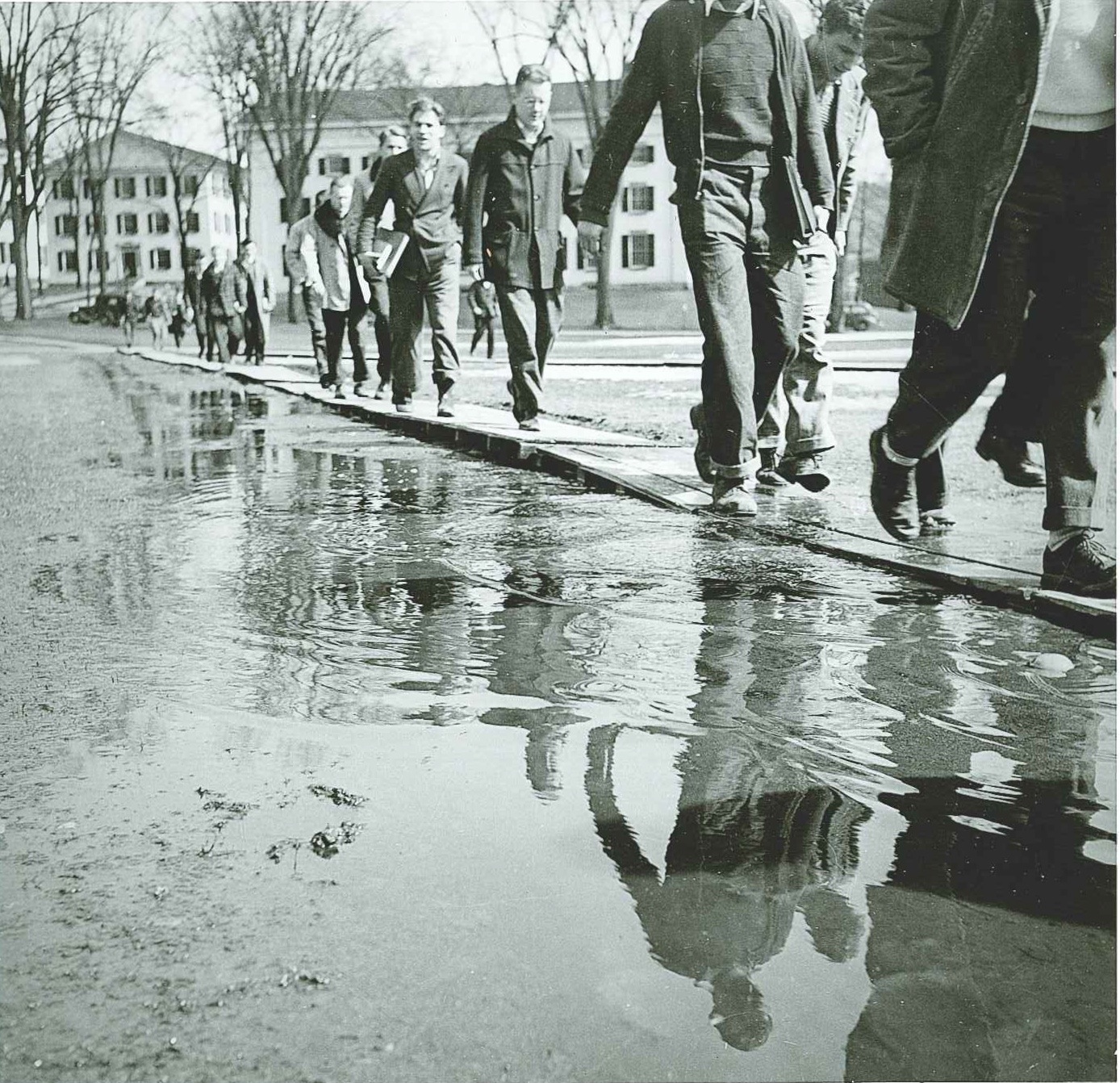
A series of men walking along boards to avoid standing water on the ground.The Chinook-like wind that swooped in yesterday briefly made the Green "mud-luscious and puddle-wonderful," as e e cummings might say. But we are lucky: the Green now drains pretty quickly. It was not always so. For most of Dartmouth's history mud season turned the Green into a sloppy mess. To deal with the problem, every March from the 1880s until the 1950s, the College would lay down "duckboards" along the pathways on the Green. The narrow boardwalks kept students relatively dry and mud free on their way to class, but, if a particularly squirrelly student stomped hard, he could shoot water through the slats and soak anyone nearby. For a time there was even a dance, "The Duckboard Drag," held each March to celebrate the coming of Spring.

In the 1950s, the College installed a drainage system and the duckboards were retired, or should I say cremated, for they fueled at least one Dartmouth Night bonfire.

A photograph of men on The Dartmouth campus, walking along boards to avoid standing water.
To see more images, ask for the Photofile: Campus--Duckboards.

Tuesday, March 6, 2012

Nice Hats, Gentlemen - Play Ball!!!

A photograph of the 1866 baseball team.
1866 Baseball Team
Dartmouth first formed a baseball club in 1865, and the following spring fielded a team, the first one in any sport to represent the College in athletic competition. Beating two New Hampshire squads, Dartmouth was named the state champion. Luckily, Amherst College was in Massachusetts; that game we lost 40 – 10.

But, this is not going to be a chronicle of Dartmouth's baseball prowess!

Some years ago, while attending a Dartmouth football game with my family, my sister looked up from her knitting long enough to comment "I like Princeton's outfits better." Admittedly, Dartmouth's football uniforms probably have never been very fashion-forward, but the same cannot be said of Dartmouth's baseball attire, which, during the 19th century, was varied, creative and bold. Since it is the start of spring training, in those places where they actually have spring, and we're all packing away our winter clothes, let's take a look back at some of Dartmouth baseball's sartorial splendor.

A photograph of the 1880 baseball team.
Baseball Team ca 1880
A photograph of the 1884 baseball team.
Baseball Team 1884
A photograph of the 1888 baseball team.
Baseball Team 1888
A photograph of the 1890 baseball team.
Baseball Team 1890
Unfortunately, by the turn of the 20th century, the familiar gray flannel with DARTMOUTH arched across the chest became the standard - not very different (except perhaps in fiber content) from today’s baseball uniform…although the striped cap really makes the outfit!
A photograph of a baseball team from sometime in the 1890s.
Baseball team ca 1890s
Ask for the photo files on "Baseball" to see more.

Thursday, March 1, 2012

Not Suitable for Children

a cartoon of a goat perched on a rock, captioned "Financial News: Goat Milk is Higher than Ever."On March 2, the National Education Association is celebrating the birthday of Ted Geisel, aka Dr. Seuss. On that day, schools around the country will have guests coming in to read Seuss stories and some lucky students will lunch on green eggs and ham. Here at Rauner, you can reflect on the good doctor's beginnings. Geisel '25 honed his craft writing for the campus lampoon magazine, The Jack-O-Lantern and adopted his nom de plume after he was caught on campus with alcohol during Prohibition. Unfortunately, most of the humor in the Jack-O was written for college-age men in the 1920s and is not particularly suitable for elementary school students. But, here are two of his milder cartoons for your enjoyment on Dr. Seuss Day.

A series of cartoons showing fantastical animals including a goat-bird hybrid, a hoofed dog creature with three bears balancing on its back, and an elephant with only two legs, both ending in sneakers. The caption reads "Why is it when one sees animals like this one never has a gun along?"
If you want to see more, ask for the 1924-25 volume of the Jack-O (DC History LH1.D3 J3 vol. 17).

Friday, February 24, 2012

Formicariums

A black and white photograph of a man holding up an ant farm.Better known as ant farms, these transparent devices were introduced to the general public by Frank Austin in 1929 and patented in June, 1931. Austin, Dartmouth class of 1895, was an inventor and developed wide variety of gadgets and toys as part of his "Austin Workshop" for children.  The ant farms proved to be wildly popular.  During the peak of the ant farm craze in the 1930s, Austin and his staff shipped more than 400 ant houses per day from his workshop in Hanover, NH.  In addition to ant farms, Austin also designed and built cricket houses, observational bee hives, and butterfly-rearing kits.

Despite the success of the ant farm and his other "housing" projects, it might be argued that Austin's most influential work was his involvement in the field of medical imaging.  In 1896, Austin, together with Professor Edwin Frost and Dr. Gilman Frost took the first American x-ray photograph of the human body when they imaged the wrist of Eddie McCarthy who had fallen while ice skating.

An x-ray of a wrist.
Eddie McCarthy's wrist
A black and white photograph of a man having his wrist x-rayed.
Eddie McCarthy being x-rayed
Austin's papers contain images, business correspondence, bills of sales and receipts related to "The Austin Workshop" as well as materials on his various inventions. The collection also contains several of Austin's short writings: "The Autobiography of Sir Lancelot by Himself," "Honey Bee," "Bumble Bees," "The Ants of King Solomon," "The Lazy Males of Antville," and other ant related pieces.

Ask for MS-186 to see Austin's papers as well as the photo file for "X-Ray".  A guide to Austin's papers is available.