Friday, March 9, 2012

Duckboards

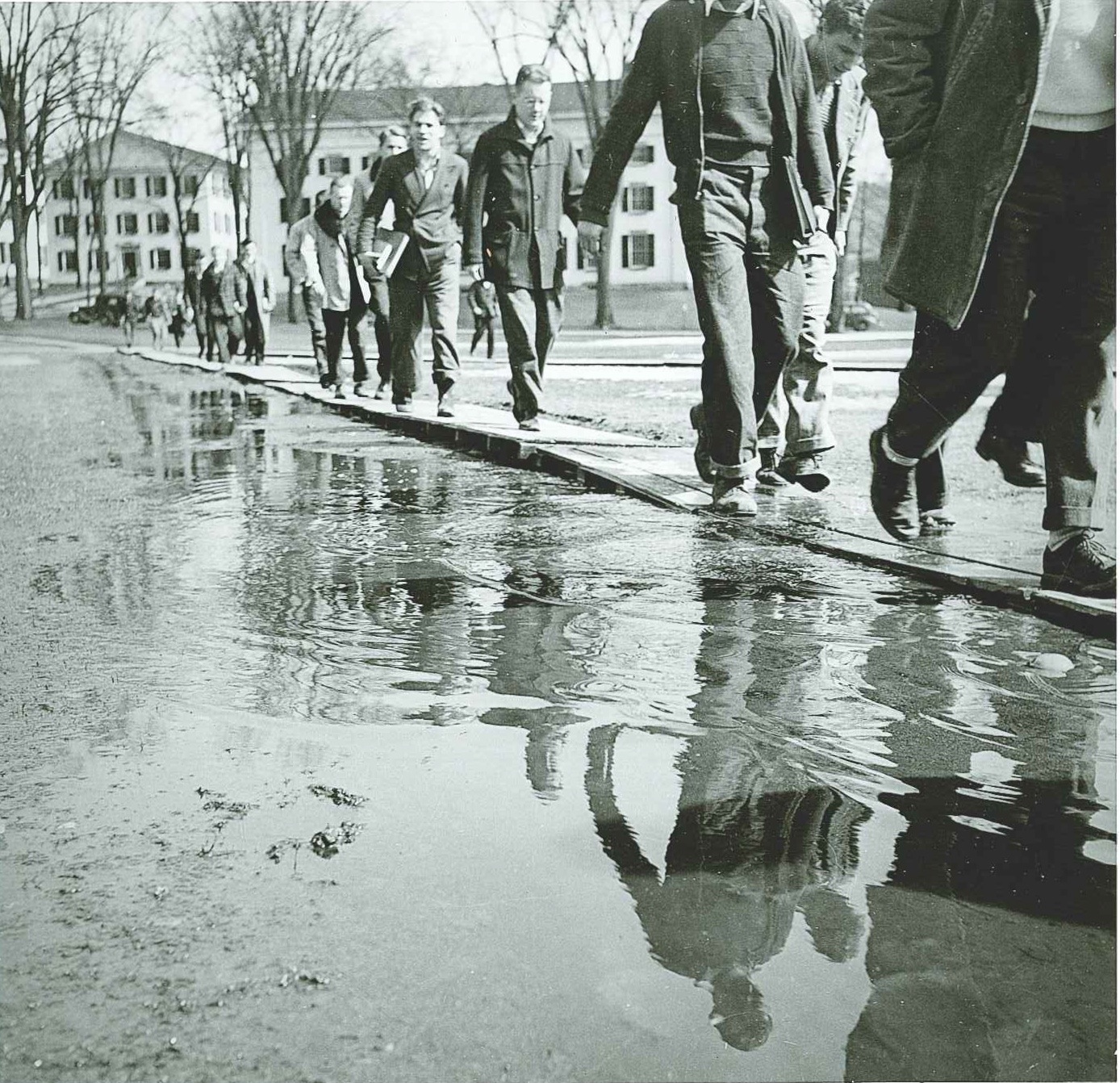
A series of men walking along boards to avoid standing water on the ground.The Chinook-like wind that swooped in yesterday briefly made the Green "mud-luscious and puddle-wonderful," as e e cummings might say. But we are lucky: the Green now drains pretty quickly. It was not always so. For most of Dartmouth's history mud season turned the Green into a sloppy mess. To deal with the problem, every March from the 1880s until the 1950s, the College would lay down "duckboards" along the pathways on the Green. The narrow boardwalks kept students relatively dry and mud free on their way to class, but, if a particularly squirrelly student stomped hard, he could shoot water through the slats and soak anyone nearby. For a time there was even a dance, "The Duckboard Drag," held each March to celebrate the coming of Spring.

In the 1950s, the College installed a drainage system and the duckboards were retired, or should I say cremated, for they fueled at least one Dartmouth Night bonfire.

A photograph of men on The Dartmouth campus, walking along boards to avoid standing water.
To see more images, ask for the Photofile: Campus--Duckboards.

Tuesday, March 6, 2012

Nice Hats, Gentlemen - Play Ball!!!

A photograph of the 1866 baseball team.
1866 Baseball Team
Dartmouth first formed a baseball club in 1865, and the following spring fielded a team, the first one in any sport to represent the College in athletic competition. Beating two New Hampshire squads, Dartmouth was named the state champion. Luckily, Amherst College was in Massachusetts; that game we lost 40 – 10.

But, this is not going to be a chronicle of Dartmouth's baseball prowess!

Some years ago, while attending a Dartmouth football game with my family, my sister looked up from her knitting long enough to comment "I like Princeton's outfits better." Admittedly, Dartmouth's football uniforms probably have never been very fashion-forward, but the same cannot be said of Dartmouth's baseball attire, which, during the 19th century, was varied, creative and bold. Since it is the start of spring training, in those places where they actually have spring, and we're all packing away our winter clothes, let's take a look back at some of Dartmouth baseball's sartorial splendor.

A photograph of the 1880 baseball team.
Baseball Team ca 1880
A photograph of the 1884 baseball team.
Baseball Team 1884
A photograph of the 1888 baseball team.
Baseball Team 1888
A photograph of the 1890 baseball team.
Baseball Team 1890
Unfortunately, by the turn of the 20th century, the familiar gray flannel with DARTMOUTH arched across the chest became the standard - not very different (except perhaps in fiber content) from today’s baseball uniform…although the striped cap really makes the outfit!
A photograph of a baseball team from sometime in the 1890s.
Baseball team ca 1890s
Ask for the photo files on "Baseball" to see more.

Thursday, March 1, 2012

Not Suitable for Children

a cartoon of a goat perched on a rock, captioned "Financial News: Goat Milk is Higher than Ever."On March 2, the National Education Association is celebrating the birthday of Ted Geisel, aka Dr. Seuss. On that day, schools around the country will have guests coming in to read Seuss stories and some lucky students will lunch on green eggs and ham. Here at Rauner, you can reflect on the good doctor's beginnings. Geisel '25 honed his craft writing for the campus lampoon magazine, The Jack-O-Lantern and adopted his nom de plume after he was caught on campus with alcohol during Prohibition. Unfortunately, most of the humor in the Jack-O was written for college-age men in the 1920s and is not particularly suitable for elementary school students. But, here are two of his milder cartoons for your enjoyment on Dr. Seuss Day.

A series of cartoons showing fantastical animals including a goat-bird hybrid, a hoofed dog creature with three bears balancing on its back, and an elephant with only two legs, both ending in sneakers. The caption reads "Why is it when one sees animals like this one never has a gun along?"
If you want to see more, ask for the 1924-25 volume of the Jack-O (DC History LH1.D3 J3 vol. 17).

Friday, February 24, 2012

Formicariums

A black and white photograph of a man holding up an ant farm.Better known as ant farms, these transparent devices were introduced to the general public by Frank Austin in 1929 and patented in June, 1931. Austin, Dartmouth class of 1895, was an inventor and developed wide variety of gadgets and toys as part of his "Austin Workshop" for children.  The ant farms proved to be wildly popular.  During the peak of the ant farm craze in the 1930s, Austin and his staff shipped more than 400 ant houses per day from his workshop in Hanover, NH.  In addition to ant farms, Austin also designed and built cricket houses, observational bee hives, and butterfly-rearing kits.

Despite the success of the ant farm and his other "housing" projects, it might be argued that Austin's most influential work was his involvement in the field of medical imaging.  In 1896, Austin, together with Professor Edwin Frost and Dr. Gilman Frost took the first American x-ray photograph of the human body when they imaged the wrist of Eddie McCarthy who had fallen while ice skating.

An x-ray of a wrist.
Eddie McCarthy's wrist
A black and white photograph of a man having his wrist x-rayed.
Eddie McCarthy being x-rayed
Austin's papers contain images, business correspondence, bills of sales and receipts related to "The Austin Workshop" as well as materials on his various inventions. The collection also contains several of Austin's short writings: "The Autobiography of Sir Lancelot by Himself," "Honey Bee," "Bumble Bees," "The Ants of King Solomon," "The Lazy Males of Antville," and other ant related pieces.

Ask for MS-186 to see Austin's papers as well as the photo file for "X-Ray".  A guide to Austin's papers is available.

Tuesday, February 21, 2012

Socialism for the 1% or for 1 cent

A title page for "The Manifesto of the Socialist League."We recently complemented our outstanding collection of Kelmscott Press books with this simple publication annotated by William Morris and E. Belfort Bax. Unlike Morris's lavish Kelmscott productions, The Manifesto of the Socialist League (London: Socialist League Office, 1885) was designed and priced at a penny to reach the masses. For his Kelmscott Press books, Morris designed his own types, had them hand cut and cast, secured woodcut illustrations from people like Edward Burne-Jones, executed his own decorative borders, and printed it all on beautiful handmade paper. His books were critiques of modern industrialization and homages to an idealized past where workers were craftsmen closely connected to the fruits of their labors.

A detailed illustration of a man reading in a garden.
Physically, the pamphlet is a jarring contrast to the Kelmscott edition of The Works of Geoffrey Chaucer (Hammersmith: Kelmscott Press, 1893), but even more so when you see the receipt. Our copy of the Kelmscott Chaucer was originally purchased by C. F. Richardson, a member of the Dartmouth English department. The 1897 receipt shows that Richardson paid $160 for the text block, then an additional $104 for the deluxe binding produced at the Doves Bindery. Adjusted for inflation, that $264 is the equivalent of around $6,800 today.

A receipt for the Kelmscott Chaucer.
To see the pamphlet ask for Rare HX11.S63 M26 1885. For Morris's Kelmscott Chaucer, ask for Presses K299c.

Friday, February 17, 2012

A Song that Appeals to the Heart

An illustration of a young man and woman seated and leaning into each other on the desk of a ship. They are identified by the caption as Walter and Florence, subjects of a Charles Dickens story.
"Walter and Florence"
Among the many cultural innovations of the Victorian age, printed sheet music was one of the most widespread. The upright piano made it possible for most middle-class families to have musical entertainment in their own parlors. Printed music had existed since the dawn of the press in the fifteenth century, but lithography and mechanized production made sheet music available to the masses.

An illustration of a seated figure. Above him, two women hold a laurel. Below him, a man and woman hold the edges of a banner including the title "The Box Quadrilles."
"The Boz Quadrilles"
At the same time, while copyright protected an author's writing, there was no concept of licensing like we have today. Beloved characters from the novels of Charles Dickens lived on in songs inspired by his works, yet not necessarily authored - or authorized - by his pen. Much like today when we buy the soundtrack to a favorite movie, Victorian readers would sing songs that continued their literary experiences and contributed to their collective enjoyment of popular literature.

A title page with blue text titled "Poor Little Nell, A Song That Appeals to the Heart." A small illustration shows two men looking over the reclining figure of a young girl.
"Poor Little Nell"
See these items and other materials from the Dartmouth College Library's collections in the exhibit "Dickens at 200: Sketches, Curiosities, Expectations," which celebrates the 200th anniversary of Dickens's birth. The exhibit was curated by Laura Braunstein and will be on view in Berry Main Street until April 27, 2012.

Tuesday, February 14, 2012

Fashionable Valentines

A title page with a fold-out illustration of a courting couple.How do I address the one I love on this Valentine's Day? The question has haunted lovers for ages, but luckily, we are here to help with Richardson's New London Fashionable Gentleman's Valentine Writer, or, the Lover's Own Book for this Year Containing a Very Choice Selection of Original and Popular Valentines with Appropriate Answers (Derby: Thomas Richardson, 183-) and the companion piece: Richardson's New Fashionable Lady's Valentine Writer, or, Cupid's Festival of Love Containing All the Most Popular New and Elegant Valentines for the Present Year (Derby: Thomas Richardson, 183-).

Whether you are a humble cottager or a man of wealth, the proper verse (and response) is "adapted to all situations in life." Love, apparently, knows class.

A page of printed verse.

Come in and find your valentine's voice: for "the gentlemen," Rare PN6110.V35 R5, or, serving "the ladies," PN6110.V35 R53 1830z.