Friday, January 8, 2010

A Sign from Heaven?

A title page for "Kometographia, or, A Discourse Concerning Comets."The appearance of Halley's comet over North America in 1682 spurred Increase Mather to write his landmark work in the development of astronomy and empirical science in the British colonies: Kometographia, or, A Discourse Concerning Comets (Boston in New England: Printed by S.G. for S.S., 1683). Mather had published earlier sermons regarding comets, but here diverges from a purely religious interpretation of "blazing stars" by incorporating his own scientific observations while referencing Kepler, Hevel, Tycho Brahe, and Robert Hooke. In so doing he deftly combines his religious beliefs with the latest scientific theories and presents them in a form easily understood by a lay audience.

His mission is laid out in his note "To the Reader":
Some Worthy Persons having desired me to Write the History of Comets; I resolved (with Divine Permission and Assistance) to spend the spare hours of a few Weeks in an endeavour that way.

Tuesday, January 5, 2010

The British Are Coming!

A photograph of the title page for "The American Military Pocket Atlas," dated 1776 in pencil.And the British who came had to find their way around the wilderness that covered most of the Americas.  To do this they needed maps.  To fill this need Robert Sayer and John Bennet had a set of maps printed and bound together in a small atlas.

It was officially The American Military Pocket Atlas, but known as the “Holster Atlas” because it was more commonly carried in an officer’s holster.  Rauner’s edition is in the original marbled boards and shows wear consistent with use. This 8.75 x 5.5 inch book was printed in London for Sayer and Bennet in 1776, and contained the “maps that the British high command regarded as providing the essential topographical information in the most convenient form.”  It was intended for use by British army officers in the field.  An advertisement bound into the atlas states, that it was “calculated in its Bulk and Price to suit the Pockets of Officers of all Ranks.”

A photograph of the atlas cover, which has a leather spine and marbled boards.The idea for the atlas was suggested by Governor Pownell, then a Member of the British Parliament, but formerly the Governor of the Massachusetts Colony from 1757-1760 and later commissary-general of the British troops in Germany.  Initially opposed to the War with America he became a supporter of Lord North after the outbreak of hostilities.

The atlas claims to contain “Surveys and Topographical Charts being fit only for a Library” and, indeed, most of the maps were issued as separate items previous to their publication in this smaller format.

A photograph of an unfolded map titled "A Survey of Lake Champlain."
There are a total of six maps: North America, As Divided Amongst the European Powers, by Samuel Dunn; A Complete Map of the West Indies, Containing the Coast of Florida, Louisiana, New Spain and Terra Firma: With All the Islands, also by Dunn; A General Map of the Northern British Colonies in America by Sayer and Bennet; A General Map of the Middle British Colonies, in America by Sayer and Bennet (based on work by Lewis Evans); A General Map of the Southern British Colonies, in America, by Sayer and Bennet (based on a map by Bernard Romans); and A Survey of Lake Champlain, by Sayer and Bennet (based on a survey by William Furness Brassier).

Ask for McGregor 5 to use this atlas or view it online.

Thursday, December 31, 2009

Pope's Iliad Revisited

A printed and signed receipt.About a month ago, we announced on this blog the acquisition of the first edition of Pope's translation of the Iliad. That copy was one of 750 printed for the original subscribers who funded Pope's work. We now have in our collection an interesting piece of physical evidence regarding that edition: a receipt for the Duke of Argyle's subscription completed and signed by Pope.

Some people may be surprised to learn that Pope was responsible for managing the subscriptions rather than his publisher. But it was not the book that the subscribers were sponsoring so much as the project. The subscriptions gave the nobility of England an opportunity to practice a kind of national patronage by paying Pope directly and funding him while he completed the translation. That it was Pope they funded, and the Iliad they desired to see wrought into English, shows how the nobility saw themselves, Britain, and the young poet. This was, after all, a country that traced its mythical roots to the Trojan War and was in the midst of building its own massive empire. A truly English version of the Iliad by the nation's most promising young poet was a project worth their attention and patronage.

Friday, December 18, 2009

Rudolph in Rauner

A cover for "Rudolph the Red-Nosed Reindeer."70 years ago, Montgomery Ward Company issued a small paper bound book to its various stores around the country.  The book was a promotional item to be given away for free to kids who came to see Santa Claus.  It was the story of a little misfit reindeer named Rudolph who turned the deficit of a large shiny red nose to an advantage and saved Christmas by leading Santa's sleigh through a foggy Christmas night.

The original story was penned by Robert L. May, Dartmouth Class of 1926.  May, a copywriter for Wards, whose wife was suffering from cancer, conceptualized the story for his daughter Barbara to lift her spirits.  May had always felt that he was a bit of a misfit himself.  He was small and weak, was never picked first for sports teams as a child and never excelled socially, even as an adult.  While his Dartmouth classmates went off to take high-powered jobs, he labored away as a lowly copywriter.  May said that he modeled Rudolph on how he felt about his own life.
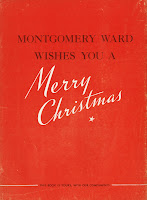
A red page reading "Montgomery Ward wishes you a Merry Christmas."May’s boss initially turned down the idea, but May persisted.  He went to his friend Denver Gillen in the art department and asked him to mock up the story. His boss loved the idea.  Wards began distributing the books on November 1, 1939 and quickly passed out 2,400,000 copies.

Production of the books ground to a halt during WWII, but Wards circulated them again in 1946, passing out an additional 3,600,000 copies.  During the writing of the story, May's wife passed away.  He later remarried, but was burdened by the debt he had accrued from his first wife's hospital bills.  At the end of the 1946 run, Wards decided they had milked Rudolph for all it was worth.  At the urging of a Vice President who knew of May's troubles, the Board of Directors turned the copyright over to May on January 1, 1947.
A typed letter on Dartmouth College letterhead.
But Rudolph was far from spent.  In 1948 an eight-minute animated film came out and in 1949, May's brother-in-law Johnny Marks composed the now classic song.  In 1964 the "Animagic" TV special Rudolph the Red-Nosed Reindeer aired for the first time.  It is still the longest running TV special in history.  In addition, May licensed hundreds of Rudolph properties including toys, pens, mugs, music boxes, pajamas and dishware to name just a few examples

In the end, May's own story was more like Rudolph's story then he would have guessed when he first sat down to write it 70 years ago.

Tuesday, December 15, 2009

Happy Charter Day!

A handwritten charter.Or Why We are Dartmouth College, not Dartmouth Academy or Dartmouth University - The Rev. Eleazar Wheelock was a very pious, and ambitious, man. On August 22, 1769, he wrote to John Wentworth, Governor of the Province of New Hampshire, forwarding a draft of the charter for the institution he hoped to establish. In the postscript he wondered if it would be possible to use the word College rather than Academy in the document. Apparently it was; on December 13th of that year, Wentworth signed the royal charter that did "by these Presents will, ordain, grant and constitute that there be a College erected in our said Province of New Hampshire by the name of DARTMOUTH COLLEGE."

In 1816, the state of New Hampshire passed "An Act to Amend the Charter and Enlarge and Improve the Corporation of Dartmouth College" which, among other things, called for an expanded board of overseers and renamed the institution Dartmouth University. Not surprisingly, the existing Board of Trustees felt the act did not improve the corporation and filed suit against the state. This case ultimately resulted in a U.S. Supreme Court decision in favor of the College which has had long reaching impact on contract law, and most likely on the name of the institution.

Friday, December 11, 2009

World War II at Dartmouth

A black and white photograph of men in uniform on the lawn.What was it like on the Dartmouth campus on December 7, 1941?  The idyllic campus setting was shattered by the news of the bombing of Pearl Harbor and the sheltered life of a Dartmouth undergraduate was about to be altered for the duration of the War and years beyond. 

Immediately following Pearl Harbor, college and university professors, students and administrators all over the nation joined or were called to military service and America's traditional four-year college experience became a casualty of war. With the draft age lowered to 18, many young men could not enroll in college - much less earn a degree - before entering the military. Adjusting to the consequent shortage of college-educated commissioned officers, the U.S. Navy developed a way to combine college education with military service: the Naval Indoctrination Training School and the V-12 Naval Training Program.

Dartmouth became host to the largest of the Navy's V-12 units. On July 1, 1943, some 2,000 enlisted men and an officer staff came "on board" at the College, including 300 students from Dartmouth and 74 from Thayer School. The College and its three professional schools accelerated their curricula and shifted to three-term, year-round operation. Fraternities closed, Winter Carnival was canceled, the Daily Dartmouth ceased publication and rationing was put in place. Civilian students were outnumbered three to one on campus. Run on military time, with reveille at 6 am and taps at 10 pm, Dartmouth operated like a naval base for the duration of the war.

Listen to descriptions of life on campus during the war from the undergraduates who were here and who went to war -- the "Greatest Generation" -- at "The War Years at Dartmouth: An Oral History Project."

Tuesday, December 8, 2009

Rauner Manuscript Codex 003203

A collection of photographs showing the cover and interior of an antiphonal.What is an antiphonal? How big could they make manuscript books in the 16th Century? What are some ways music was represented in the 16th Century? What might work well in a Harry Potter movie? We acquired an item that may answer several of those questions at once.

This antiphonal dates from about 1525-1575 and is approximately three feet by two feet. The original cowhide binding is sewn on seven bands of cords laced into wooden boards with decorative brass bosses with scroll-designed furniture and has two fore-edge metal clasps. The text is in Latin. The item presents staff notation with staves in red and bar lines in yellow.

Antiphonal, Antiphonary, or Antiphoner. Properly the Roman Catholic Church’s collection of traditional plainsong antiphons, but the use of the word has become more comprehensive and it now generally means the book containing all the traditional plainsong for the Divine Office, in distinction from the Gradual, which contains all the plainsong for the Mass.
(The Oxford Companion to Music, 9th ed.)

The Latin term antiphona was borrowed directly from Greek, where it meant the octave. In the first century C.E., antiphona was used in the East to describe singing of two choirs in alternation, one of men and one of women (presumably singing an octave apart), and subsequently it referred simply to psalmody consisting of the alternation of two choirs. By the 4th century, when the term was first used in the West and when St. Ambrose introduced antiphonal singing there, antiphona referred, as it has in general since, to a melody that accompanied the antiphonal singing of a Psalm.
(The New Harvard Dictionary of Music)

Rauner's BIG antiphonal.