Friday, April 21, 2023

The Philosophy of Botany

A detailed engraving of a sunflower next to a sunflower seed.As spring creeps in, we're taking a look at some of the more exuberant botanical books in our collection. Today, it's Robert John Thornton's 1799 The Philosophy of Botany, This volume contains an exploration (lavishly illustrated) of the different kinds of seeds one can observe in nature, the casings those seeds tend to come in, and the transformation of a seed into a plant. Later in Philosophy, the focus shifts to cross-sections of roots and branches. The illustrations become increasingly geometric and abstracted in attempting to show their audience a microscopic view of plant structure, until at the end they snap back out and devote several pages to recognizable, whole plants.

To see something lovely, come in and ask for Rare Book QK92 .T5 1799.

A series of engravings depicting various types of seeds.A cross-section of the root of a sunflower.A bean plant germinating from three different angles.

Friday, April 14, 2023

What to Take on a Hike

Page one of What to Take on a Hike
It feels like early summer today, so our thoughts turned to the outdoors. What better place to look for inspiration than the MacKaye Family papers (ML-5). In 1921, Benton MacKaye wrote an essay called "A Project for an Appalachian Trail." His audacious proposal gave birth to the AT which cuts right through campus. The proposal is very cool, but we got more excited by his four-page, single-spaced, typed list of "What to take on a hike." 

What better place to start than bacon: "I have tried the Deerfoot which comes all sliced, but find that it runs pretty fat, and prefer a straight flick." (If anyone knows what "straight flick" means when applied to bacon, let us know!) He also suggests a lot of cereal, condensed soups peanut butter ("the more granular sort"), and Swiss cheese as a special delight for the first few days.

For gear, there is of course a good knife, a compass, watch and map, but also a revolver. For clothing he has a lot to say about boots:

Heavy porpoise boots worn sufficiently to be already comfortable, fitted with long porpoise lacings, and heavy rubber soles reaching back to heel, and rubber heels. Great care needs to be taken in fitting this sole else it will peel off in the first day. It should be glued, kept under pressure over night and be riveted on besides. I am strongly opposed to hobnailed boots believing them practically useless and even dangerous besides heavy and uncomfortable. Incidentally they are not so nice for the other fellow when you accidentally tread on him.

Page four of What to Take on a Hike
Page three of What to Take on a HikePage two of What to Take on a Hike

In August the thru hikers start inhabiting the Green--making the trek in 1920s' gear sounds impossible, but the smell of bacon each morning would be nice!

Ask for ML-5, Box 97, folder 29, to get ready for your next leisurely.

Friday, March 31, 2023

Memorial Markers for World Fellowship

A card memorializing Julius and Ethel Rosenberg.The World Fellowship of Faiths in Albany, NH, was established in the late 1930s as a retreat focused on social justice issues. We've written a little about the World Fellowship before, but today we'll look at their "Save and Name a Tree" campaign. Cutting of the organization's pine and maple groves for lumber was "repeatedly urged" as a source of addtional funding, until the campaign began in 1943:

"We are reliably informed that about $3.50 is all that one of the World Fellowship's noblest, old, majestic pines would net us if slaughtered for lumber... we invite our friends to contribute Ten Dollars or More to Save a Tree and to place upon it, permanently, a small, modest marker bearing the tree's name (determined by the donor) with the donor's name and the date of his contribution."

The Charles F. Weller papers include mock-ups for the markers that would go on these trees. Most function as memorials, including beloved pets, family members, historical figures, and whole groups. Going through the markers is a fascinating peek into who and what members of the World Fellowship considered important in the 1940s and 1950s.

A small card memorializing "Clippy," a beloved dog.

To check out the markers, ask for Box 5 of MS-1295, the Charles F. Weller papers.

Friday, March 24, 2023

Happy New Year's Eve?!

Quaker document page 1Tomorrow is New Year's Day! Well, at least, it would be here in the former English colonies if not for an Act of Parliament in 1750 that firmly established January 1 as the start of the "New" New Year. This was a necessary law because of the widening discrepancy between the dates of the Julian calendar, which was only still used by England, and the Gregorian calendar, which had been in use by the rest of Europe since 1582. Fiercely Protestant at the time, England had rejected the Pope's calendrical fiat and stuck with the Old Style system.

Well, at least, partially; March 25th remained the first day of the legal year (akin to July 1 being the start of the fiscal year for some institutions like Dartmouth), but everyone generally accepted January 1 to be the start of the real New Year because of the need to synch up important celebratory dates with the rest of Europe. So, often, English documents from 1582 until 1750 used a double-dating system to note both Julian and Gregorian systems.

Moreover, by the 1750s, the two calendars were more than ten days out of sync with each other because of their use of different strategies to account for their system's inability to perfectly match the actual orbital cycle of the earth around the sun. 

Whew. Are you still with me? It's okay if not; all that's important for this post is that the British powers-Quaker document page 3that-be called a halt to the madness by instituting a multi-step changeover to the Gregorian system that was finished in 1752. Despite previous Protestant pushback against the Pope's preferred program, at least one group of dissenters saw the change as a chance to remind its followers about what they viewed as textual idolatry. In a broadside addressed to "The Quarterly and Monthly Meetings of Friends in Great-Britain, Ireland, and America", the group's standing representative body encourages its members to embrace the use of numbers instead of names for months and days so that they would no longer give "honor to the idols of the heathen."  The document then spells out the sources for all of those names. Although you're probably familiar with some of these attributions, some of them may be new to you. One detail that I had never really considered, but that makes perfect sense, is that Sept-ember, Oct-ober, Nov-ember, and Dec-ember are named after their previous chronological place in the Julian system (since February was the twelfth month of the year, not December!).

To read the entire document denouncing pagan months and days, come to Special Collections and ask for Presses F854f.

Friday, March 17, 2023

Llull's "Ladder of Understanding"

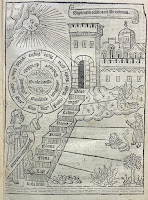
Woodcut of Llull's "Ladder of Understanding"This striking woodcut is found in the 1512 edition of Ramon Llull’s Liber de ascensu et descensu intellectus (Book on the Ascent and Descent of Understanding, written ca. 1305) that was printed in Valencia. It represents the “Ladder of Understanding” (scala intellectus) that Llull elaborates in this work. The particulars of Llull’s system are abstruse, but behind them lies the assumption that humans can, using their senses and intellect, understand the links between the created world and divine reality (Note: A full transcription and translation of the words found in this woodcut can be found at the bottom of this post).

The extraordinary Ramon Llull (c. 1232 - c. 1315) was born in Majorca. By his own account, he lived as a licentious troubadour before a series of visions convinced him to abandon his worldly life to serve God. Llull was particularly inspired to convert Muslims. He learned Arabic and deepened his knowledge of philosophy and other branches of knowledge.

It was on a mountain, the story goes, that God once again inspired him to write a book that would convert non-believers. “[Llull] came down from the mountain and … began to plan and write the book in question, calling it at first the Ars major, and later on the Ars generalis. Within the framework of this Art he then wrote many books … in which at great length he explained general principles by applying them to more specific things.” (Ramon Lull, A Contemporary Life, ed. And trans. Anthony Bonner (Barcelona / Woodbrige 2010).

This little book is one of the many expressions of Llull’s Art (largely logical in nature) – he wrote over one hundred works, including novels to alchemical works. His logical works, however, have sometimes earned him the status of pioneer in computational theory.

Description of the Woodcut:

There are three ladders depicted in the woodcut. The professor (bottom left), with a banderole that reads “Combined understanding,” has one foot placed upon the bottom step of the first ladder, and points to it with his right hand. With his left hand, he holds up the second and third ladders (the two concentric circles).

The first ladder:

Stepping from the bottom to the top, our intellect ascends (in understanding) first through stone, then fire, the plants, then animals, then man, then the heavens, the angels and, finally, God. The hierarchy is clear: the stone is most simple, and God is most complex.

The second and third ladders:

To understand the properties each of the steps on the first ladder, the professor holds up the second and third ladders (the two concentric circles), each subdivided into “steps” with words. 

It is perhaps easiest to understand these words as forming a conceptual rubric through which one can classify the properties belonging to a created thing. A stone, for example, might be classified as “cold, inert, passive,” and so on.  Using the conceptual rubric of the second and third ladders, one can range up and down the first ladder. Without using the proper concepts, Llull says, the intellect is ineffective in understanding. 

If we use the Llull’s Ladder of Understanding, we can enjoy serene contemplation in the Mansion that Wisdom Built for Herself (Sapientia edificavit sibi domum).

Llull’s conception of a chain linking the simple to the complex is not unique to him. See Great Chain of Being. To see our copy of Llull's Liber, come to Special Collections and ask to see Rare Book PA8360.L93 D4 1512.

This post was written by Daniel Abosso, Research & Learning Librarian for Humanities.


*****

Transcription and Translation for Woodcut:

Top banderole: Sapientia edificavit domum. Wisdom has built a home for herself. (Proverbs 9:1, paraphrased)

Bottom banderole (magister): Intellectus coniunctus. Complete understanding.

Scala i(n)tell(ectu)s — Ladder of understanding

Lap(is) - stone
Flam(m)a - fire
Planta - vegetable
Brutu(m) - animal
Homo - man
C[a]elum - heaven
Angelus - angel
Deus - god

Circular Diagram:

At center: Scal(a)e intellectus — Ladders of understanding

Outer circle (=second ladder), clockwise:

Ac(cide)ns - accident
S(ubs)t(an)tia - substance
Natura - nature
Actio - action
Passio - passivity (being acted upon)
Act(us) - actuality
Ens - being (existence)
Gen(us) - genus
Spe(cie)s - species
I(n)divi(duu)m - individual
(Com)positu(m) - compound
Simplex – simple

Inner circle (third ladder), clockwise:

Dubita(bi)le - Doubtable
Imagina(bi)le - capable of being apprehended by the mind
Sensibile - capable of being apprehended by the senses
Intellegi(bi)le - understandable
Credibile - believable

Friday, March 10, 2023

Call (Number for) the Midwife

Childbirth depicted in Ruff's De Conceptu
We have a lot of really amazing guides to midwifery in our collections. They are fascinating--all written by "expert" men for the use of women assisting other women in childbirth and tending to many of their other medical needs. There is a weird vibe to them: you always get the feeling the users of the books were better informed than the producers.

Reproductive system from Ruff's De Conceptu
Today we show off two of our favorites from the 16th century. The first is Jakob Rüff's De Conceptu et Generatione Homminis (Frankfurt, 1580). We love this one for the images. The reproductive system looks like a plant producing a fruit--that seems fitting with a lot of early metaphors for reproduction. But it also has a great image of a birth. You'll notice the mother is being attended by a midwife, and off to the side are two gentlemen studying the stars to determine the child's fate. Good thing it was nighttime!

Title page to Birth of Mankind
The second is one of those survivals that gives you tingles. It was owned by two different midwives. Susan Aylett laid claim to it on the title page, and Elizabeth Fiss used the back flyleaves of our copy of Thomas Raynalde's The Birth of Mankind (London, 1565) as a record of births. She has listed each in the name of the father not the mother, for example, "Thomas Lucas his wife of" followed by three hash marks. There is also a big fat inky thumbprint on in the margins of the "Prologue to the women readers." We're dying to know if that was just a sloppy mistake in the printing office or if Elizabeth or Susan or left more evidence of their lives behind in this book. 

Midwife's notes in back of Birth of Mankind

Thumbprint in Birth of Mankind
To see them, ask for Rare RG91 .R27 and Rare RG91 .R9.

Friday, March 3, 2023

Cymbal Scion

Photograph of Robert Zildjian examining a cymbalFour hundred years ago, in the city of Constantinople, an alchemist named Avedis discovered a revolutionary means of treating alloys. Avedis belonged to a family of metalsmiths and cymbal-makers, and his innovative process immediately became a closely-guarded secret that was passed down from father to son over the centuries. Today, the family business is thriving: it is the oldest manufacturer of musical instruments in the world, one of the oldest continuously operating global companies still in existence, and the largest cymbal and drumstick maker in the world. The organization is still family owned and operated, and does business under the surname originally bestowed upon Avedis by the Sultan of the Ottoman Empire: Zildjian or, in Armenian, "Family of Cymbal Smiths". Numerous legendary 20th-century drummers use or have used Zildjian cymbals, including such musical luminaries as Buddy Rich, Gene Krupa, Ringo Starr, Keith Moon, Neal Peart, Dave Grohl, and many others.

Interestingly enough, one of the scions of the house of Zildjian attended Dartmouth College before returning to the family business. Robert Zildjian was a member of the class of 1945, where he majored in History and Philosophy, was a member of Chi Phi fraternity, and participated in Le Cercle Francais. In 1981, after a dispute with his brother over the company, Robert left the Avedis Zildjian Company and founded Sabian Cymbal in New Brunswick, Canada. Sabian Cymbal is today considered one of a handful of dominant cymbal makers, alongside Zildjian, Meinl, and Paiste. To read more about Zildjian, both the company and the man, come to Rauner and ask to see the alumni file for Robert Zildjian '45.