Friday, October 27, 2017

The Morning of...

Diary entry for January 1, 1865When Elbridge West Merrill returned to Dartmouth College on January 1, 1865, he was looking forward to a good year. He acknowledged that “the past year was the most marked of my life, the most varying between Good and Ill –fortune, pleasure and pain.” However, things were looking up. He had “formed many pleasant acquaintances at College” and he hoped “some enduring friendships.” His motto for the upcoming year was “Look not mournfully upon the Past. It comes not back again. Wisely improve the Present. It is Thine.”

Diary entry for April 13, 1865, quoted at length
And then came the morning of April 13, 1865, an entry bordered in black. “This morning the terrible news spread across the wires o’er our happy and even jubilant land that last evening the President had been shot down by the dastardly hand of an assassin in Ford’s Theater at Washington.” Merrill was stunned, like most of the country. “How can I describe the feelings, the emotions of that day…Never shall I forget that crowd of students that stood at the posts discussing the sad news.” Lincoln, he wrote, was an “honest,” “kind hearted,” “God-serving,” honorable and upright statesman.” Some had, however, been concerned for Lincoln’s safety when he traveled but everyone believed him to be safe in Washington. Merrill also worried that future “Northern statesman and generals” could be
thus pursued and struck down by Southern fanatics many of whom frenzied by their utter overthrow and excited to madness by the spirit of malignant revenge and hatred would be only too eager to gain an eternal name of infamy and gratify their hell-born desires by emulating the example of the execrable Booth.
Merrill continues for several more pages to put his thoughts, feelings and assessment of the situation down before returning to describing in detail his life at Dartmouth College. Unfortunately, Merrill’s life after Dartmouth was a series of mishaps and financial disappointment and he died at the age of fifty-three.

To read his diary ask for Codex 003345. You can learn more about his life after Dartmouth by asking for his Alumni file.

Tuesday, October 24, 2017

More Birch Bark

Concert playbill printed on dark birch barkWhat is it about these birch bark items in our collections that keeps us blogging them? First, a student blogged our copy of Red Man's Rebuke, then another wrote about our copies of Charles Fletcher Lummis's Birch Bark Poems. So, it is probably a bit redundant to feature our latest acquisition, a playbill for a sacred concert at the Crawford House on September 26th, 1886, in the heart of the White Mountains printed on birch bark. But it is just too cool to resist.

The concert got off to a suitably rustic start with the William Tell Overture, but would any of the other composers dreamed their works would be listed on tree bark? Can't you just picture the concert goers idly fidgeting with the chalky bark playbill during the concert? The temptation to slowly shred it surely overcame many--birch bark just begs to be torn along its grain--but luckily someone had the self restraint to preserve their copy, and it now joins our amazing White Mountains Collection.

It is not cataloged yet, but we will put up a link to the record when it is.

Friday, October 20, 2017

Illustrated Iberia


An engraving of the Iberian peninsula with hand-colored borders to mark the separate regions.
This week at Rauner Library, we hosted a high school class that was studying the history of Spain. That gave us an opportunity to explore the Bryant Spanish Collection at Dartmouth College. This phenomenal collection was begun in 1952 and now consists of over several thousand volumes of books in Spanish and books that reflect the culture and history of Spain. The collection was created by William "Junior" Bryant, class of 1925, with the assistance of Dartmouth's Associate Librarian Harold Rugg, class of 1906. Bryant had taken a class from Rugg during his student days at Dartmouth and had fallen in love with books as a result. Over several decades, Bryant worked with Rugg and his successor Edward Lathem, class of 1951, to curate an amazing gathering of texts that is rich in archeological works, histories of Spanish towns and institutions, dictionaries, travel guides, art books, philology, various ethnic groups within Spain, and geography.

While selecting materials for the Spanish class, we came across many fascinating items, including a A hand-colored engraving of the entire world, represented as two circles to portray both sides of the globe.pocket atlas that was printed in Madrid in 1711. The charming little volume is filled with fold-out illustrations and maps, most of which have been hand-colored with enthusiasm, if not with care. The map of Spain colorfully divides the country into clear regions, and there is a delightful map of the heavens that shows all of the creatures of the zodiac filling the sky. The engraving of the entire world includes a representation of California as an island and some random mountains above it, a signal that the reader's guess is as good as the engraver's or author's as to what awaits future explorers to the region. One of the high school students was struck by the fact that these images of the world would have been taken as fact for Spanish people of the 1700s, despite their many inaccuracies. For us, helping to provide these sorts of intellectual discoveries is even more exciting than finding a lost treasure among our stacks.

To explore Francisco de Afferden's Atlas Abreviando, come to Rauner and ask for Bryant G1015 .A3 1711.

Tuesday, October 17, 2017

Dear Peter Pan

Watercolor of pirate ship with Tick TockLess than a year after Peter Pan's debut in London, the play came to Broadway starring Maude Adams in the title role. She was a spectacular success, and the play helped to cement her reputation as one of the most popular actresses of her era. She was inundated with fan mail, very little of which made it into the collection of her papers here in Rauner. But, one thing she saved was a book of artwork made by a class from the Francis Parker School.

The cover letter is absolutely adorable:
Dear Peter Pan,
This is our Thanksgiving to you for the pleasure you have been to us for many days.
Letter from second graders to Peter Pan
What follows is the creative interpretation of the play by a class of second graders in 1906. We thought you would like to see a little of what they sent to Maude.
Collage image of children flying through the window

Watercolor of lost boys in the woods
 Watercolor of sword fight

 You can see the whole booklet by asking for MS-285, Box 1.

Friday, October 13, 2017

Protector of the Indians?

Frontispiece of De Las Casas's "A Short Account of the Destruction of the Indies," displaying violences committed against indigenous peoples by the Spaniards.
If you live in the Americas, there is a good chance that your country celebrated Columbus Day this past Monday. In the United States, the holidays of both Columbus Day and Indigenous Peoples' Day now uneasily occupy the same date on our calendar here in the United States. In some regions of the country, Columbus is seen in such a negative light that his holiday is not recognized at all. In particular, Alaska, Hawaii, Oregon, and South Dakota, do not formally celebrate Columbus Day.

The controversy over Columbus that has raged on social media this week, combined with a Writing 5 class on Monday that explored world-building through word and image, has us thinking about the early days of exploration by the Spanish government on this continent. One of the books that we used in the class was a 1598 edition of Bartolome De Las Casas's A Short Account of the Destruction of the Indies. De Las Casas was one of the first Spanish colonists to arrive in the new world; he immigrated with his father to Hispaniola with he was about eighteen years old. De Las Casas was originally a slave owner who controlled an estate that garnered him profits via the encomienda labor system, which gave the beneficiary the legal right to own a number of indigenous
An engraving that depicts Spaniards burning indigenous people to death in a house while an indigenous women is hanged from a tree outside the building.
people in exchange for protecting Spanish interests in the region. He and his family knew the Columbuses because they had sailed with them to the Americas; Diego Columbus, Christopher's eldest son, was the Governor of the Indies during De Las Casas's time in Hispaniola.

However, in his early thirties, De Las Casas had a change of heart; he had witnessed the atrocities visited upon the indigenous community by their Spanish overlords, and was deeply troubled by the abuse and exploitation he witnessed. In 1515, he gave up his slaves and his resulting profits from their labor and instead began to advocate on behalf of the indigenous population in the Spanish Americas. He eventually entered the Dominican order and became a zealous proponent for ending the physical abuse and cruel treatment of native peoples. Ultimately, De Las Casas would be appointed to the administrative office of Protector of the Indians and serve as a liaison, advisor, and advocate for indigenous peoples and the rulers of the Spanish colonies. De Las Casas was by no means a singularly heroic figure; he had many flaws, including a belief in slavery as an acceptable practice that stayed with him for many years. Still, he made some small advances in a more humane official approach to treatment of colonized people by the Spanish government.
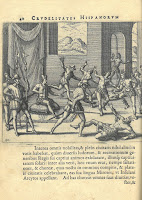
An engraving that depicts Spaniards overthrowing indigenous leadership
A Short Account of the Destruction of the Indies was one of De Las Casas's most powerful writings, sent to King Philip II of Spain after its publication in 1552. De Las Casas intended the book to be a wake-up call to the Spanish people because he feared for the state of their souls if they continued their abusive and exploitative treatment of other cultures. The already controversial text was later independently illustrated by a Dutch Protestant, Theodor de Bry, whose graphic depictions of horrific violence enacted by the Spanish soldiers shifted the emphasis of the text from jeremiad to anti-Spanish propaganda.

To see more of de Bry's engravings, or to engage with De Las Casas's argument in Latin, come to Rauner and ask to see McGregor 33.

Tuesday, October 10, 2017

The "Nansen passport"

Nansen passport circa 1929
"Nansen passport." From
United Nations High Commission for Refugees,
Nansen Centennial, 1961.
Although he started out his public life as an explorer, Fridjtjof Nansen was also renowned for his humanitarian work, especially his efforts in the various refugee crises that erupted after the First World War.

Nansen earned early fame as the leader of the first team to cross the interior of Greenland - he skied across in 1888 - and for his attempt to reach the North Pole. Though he didn't quite make it to the Pole, he came within a few degrees - again skiing the final leg of the journey. We've blogged about the ads that filled out his serialized Farthest North.

During his work for the League of Nations, Nansen was deeply involved in resettling Russian refugees following the Revolution. One of the innovations he introduced was the "Nansen passport," an identity document accepted by numerous governments which granted displaced and stateless people the ability to travel across international borders. For this and other efforts he was awarded the Nobel Peace Prize in 1922.

Though most of Rauner's Nansen material focuses on his polar explorations, we do hold a few items related to his humanitarian work, including a letter to Gilbert Murray from 1926 in which he discusses "the saddest affair I have ever been connected with." Though Nansen doesn't specify the subject, he may be alluding to his work resettling Armenians following the attempted genocide by the Ottoman Empire.

Nansen letter to Gilbert Murray, March 1926

A guide is available for Stef Mss-156.

Tuesday, October 3, 2017

Scattered Poetry

Close up of a page from Fragments of Light showing cut circles of silver mylarWe previously blogged a truly spectacular manuscript Sufi prayer book. We were taken by it as a physical manifestation of the mystical teachings of Sufism. It now has a modern companion that complements it by scattering light and text in a translation of Rumi's poetry.

Vincent FitzGerald cut out lines of Rumi's verse on shiny Mylar pages, then used a steel plate backing to anchor his Fragments of Light 4 (New York, 2009). The result is a play of light and poetry that both "mirrors" the poems and reflects the reader (and photographer!) onto them.

Two-page spread of Fragments of Light showing mylar reflection
Come take a look by asking for Presses K298rufr.