Friday, November 4, 2022

What in the Blazes?

First page of the statutes of the Society of Self-WatchersIn my work I often come across curious or odd organizations. They are usually created by men who are trying to exclude and/or control other members of society. The one I came across today, however, was created so that its members could police their own behavior. Let’s hear it for the "Society of Self-Watchers". What are they watching themselves for, you may ask? Profane swearing, which is defined as "swearing that constitutes sin and shows a lack of respect for all things held sacred".

There is actually a long history in the West of legalistic attempts to protect society from blasphemous utterings. Laws were put in place beginning with the Profane Swearing Act in England in 1694, and followed by the Profane Oath Act in 1745, which was not repealed until 1967. The United States had similar laws that fined people for profane swearing in public. The state of Virginia, for example, did not repeal its profanity law of 1792 until 2020.

The Society of Self-Watchers was founded in Hanover, New Hampshire on February 16, 1856. The group created a preamble and resolutions that declared that "the sin of profane swearing is a vice so mean and so low that every person of sense and character will detest and despise it".

In addition, they resolved to:
...acknowledge the higher authority of him who has commanded “Thou shall not take the name of the Lord thy god in vain for the Lord will not hold him guiltless that take his name in vain.”and feeling the need of every possible restrained and protection against and unmanly and sinful habit so sadly formed, we do together agree to form ourselves into an Association of principle and practice opposed to the sin of profane swearing and do take for our watchword and motto, the precept of Christ our Savior, “Swear not at all”.

Ten specific resolutions follow this preamble that advise the members to be vigilant of their own behavior, including:

Resolved, that should we ever hear of one of our company using deliberately or hastily a profane word we will kindly remind him of our agreement by repeating to him our watchword "Swear not at all".

Resolved, that we will receive kindly any similar report from our companions or from any other persons if we ourselves in any matter violate the principles we hear profess.

The members of the Society of Self-Watchers vowed to hold steady in their conviction with God’s help even when ridiculed. The agreement was signed by forty-six Hanover men.
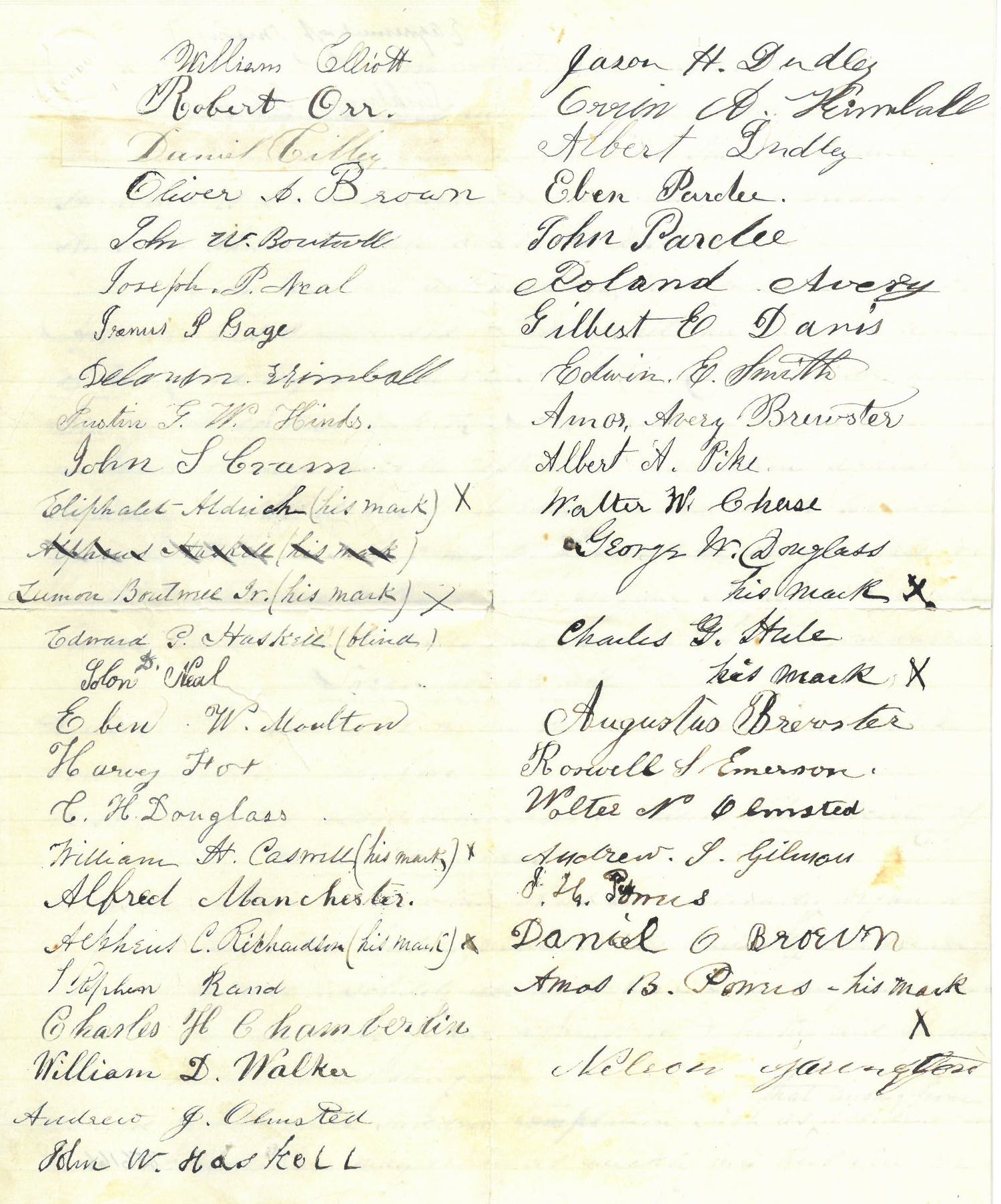
Signatures of the members of the Society

To read their resolutions, come to Special Collections and ask for MSS 856166.

Friday, October 28, 2022

Dracula at 125

Image from Gorey's illustrated edition of Dracula
This year marks the 125th anniversary of the publication of Bram Stoker's Dracula. First released into the world in 1897, Dracula is a gothic horror novel that solidified the concept of the vampire in English literature, building on the 19th century's previous forays such as John Polidori's The Vampyre (1819), James Malcolm Rymer's penny dreadful Varney the Vampyre (1845-1847) and Sheridan Le Fanu's novella Carmilla (1871-1872). The story, told in epistolary format, begins with a young English solicitor named Jonathan Harker traveling to the Carpathian Mountains to assist the mysterious and aristocratic Count Dracula in purchasing a new home near London. It's not long before Jonathan comes to realize that he is trapped in the Count's castle, and that his host may not be human... 

The novel is remarkable for its conflicted and complex depictions of gender and sexuality, played out in the characterization of both the monster and the heroes. Its not-so-complex depiction of race and foreign peoples marks it as a piece of invasion literature, where a colonizing population faces the anxiety that they will in turn be colonized. Count Dracula makes his way from Eastern Europe to London and begins to exert his influence over its more vulnerable inhabitants, spreading like a disease and reflecting Victorian fears about blood "purity." These themes feed into Dracula's status as one of the most influential horror stories of all time, and its impact on the genre continues to be relevant today.

Stoker himself had a lifelong love of the theater and spent nearly thirty years working for the English stage actor Henry Irving. With that in mind, today we're highlighting a book of plans replicating the Broadway version of Dracula designed by the master of the humorously macabre, Edward Gorey. The plans are intended to be cut out and assembled into a toy theater, though we've declined to take that step.

Come ask for Illus G675dra and take a look yourself. Happy Halloween...

Thursday, October 20, 2022

Days of Caring

Jens Larson, Architect, sketch of Dick's House
We have all been through a lot and the campus community is shaken. This Friday, October 21st, has been designated a Day of Caring. Classes are canceled, the Library is operating on skeletal staffing, and many campus services are curtailed to give everyone an opportunity to step back and take care of themselves.

"Squeeze It" Poster commorating John Kemeny's actions after Kent State

Dartmouth has seen tough times before. To mark the day, two students, Sabrina Eager '23, and Kira Parrish-Penny '24, looked back through the archives to find other instances where the Dartmouth community came together after a tragedy with a compassionate response that made the campus a better place: the establishment of Dick's House in 1927; the response to the shootings at Kent State in 1970; and the memorial tributes to Karen Wetterhahn after her death in 1997. Sabrina and Kira have put together a pop-up exhibit that we will have out on Friday the 21st from 10:00-3:00 in our reading room. Please stop by.

Lab book from one of Karen Wetterhahn's students


Friday, October 14, 2022

New Exhibit: "Indigenizing an Institution"

On Monday, October 10, 2022, students belonging to the group Native Americans at Dartmouth (NAD) hosted a gathering on The Green in honor of Indigenous People's Day. Members of NAD distributed signs, read speeches, and presented poems to the 150+ individuals in attendance. The mood was somber, as students reflected on the historical oppression of Indigenous peoples as well as modern forms of violence enacted against their communities. However, the event was also celebratory, as members of NAD, or "NADs", emphasized the resilience of Indigenous peoples and their distinct cultural practices. 

The style of assembly was not unique - in fact, Native students have orchestrated numerous events with the objective of raising awareness for Indigenous issues over the decades. Specifically, the past 50 years have witnessed NADs utilize petitions, demonstrations, symposiums, and more to share their concerns with others and advocate for pan-Indian causes. Commonly, such events were intended to counteract pervasive and harmful imagery, language, or "traditions" on campus related to Native representation. in other instances, such as the protests against Dartmouth's controversial investment in Hydro-Quebec, the tenacity of NADs ultimately benefited others. 

Despite The College's foundational promise to educate Native youth, such affairs were neglected by the school for nearly 200 years, cultivating an environment that was hostile towards Indigenous peoples. By 1970, only nineteen Native students had graduated from Dartmouth, which likely contributed to the general disregard for Indigenous peoples and customs by others on campus. However, the re-dedication of the institution's commitment to instruct Native pupils occurred around this period, precipitating record numbers of Indigenous students matriculating at the college. In recent years, Indigenous voices (with the assistance of their allies) have been instrumental in producing positive change at Dartmouth, especially as it pertains to the Native community. 

Our Lathem Special Collections Fellow, Sydnie Ziegler '22, has an exhibit called "Indigenizing an Institution," which aims to showcase the actions and achievements of Indigenous student advocacy since the 70s. It will remain on display in the Rauner Library foyer from October 10th through the end of November (Native American Heritage Month).

Friday, October 7, 2022

The Art of Gunboat Diplomacy

Depiction of four American soldiers and their uniformsIn 1853, Commodore Matthew Perry steamed into Japanese waters with an impressive display of force. Four gunboats and a crew of soldiers demanded that Japan end its centuries-long isolation and open its borders to trade with the United States. It was a show of imperialist-minded moxie that rattled Japan.

Depiction of American soldiers marching in formation
But there was also a fascination with these "Black Ships" and the odd manners, uniforms, and customs of the foreign power docked just off the coast, and a desire to spread the news of the wondrous visitation attracted Japanese artists. They created a series of "Black Ship Scrolls," long hand painted scrolls that depicted Commodore Perry's uninvited visit to Japan.

We are fortunate to have one of these scrolls. It is an impressive sight--to us perhaps more impressive than Perry's gunships. The scroll is forty-six feet long on fine Japanese paper. The most stunning panel shows the ships at mooring, but the drawings of the soldiers and their uniforms show the exoticism of these foreign visitors. It is an intriguing artifact of a critical moment in Japanese and American history, where the United States flaunted its naval power to gain the concessions it wanted and Japan unwillingly began to open itself to the world.

To see all forty-six feet, ask for Codex MS 003505.

Friday, September 23, 2022

Exhibit: A Fighting Tradition

Exhibit posterThe Dartmouth College community has been involved in every one of the country's major military engagements, from as far back as the Revolutionary War all the way up to the recent conflicts in the Middle East. For centuries, Dartmouth men and women have carried on a storied tradition of valiant wartime service to the United States of America, serving all around the globe and in all branches of the military.

During the 2022 fall term, an exhibit curated by Ryan Irving '24, current president of the Student Veterans Association, explores this tradition. "A Fighting Tradition: Dartmouth in American Wars" will be on display in Rauner Special Collections Library's Class of 1965 Galleries until December 3rd.

As Irving's exhibit illustrates, this tradition has evolved over the years, as has the college's identity and the nature of its student body. In the first decade of Dartmouth's existence, its connection to war was primarily through alumni involvement. Over the course of the next two centuries, the college's participation in war efforts grew in scope and variety: it saw the creation of student military societies, facilitated the training of soldiers on campus, sponsored military support services, and allowed students to put their college years on pause to enlist.

National unrest over the country's involvement in the Vietnam War was reflected on campus by the formal elimination of ROTC sponsorship due in part to student protest. However, in the early years of James Wright's presidency, and because his influence at a national level, Dartmouth was afforded the opportunity to support the war effort in a new way: by welcoming veterans to campus as students, along with the wealth of experience and diversity that they brought with them.

To see the exhibit while it's on display, come by Webster Hall and visit the exhibit space on our mezzanine. To read more about the exhibit online, visit its website.

Friday, September 16, 2022

Representing Lust (and Chastity!)

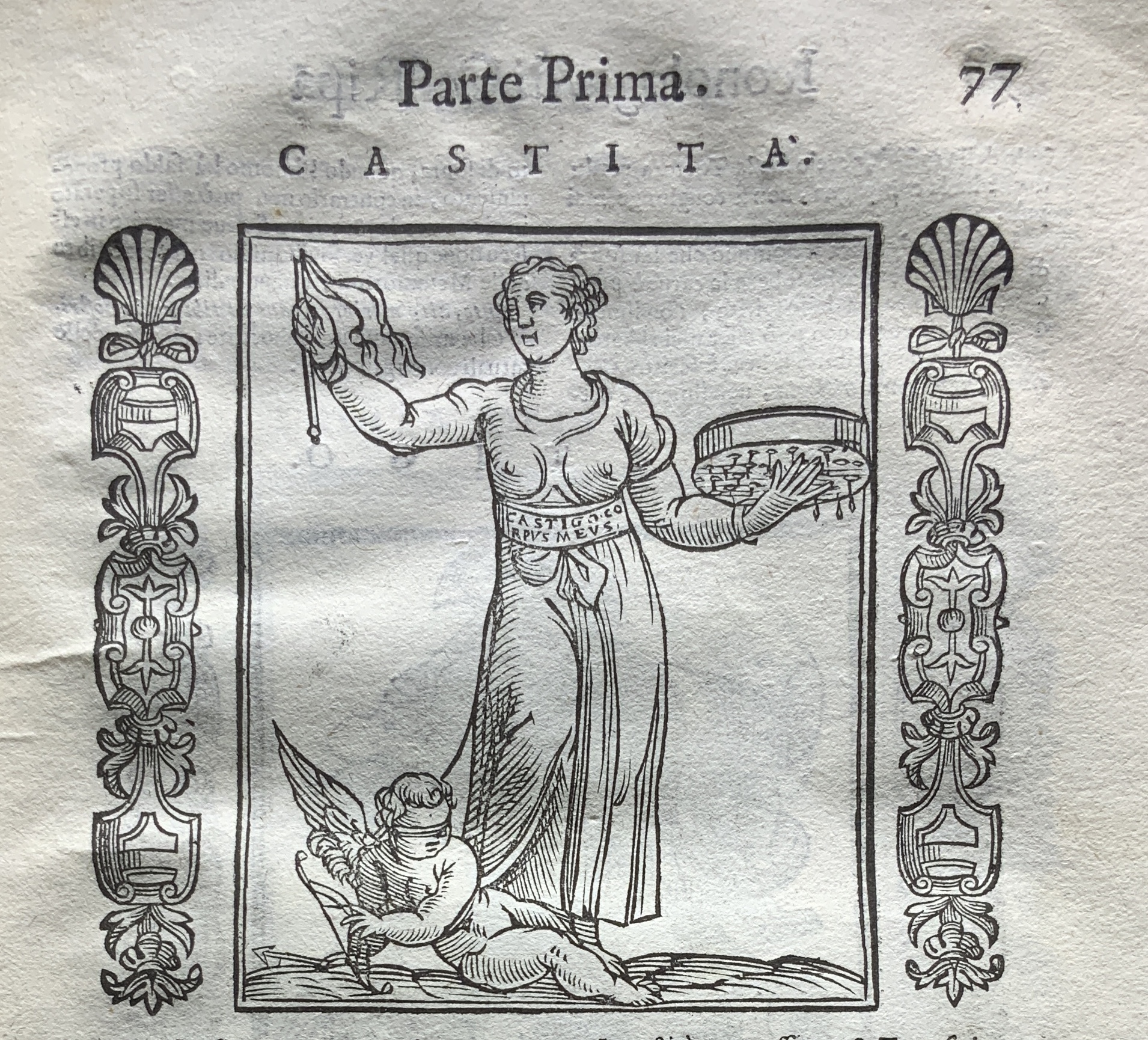
Woodcut image of ChastityThe use of emblems was popular during the Baroque time period in Italy and Europe in general, serving as a guide and source of inspiration for artists, poets, and sculptors when they were looking to creatively represent virtues, ideas, or even animals.

Cesare Ripa’s Noua Iconologia, printed in 1618, takes an encyclopedia-like format, alphabetically categorizing his emblems in multiple sections: Main Images (in 3 parts), More Notable Things, Animals, Colors and Metals, Gestures and the Human Body, Artificial Objects, Fish, and Plants. With each emblem description, Ripa also includes allegorical interpretations and references famous philosophers and writers of the time, whose interpretations of a particular object or virtue influenced his depiction of it.

Take the examples of Lust (Libidine) and Chastity (Castità). Ripa writes that the woman that symbolizes Woodcut image of Libidine Chastity in his emblem dresses in white to represent “the purity of the spirit, which maintains this virtue” (“Vestesi questa donna di bianco per rappresentare la purità dell'animo, che mantiene questa virtù.” (77).) and we see an association of colors with the value of chastity, but even more importantly, there is a suggestion that chastity leads to strength and truthfulness of character, as though someone who isn’t chaste is deceitful. Similarly, the emblem of Lust uses a particularly large amount of animal imagery, from beaks to panthers, all of which Ripa says symbolize lust, whose beauty “devours time, money, fame, body, and soul and spits it out becoming a slave to sin and the devil” (“Il che molto è simile alla Libidine, la quale con la bellezza ci lusinga, e tira, poi ci divora, perché ci consuma il tempo, il dannaro, la fama, il corpo, e l'anima istessa ci macchia, e ci avvilisce, facendola serva del peccato, e del demonio.” (312)). This, therefore, adds an element not just of deception, but of monstrosity and of sin, bringing in a religious element as well. Lust, according to Ripa, derives in women not even solely on a sexual level but also on the pursuit of fame and money.

All of this is to say that the use of emblems both had an impact on the time period’s interpretations of virtues, people, and things in the moment, as well as a longer lasting impact when the allegorical interpretation of these virtues are still seen in the present day depictions of values and morality.

To explore the woodcuts of Lust, Chastity, and many more, come to Special Collections and ask to see Rare N7740.R52 1618.

This post was originally written by Diana Alvarado '22 for Nancy Canepa's Italian 23 class, "17th and 18th Century Italian Literature".