Friday, May 19, 2017

One Genius Too Many

Title Page of Book, reading "An Historical, Physiological and Theological Treatise of Spirits, Apparitions, Witchcrafts, and other Magical Practices. CONTAINING An Account of the Genii or Familiar Spirits, both Good and Bad, that are said to attend Men in this Life; and what sensible Perceptions some Persons have had of them: (particularly the Author's own Experience for many Years.) Also of Appearances of Spirits after Death; Divine Dreams, Divinations, Second Sighted Persons, &c. Likewise the Power of Witches, and the reality of other Magical Operations, clearly asserted. With a  Refutation of Dr. Bekker's World Bewitch'd; and other Authors that have opposed the Belief of them. By Jonh Beaumont, Gent. Praestat aliqua probabiliter nosse de rebus superioribus & Caelestibus, quam de rebus inferioribus multa demonstrare. Arist. Moral. 9. London: Printed for D. Browne, at the Black Swan without Temple-Bar; J. Taylor, at the Ship in St. Paul's Church-Yard; R. Smith at the Angel without Temple-Bar; F. Coggan, in the Inner-Temple Lane; and T. Browne without Temple-Bar, 1705.
We've recently acquired an interesting text that was authored by an equally interesting individual. John Beaumont was an English physician and geologist who was an early member of the Royal Society, a learned society for science that was founded in 1660 and is still in existence today. Beaumont lived in a small town in southwestern England called Ston Easton, within the county of Somerset. Many of his geologic interests centered around the exploration of limestone caves near his home, and he wrote several letters to the Royal Society that provided information about his discoveries. Robert Hooke, the Society's Curator of Experiments and the author of Micrographia, encouraged Beaumont to pursue further study of the natural history of Somerset.
an engraving that shows An Evil Genius on the left, who looks like a bearded man wrapped in an animal skin; and "2 Good Genii" on the right, both holding what appear to be cornucopia and wearing laurel garlands. The left-most of the two appears to be a young child while the right-most is a bearded man.However, despite his interest in rocks and stones, Beaumont's true fascination was focused upon more ethereal subjects. In 1705, at the age of fifty-five, Beaumont published An Historical, Physiological, and Theological Treatise of Spirits, Apparitions, Withcrafts, and other Magical Practices. In particular, Beaumont was interested in discussing what he calls genii, or familiar spirits. Distinct from our modern understanding of jinn or genies, which have their origins in Arabian and Islamic mythology, Beaumont's concept of genii is more in keeping with ancient Roman religion. For ancient Romans, a genius was a sort of guardian angel or spirit that served as a personal protector for every individual. Our current use of the term to indicate someone of exceptional ability or talent derives from the early Romans' attribution of the accomplishments of great individuals to their extraordinarily powerful genius, or guiding spirit. 
An engraving captioned "Jews going out in the Moonshine to know their Fortune". The image is of four men holding palm fronds and gesticulating at a shining moon that is half-hidden behind some clouds.For Beaumont, the existence of genii was more than an abstract theoretical notion; in his book, he identifies himself as someone who had the dubious gift of "second sight," whereby he was able to see a vast multitude of spirits all around him at all times. Beaumont states that "this gift is very troublesome to those that have it, and they would gladly be rid of it; for if the object be a thing that is terrible, they are seen to sweat and tremble, and screek at the Apparition." Over a three-month period, Beaumont claims that he was attended night and day by two spirits, who spoke with each other and a number of other spirits who came calling at his bedroom door. The spirits were dressed in "Womens Habit, they being of a Brown Complexion, and about Three Foot in Stature; they had both black, loose Network Gowns, tyed with a black sash about their Middles, and within the Network appear'd a Gown of a Golden Colour, with somewhat of a Light striking thro' it; their Heads were not drest with Topknots but they had white Linnen Caps on, with Lace on them, about three Fingers breadth, and over it they had a Black loose Network Hood."
Beaumont's experience with these genii naturally caused him some consternation, given his predisposition towards natural science, and so he attempts towards the end of his text to provide rational hypotheses for the existence of these spirits as well as providing examples from Judeo-Christian theology. Ultimately, you'll have to be the judge of whether he makes a convincing argument or not. Come to Rauner and ask for Rare BF1445 .B4 1705.

Friday, May 12, 2017

Theater of Cruelty

Engraving depicting a scene of violence. A monk is shown being hung while a fire is built to burn bodies.The Reformation spurred a lot of books decrying the evils of Catholicism. Our collections are full of diatribes against Popish forces along with plenty of graphic illustrations of Protestant martyrs. The propaganda on both sides ran freely, but our collections seem to revel in the anti-Catholic. That's why we were pleased to pick up a counter reformation depiction of atrocities committed against Catholics--specifically focused on the plight of English Catholics as Great Britain flip-flopped between Protestant and Catholic power in the 16th century.

Richard Verstegan's Theatrum crudelitatum haereticorum nostri temporis (Antverpiae: Apud Adrianum Huberti, 1592), does to English Protestants what Foxe did to the Catholics. Together they will shake your faith in humanity, if not your faith. Come in and take a look by asking for Rare BR1600.V4 1592. For the other side, check out Foxe's Book of Martyrs by asking for Presses D334f.

Tuesday, May 9, 2017

Cocaine and Cuckoldry

An image of the front cover of David Garnett's first published book Dope Darling (written as Leda Burke). The image is of a young woman staring blankly out at the reader.
While answering a reference question for a researcher who couldn't visit us in person, we had the good fortune to encounter this little gem hiding among the other and seemingly more respectable volumes on our shelves. Although the author's name is Leda Burke, this little book was actually the first published novel of author David Garnett, who went on to write dozens of books including the prize-winning Lady Into Fox in 1922 and Aspects of Love in 1955. Garnett was a late addition to the Bloomsbury Group, a collective of English writers, intellectuals, philosophers, and artists that were especially active during the first half of the 20th century. The set's list of impressive members included Virginia Woolf, John Maynard Keynes, and E. M. Forster, among others. Most of the male members of the group knew one another from their time in university; they either attended Trinity or King's College while at Cambridge, and a significant number of them were members of the Cambridge Apostles, an exclusive intellectual society that was originally founded in 1820 by a student who went on to become the Bishop of Gibraltar.

The title page of Lady Into Fox" "Lady into Fox / By/ David Garnett / Illustrated with wood engravings by / R. A. Garnett / London / Chatto & Windus / 1922." There is a small woodcut of a man leading a woman by the hand as they go through a gate.
Garnett's entry point into the Bloomsbury Group was Duncan Grant, the cousin and sometime lover of Lytton Strachey, himself one of the founders of the Group. The two men met at a Christmas party hosted by Strachey in 1914; they soon became lovers and ran off to work a fruit farm together as conscientious objectors during World War One. In a scandalous but very Bloomsburian twist, Garnett would later go on to marry Grant's daughter Angelica, whose infant baptism he had attended as a young man of twenty-six. Angelica herself was a product of an affair between Grant and Vanessa Bell, the nominal wife of Bloomsbury artist Clive Bell and the sister of Virginia Woolf. Keeping track of it all tends to make one's head spin.

The title page of Nonesuch Press's "Love Poems of John Donne": Love Poems / of /John Donne / With some account of his / life taken from the writings / in 1639 of Izaak Walton / Soho / The Nonesuch Press / 30 Gerrard Street / 1923"For the book lover among us, though, we have reason to appreciate Garnett for more than his skill with a pen. He also ran a bookshop with Francis Birrell, unsurprisingly named "Birrell & Garnett," near the British Museum on Gerrard Street. It was in the basement of the bookshop that Garnett and his friends Francis Meynell and Vera Mendel founded the Nonesuch Press. The Press's first book was a volume of John Donne's Love Poems, printed in 1923. The Nonesuch Press was prolific for the next few decades and eventually came under the control of George Macy, founder and owner of the Limited Editions Club, before shuttering its windows for good in the 1960s.

Any blogpost that involves the Bloomsbury Group is liable to run on at length, given the myriad fascinating individuals who were a part of its heyday. We will restrain ourselves for now, but we encourage you to come in and and see our first edition of Dope Darling, also known as Val 827 G187 P5, which was given to us by the Friends of the Dartmouth Library. You can also look at our first edition of Lady Into Fox, which is Rare PR6013.A66 L3. To see the first Nonesuch Press printing of John Donne's Love Poems, also here at Rauner, ask for Presses N731do.

Friday, May 5, 2017

A Starry Messenger

Frontispiece to Galileo's Dialogo showing three characters in 17th century Italian robes in heated discussion Italian mathematician, astronomer, engineer, and philosopher Galileo Galilei played an incredibly vital role in the scientific revolution of the 17th century, especially through the publication of Dialogo sopra i due massimi sistemi del mondo (Dialogue Concerning the Two Chief World Systems). This work rigorously examines the astronomical observations of Copernicus and Ptolemy and seeks to answer the question of the true position of Earth amongst other celestial bodies in the universe – fixed at the center, or orbiting elliptically around the sun.

Although we take for granted that the latter has become established as the best-supported astronomical model for our solar system today, Galileo’s defense of heliocentric theory during the Roman Inquisition was met by enormous opposition from the Catholic Church and the papal administration. Found “vehemently suspect of heresy” for his Dialogue critiquing the geocentric view held by the Church via literal interpretation of the Holy Scripture, Galileo was forced to recant his support for heliocentric theory and condemned to house arrest for the remainder of his life.

However, his trial catalyzed an enormous scientific movement, which grew to champion empirical observation and experimentation in the pursuit of new knowledge, abandoning blind faith in the philosophies and idealizations of Greek and Roman antiquity.

The dialogue features an impassioned debate between three fictionalized characters as they critically analyze the merits and shortcomings of both hypotheses, providing diagrams, calculations, marginal notes, and an enormous wealth of conversational rhetoric to support their respective views.

Join the Dialogue by coming to Rauner to thumb through Galileo’s prose! Ask for Val 520 G133d.

Posted for Jerrel Catlett '18.

Tuesday, May 2, 2017

Case Study in a Fully Functioning Government

Situated remotely in Bretton Woods, New Hampshire, the Mount Washington Hotel opened its doors in July, 1902, boasting that it could accommodate "a family of eight hundred." Families could travel by rail or motor roadway to spend their summers in the White Mountains, “an ideal environment” that boasted weather “cool enough to enjoy outdoor exercise practically every day throughout the season.” Yet only three decades later, the Mount Washington Hotel experienced severe financial difficulties brought on by the Great Depression. Then, shortly after the United States entered the World War II, the hotel closed for several years. It reopened in 1944 under new ownership, but its future was uncertain.

It was in this context that an unusual group requested rooms for some 730 guests in the summer of 1944. But unlike most visitors, “mountain interests” were not of “first importance” to this group. Rather, these were delegates of 44 Allied nations gathering at Bretton Woods for the United Nations Monetary and Financial Conference. The express purpose was to construct the post-war international monetary system. In the words of New Hampshire Senator Charles Tobey, “We lived together for a little over three weeks, as we hammered out the Bretton Woods Agreements into shape. There before us was the world in miniature…”

As a delegate of the United States to the Bretton Woods conference, Senator Tobey was determined that international cooperation would serve two purposes in the post-war world. First, immediate financial assistance and lowered trade barriers would “create conditions in which” people living in war-torn communities across the world could “be secure, and prosperous and free.” The financial difficulties during the interwar period, brought on by the Great Depression and compounded by protectionist trade barriers, obstructed economic security. People whose basic needs were not met looked inward toward leaders who would protect national interest at the expense of global peace. Multilateral institutions could achieve this end. The World Bank lent money to nations afflicted by war and poverty for reconstruction, and the International Monetary Fund (IMF) set stable exchange rates for member states to coordinate monetary policies and prevent “economic war [from engulfing] the world.” Second, international cooperation and American engagement would underwrite global security for future generations. Along with other multilateral institutions such as the United Nations and North Atlantic Treaty Organization, the Bretton Woods system gave teeth to the lofty idea of “permanent world peace.”

At the conference, Senator Tobey and the architects of the Bretton Woods system were trying to avoid the mistakes of the First World War that failed to prevent the current global conflict. American leaders believed they could not “withdraw within" as they had after World War One. A new era of global politics would require American engagement rather than immediate retrenchment. Also, Senator Charles Tobey and other delegates to the Bretton Woods conference remembered when the United States Senate did not ratify the League of Nations charter nearly three decades earlier. American leaders recognized that President Woodrow Wilson, a Democrat, signed the charter’s death warrant in excluding Republicans from the negotiating process. In reaching out to leadership from across the aisle, President Franklin Roosevelt hoped to avoid this fate. Senator Tobey, a long time Republican, was instrumental in achieving his party’s approval of the Bretton Woods system. Treasury Secretary Henry Morgenthau confirmed this view when he wrote to Senator Tobey before the bill went before the Senate floor: “I know that your enthusiastic support of the Bretton Woods proposals will serve to promote non-partisan consideration… I fully appreciate the enormous efforts that you have made to keep this legislation from becoming a party issue.” Senator Tobey indicated his ready cooperation toward this achievement when he proclaimed, “The battle for the future of our whole generation is being fought in the Senate of the United States - the battle against both political and economic isolation.”

To learn more, ask for ML-3, Box 108. And for more goodies from Tobey's papers, see our blog post on Crackpots and Cranks.

Posted for Drew Leonard '19

Friday, April 28, 2017

Your Next Travel Dictionary: The All-in-One Guide for the "Speedy Learning of the Italian Tongue"

Frontispiece to Florio's Queen Anna's New World of Words. Floio is depicted in Elizabethan clothing in an oval frameIf you’ve ever wondered how to say “mouthful” in Italian, you might want to consult John Florio’s Queen Anna’s New World of Words, a hefty Italian-English dictionary written in 1611. There you’d be delighted to find that the 17th century Italians called it a “boccata,” which Florio translates as:
A mouthful, a mouthing. Also a word used when one is about to tell a thing and knows not what it is, or that a scholar would feign read his lesson and cannot, and we by some sign or voice would let him know that is out, and says he wots not what, we use to say Boccata, as in English, Tush, yea in my other hose, jump as Germans lips, and such other phrases.
What a mouthful! In defense of Florio’s verbosity, this definition is a significant improvement from the 1598 edition, which includes “you are as wise as a Waltam’s calf” as an acceptable alternative to “mouthful.” I hesitate to recommend the 1598 edition in fear that, if you did in fact call someone as wise as a Waltam’s calf, you might be accused of being behind the times. To avoid the unpardonable blunder of outmoded usage, the updated 1611 edition is the only way to go—and, what’s more, it comes with a complete guide to Italian grammar, which Florio borrowed (plagiarized) from his father! If it’s good enough for Queen Anne and the English cosmopolitan élite, it’s good enough for you. If you weren’t wondering how to say mouthful in Italian, Queen Anna’s New World of Words has 74,000 other fascinating Italian words, translated into beautiful, albeit long-winded, English.

John Florio, son of a Protestant Italian émigré during the Roman Inquisition, was a linguaphile, polyglot, translator, and high-profile language instructor who lived in London. His English translations of Montaigne’s Essays and Boccaccio’s Decameron from French and Italian are canonical, and his groundbreaking bilingual dictionaries confirmed his status as cultural mediator. He considered himself an Italian, though he never set foot on what today would be considered Italian soil. He snobbishly turned his nose up at English culture (not recommended for beginning travelers), which he considered barbaric and uncouth. Italian, in Florio’s day, was a sort of lingua franca, an all-access-pass to European culture and courtesy. Florio penned two dictionaries, two language pedagogy books (also recommended), and numerous translations, marking the beginnings of Italian language acquisition as a symbol of status and refinement in England. His dictionary is said to have influenced Shakespeare, who set many of his plays in Italy. Some scholars even suggest that Florio was Shakespeare’s ghostwriter—a rumor I encourage you to spread. Within the 700 pages of Florio’s tome (pocket-size edition not currently available), you’ll find risqué words collected from the Index of Forbidden Books, curse words, insults, numerous words to talk about dogs, food words (buon appetito!), idioms, and cultural insights: everything you need to keep your Italian hip… in a Baroque way. So the next time you need to say “mouthful” in Italian, check out Florio’s Queen Anna’s New World of Words, or just point and gesture like all the other tourists.

Quote from "To All Readers" section of the preface. "To be a Reader, requies understanding; to be a Critike, judgement. A Dictionarie gives armes to that, adn takes no harme of this, if it mistake not. I with thee both, but feare neitehr; for I stil rest Resolute. John Florio"
Ask for Rare PC1640.A2 F6 1611.

Posted for Joseph Waring '18

Tuesday, April 25, 2017

Audubon's Prospective Patrons

The cover page of Audubon's Birds of America prospectus: "Under the particular patronage and approbation of his most gracious majesty. Birds of America, from drawings made during a residence of twenty-five years in the United States and its territories by John James Audubon, citizen of the United States...
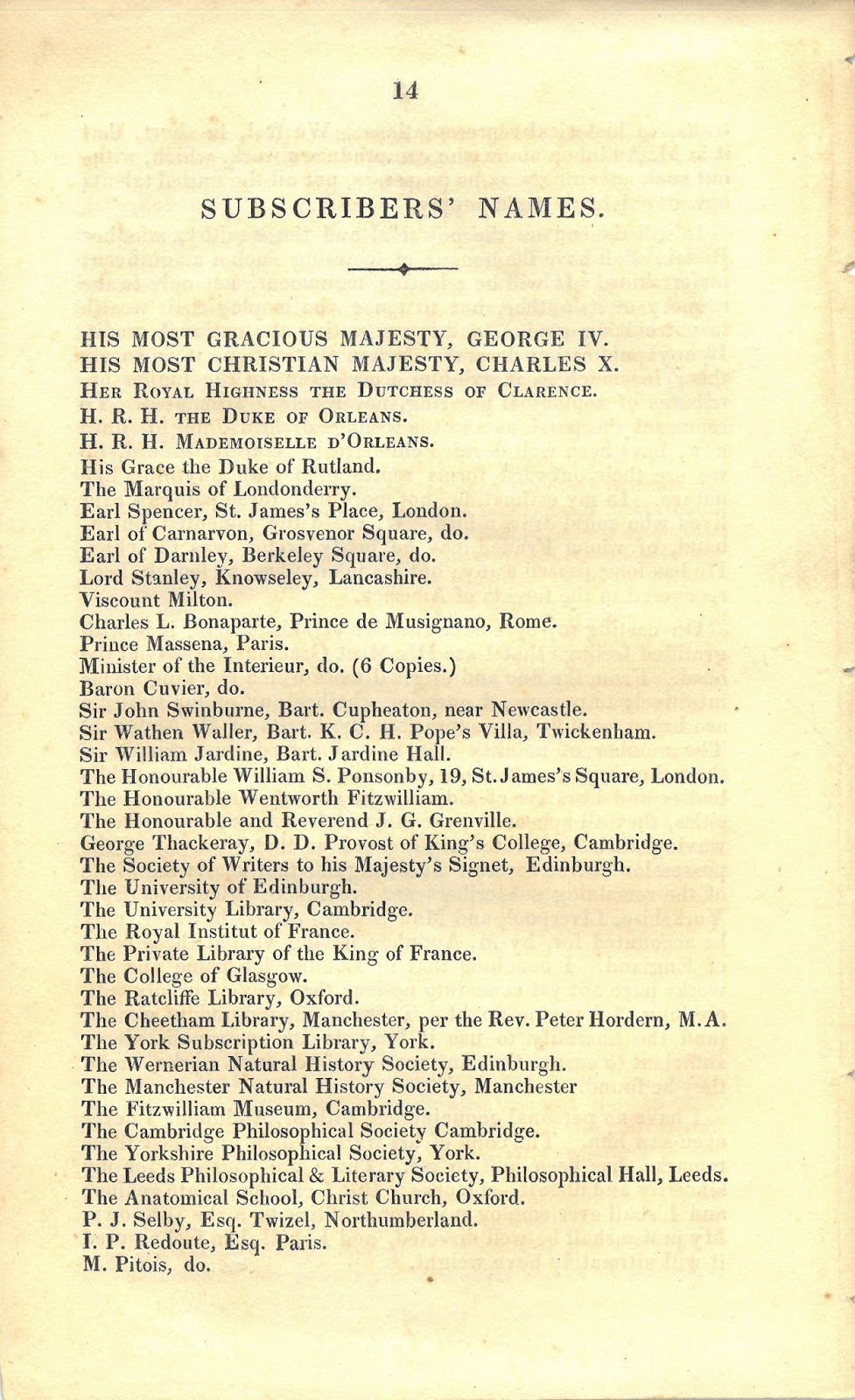
Tomorrow marks what would have been John James Audubon's 232nd birthday. Our copy of the famous naturalist's Birds of America, which once belonged to Daniel Webster, is the only item in our collection that is on permanent and prominent display in the Rooke Reading Room. Still, while the beautiful images of birds that fill this set of books are indisputably his most popular and memorable achievements, we here at Rauner hold another Audubon item that is a rarer bird than his well-known magnum opus. In 1826, Audubon had arrived in England to look for an engraver for his avian images. At that time, he began to give thought to the creation of a prospectus in order to advertise his book and acquiring dedicated subscribers to each successive number of plates. Audubon's plan was to create five numbers of five plates per year, for a total of twenty-five birds annually. Ultimately, he would issue four hundred and thirty-five plates over the span of eleven years.

Page 14 of the prospectus, listing numerous subscribers to the publication beginning with George IV and Charles X.At present, there are one hundred and twenty known surviving copies of Aubudon's Birds of America. However, the prospectus is itself much scarcer. An old source, Waldemar Fries's The Double Elephant Folio (Chicago: American Library Association, 1973), states that at the time of its printing there were only sixteen known extant copies of the prospectus, which was published in six editions over the course of several years. Rauner's copy is not one that Fries lists so it must have surfaced some time between 1973 and 1993, which is when its online catalog record was created. Our version is the fourth edition, or Edition D, which wasn't dated but most likely printed in early 1829 after ten numbers, or fifty plates, and been printed and distributed. In the back of the prospectus, Audubon lists the current subscribers who include King George IV of the United Kingdom and King Charles X of France, as well as numerous university libraries such as Edinburgh, Cambridge, and Oxford.

To see Rauner's copy of the fourth edition of Audubon's prospectus, come in and ask for Rare Book QL674 .A9 1827a. To see Audubon's Birds of America, walk into the Reading Room and take a look in the glass display case. For a special treat, come by on Friday mornings when we turn the page to reveal the new bird for the week (we call it the Friday Fowl).