Showing posts with label Photography. Show all posts

Friday, February 25, 2022

Is Time a Flat Circle?

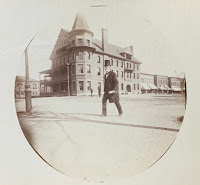
circular photograph print of a man crossing the street in front of the Hanover Inn, circa 1901Photograph albums of Dartmouth campus, especially those from the 19th and early 20th century, always captivate me. I get caught up in the sameness and yet profound difference that each image represents. In some, the large, mature elm trees along the green droop down and create a sense of shelter and shade. In others, the rough and dirty streets of downtown Hanover make me wonder how anyone ever kept their clothes clean for more than an hour.

Today, I leafed through a photo album that was compiled by Merrill Shurtleff, a member of the class of 1892. Along with the usual photographs of college students goofing around or playing sports on the green, there were a number of circular photographs. My curiosity was piqued by the shape of these prints, and I soon discovered by reading the catalog record that the images were taken with a newly-patented Kodak Number 2 camera, also known as a Brownie. Given that these weren't manufactured until 1901 at the earliest, my guess is that Shurtleff must have taken these photos during a trip back to his alma mater.

This photo of the Hanover Inn, with a rather fancy elderly gentlemen crossing the street in front of it, is an excellent example of the permanence of some institutions and the ephemerality of others. To explore Merrill Shurtleff's photo album for yourself, come to Special Collections and ask to see Iconography 1627.

Friday, November 22, 2019

"Is It You?"

Headshot of Maude Adams
This is a line uttered by actress Jane Seymour in the 1980 romantic drama film Somewhere in Time. In the movie, Seymour portrays the fictional character of Elise McKenna, an actress living in the early part of the 20th century who falls in love with a writer from 1971, portrayed by the late Christopher Reeves. It is a tale of star-crossed love and was based on the novel "Bid Time Return" by Richard Matheson.

Matheson based Elise's character on the actress Maude Adams who was a famous stage actress in the late 19th and early 20th century. Today, Adams is best known for portraying Peter Pan on the American stage in 1905.  However, as an actress she was in demand, touring the country in plays such as The Little Minister, Quality Street, Joan of Arc, and The Legend of Leonora. She retired from the stage in 1918 and did not return until 1931, when she played in a production of The Merchant of Venice in Ohio.
Photo of Maude Adams as Peter Pan

At its release Somewhere in Time was not a critical success but has over the years become a cult movie whose followers meet once a year at the famed hotel on Mackinac Island, Michigan where the movie takes place.

Matheson used many characters from Maude Adam’s life for his book, including basing Elise’s manager in the book on Charles Frohman, the man who oversaw Adam’s career. He also gave his protagonist the name of a roommate of Adams'.

We have here at Rauner a small collection of Maud Adams’ papers. The collection is particularly rich in photographs of Adams on and off the stage.

Maude Adams retired again from acting in the 1930s and became the head of the drama department at Stephens College in Missouri where she taught until 1949.

To view the collection, ask for MS-285.

Tuesday, June 5, 2018

Dartmouth Blues

A portrait photo of Hildreth, most likely as a college senior.
With commencement only a few days away, we happened to stumble upon some images of a past graduation ceremony inside an alum's personal photograph album. Charles L. Hildreth was a member of the class of 1901 who grew up in Westford, Massachusetts. After graduating from Dartmouth College, he attended Harvard Law School and became a practicing attorney in Lowell, Massachusetts, for many years before dying there at the age of eighty-eight.

What makes Hildreth's photographs truly remarkable is not merely the
A group of men and women standing near Bartlett Tower.crispness of the images, but also that they are all cyanotypes. A cyanotype is an image made by employing a photographic printing process that produces a cyan-blue print; engineering blueprints are probably the most familiar example of the process. We have a few examples of these fascinating images here at Rauner, and Hildreth's are some of the best of them. The image of men and women wearing their turn-of-the-century finest while crowded near the stump of the Old Pine, for example, is a fascinating look into the fashion of the time. It's hard to believe that they were wearing so many layers at that time of year.

A group of men and women listen to an orator on the lawn in front of Dartmouth Hall.
Another image, one of my favorites, shows a group of people gathered in front of Dartmouth Hall with Rollins Chapel in the background. On the steps of Dartmouth Hall, initially unremarkable, stands what appears to be a studio camera, complete with black hood for the photographer to hide behind. While two men fuss with the camera, the crowd listens to an orator perform. These are only two of the many remarkable cyanotypes from the album; there are also some fantastic images of the bonfire tower, both before and after being set ablaze. To turn the pages of Hildreth's book, come to Dartmouth and ask to see Iconography 1574.


Friday, April 27, 2018

The Art of Photography

Photogravure of an old man looking at a marble statue of a womanThis last week, Rauner welcomed art history professor Katie Hornstein's History of Photography class for an hour-long romp through some of the most amazing books related to photography. Some of the gems included Gardner's Sketch Book of the Civil War and autographed prints by Margaret Bourke-White that were published in Erskine Caldwell's You Have Seen Their Faces. Another beautiful work that the students explored was Camera Work, a photography journal edited by Alfred Stieglitz that ran from 1903 through 1917.

Photogravure of a nude woman kneeling with her back to the camera and her arms clutching her headAlfred Stieglitz is often credited for the eventual acceptance of photography as an legitimate art form in the 20th century. He was also known as a promoter of modern art and ran several New York art galleries and was the husband of artist Georgia O'Keeffe. Shortly after 1902 Stieglitz founded a movement called the Photo-Secession that disavowed all traditional definitions of what constituted a photograph. This included a rejection of the oppressive control that contemporary institutions, galleries, and art schools had over the determination of what could and could not be considered art.

Photogravure of an adolescent looking at the camera smuglyCamera Work was a vehicle for promoting this movement by showcasing the work of the Photo-Secessionists, primarily through high-quality photogravure reproductions of film positives that had been transferred to a copper plate. Stieglitz's insistence on perfection in these reproductions was such that, at least in one instance, the photogravures were hung in a gallery exhibition instead of the actual prints, whose delivery had been delayed.

At Rauner, we are fortunate to have a complete run of Stieglitz's groundbreaking publication. To see more of the stunning photogravures in any of Rauner's fifty volumes (in twenty-four issues), come to the reference desk and ask to see Rare TR1 .C5.

Friday, April 13, 2018

Illustrated with a Poem

MacLeish text "Now we don't know" next to Migrant Mother imageWe seem to be obsessing over photograph books lately. Not sure why, but here is another one! In 1938, while the Depression still raged, the poet Archibald MacLeish made use of the Farm Security Administration's invitation to writers to make creative use of their vast photographic collections. MacLeish produced a poem, but rather than use the photographs to illustrate the poem, he reversed the usual format. On the dust jacket blurb, he writes: "Land of the Free" is the opposite of a book of poems illustrated by photographs. It is a book of photographs illustrated by a poem.

MacLeish text "We're wondering" next to image of woman on a cot in a tent
The "poem" is also referred to as a soundtrack, and similarly to how illustrations change the way you read a text, MacLeish's poem alters your vision of the photos.

MacLeish text about a riot next to image of a riot scene
It is a cool interplay of text and image well worth your time. Come in and ask for Land of the Free, Rare E169.M16.

Tuesday, April 10, 2018

Cruise of the "Pandora"

Photo captioned "My last look at the North-West Passage"We have blogged about William Bradford's mammoth photographic ode to the North, Arctic Regions, in the past. We just found in our collections a book that could be considered its little cousin: Allen Young's Cruise of the "Pandora" from 1876. Like Arctic Regions, it uses actual pasted-in photographs as illustrations. The scope and size is considerably smaller (it contains just twelve photos in a book you you can easily hold in your hand), but it shows the same kind of environmental and cultural tourism Bradford displays.

Photo captioned Cape Riley where the first relics of Franklin's Expedition were found."There are photos of Cape Riley "where the first relics of Franklin's Expedition were found"; a sentimental "last look at the North-West Passage": and the quarter deck of the Pandora after a successful hunt. The book also shares Bradford's awe toward the Arctic. Even though the journey had the dual purpose to complete the Northwest Passage and search for Franklin's lost ships, to Young, the region was a place of wonder and beauty.

Photo captioned Quater-deck of Pandora--A mornign's bag
To take a look, ask for Stef G665 1875 .Y5.

Tuesday, April 3, 2018

The Americans

Photograph from The Americans showing a segregated bus in New OrleansIn 1959, as the country began to wake up (again) to its legacy of racism, an artsy photography book by a Swiss-born photographer was issued by Grove Press. It was so unsettling. Robert Frank's masterpiece, The Americans, took a cold, critical look at 1950s America and exposed it in a style evocative of the 1930s Farm Security Administration photographs. It was scorching. Things were supposed to be better now--the Depression was over and we had won the war. But, somehow they weren't.

Cover of French edition of The AmericansJack Kerouac wrote a Beat-inspired introduction that gave the book a counter-culture kick and set Frank up as a poet employing the medium of film and light. What most people didn't realize was that the book of minimally captioned photographs, without text except for Kerouac's short intro, had been released a year earlier in France. The French version contains the same images, but also an extended essay on American history and culture by French poet Alain Bosquet. The essay contextualizes Frank's work and simultaneously uses the images as illustrations. The two books set side by side represent very different aesthetics attempting to do different things for different audiences.

Photo from The American of apartment windows in Hoboken, New Jersey
We are now fortunate to have both "firsts" in our collections. Ask for Rare E169.02 .F713 1958 for Les Américains. The Americans will be cataloged soon. Come take a look and see what has changed and what hasn't.

Friday, September 22, 2017

Gardner's Photographic Sketch Book of the War

Title page to Gardner's Photographic Sketch Book of hte WarIn May, the Dartmouth College Library was abe to acquire the 1866 edition of Gardner’s Photographic Sketch Book of the War, the most powerful and most well-known collection of photographs from the Civil War. It contains 100 original albumen silver prints, each mounted on lithographed cards and bound into two volumes. It was published in an edition of no more than 200 sets and includes many of the most celebrated and recognizable images of the war such as: "Burial Party, Cold Harbor"; "A Harvest of Death"; "Field Where General Reynolds Fell, Battle of Gettysburg"; and "President Lincoln on Battle-Field of Antietam.” The acquisition was made possible by a generous bequest by Hans Penner formerly of the Religion department.

"Harvest of Death" from Gardner's Photographic Sketch Book showing dead soldiers on the field of Gettysburg
To celebrate this amazing acquisition we are hosting a half-day symposium on September 25th, “Civil War Object Lessons: Gardner’s Photographic Sketch Book of the War as Relic, Monument, and Narrative” to which you are most cordially invited. We will be featuring two visiting speakers, Elizabeth Athens from the Worcester Art Museum, and Elizabeth Young from Mount Holyoke College, as well as two panels of Dartmouth faculty and staff to discuss how the book will be used in their teaching and research.

"Gettysburg" showing the fields around Gettysburg, PA
The symposium runs from 12:45-5:45, and all of the presentations will be held in the Kreindler Conference Room (Room 41) in the Haldeman Center. You can find the schedule here. If you can't make it to the symposium, sometime when you are free, come to Rauner and ask for Rare E468.7 G19 1866.

Friday, July 7, 2017

Summer Vacation Battles

Willey House photograph ftramed with pen and ink sketch of rustic boardsIn July 1864, a group of wealthy women and one gentleman set off on an excursion "to rusticate a few weeks among the mountains." They brought along a camera and took pictures along the way. When they returned, they had a book privately printed, a copy for each member of the party, with photographic prints framed with hand done decorations.

Image of one of the tirp participants framed with pen and ink ivyIt is an exquisite book commemorating their travels, but one has to wonder about their sense of place and time. While they rusticated and admired the natural wonders of the White Mountains, the country was still in the midst of the Civil War, when battles were being waged across the South. At one point the author notes a parallel, but one that reflects a distance from reality:
From this point it had been our purpose, if possible, to make the ascent of Mt. Washington on horseback, a method more congenial to our taste than the usual, though less fatiguing, one in a carriage from the Glen. But the haze! that pertinacious foe, adopting Gen. Sherman's tactics, had constantly flanked us since we started from Bethel; now, with provoking tenacity, it seemed to be taking position in our front up the mountain, and concentrating to dispute our passage.
Eventually they made it to the top, but the "battlements" of a storm came upon them and they had a "council of war" in the hotel parlor to decide what to do. In despair, they settled on a retreat to the bowling alley for nine pins. The rhetoric of war is not surprising, but it is a bit shocking how they could compare their lack of a view with the horrors of Sherman's march. Perhaps these families were more insulated from the war than most.

photo of flowers fromed with pen and ink drawing of tree branchs
The book is a fascinating view into their lives, views of nature, and their sense of adventure in a time of national calamity. To see it, ask for White Mountains F41.32 A465.

Friday, June 9, 2017

Preparing for War: Commencement, 1917

line of students at commencement, some wearing military uniformsThe 1917 Commencement was a far different affair than what we will celebrate this year. One hundred years ago, the United States had just entered the first World War and the campus was becoming part liberal arts college, part military training camp. Dartmouth students were already well represented at the front in the ambulance corps, but members of the graduating class of 1917 were gearing up for active battle by drilling on the Green. For many, military uniforms replaced the traditional cap and gown at Commencement.

Students performing military drills in front of Webster HallThe most dramatic display of military preparedness on campus, though, was on the athletic fields. In the Spring of 1917, the War Department’s Students Army Training Corp Program at Dartmouth dug an intricate system of trenches on the fields under the leadership of Captain Louis Keene of the Canadian Expeditionary Force. Photos of campus make it look like an active war zone rather than a bucolic small town in New England.
Students digging trenches on campus

The campus photos from World War I are among the last batch being scanned and put online from our Archival Photofiles. You will be able to see them all online soon!

Tuesday, April 4, 2017

Adrift in the Soviet Era

Image of four scientists on a mount of ice holding up two flags. On flag has Stalin's image on it.In May of 1937, four Soviet scientists and their faithful dog were set down on the ice in the Arctic Ocean with supplies (five tons of food!) and an insulated tent in an endeavor to better understand drifting ice and the dynamics of Arctic waters. After 274 days and innumerable measurements of water and air temperatures, wind speeds and water depths, they were picked up by icebreakers over 2,800 kilometers from where they started.

Four photos montaged to show an icebreaker coing to retrieve the scientistsThroughout their drift, they took photographs and these were turned over to one of Stalin's favorite designers, Alexander Rodchenko, and fellow constructivist artist Varvara Stepanova. In their hands, the photographs were transformed into photo montages that sought to accent the heroic qualities of the expedition and celebrate it as "A Feat Worthy of the Age of Stalin." They managed to make what must have been an extremely boring expedition (over nine months of drifting on the ice) into a dynamic, exciting event. You can see it all in their Podvig, Dostoinyi Stalinskoi Epokhi: Fhotoseriya (Moscow: Soyuzfoto Fotokhudozhnik, 1938).

Photo montage of the arrival home of the scientists. It shows a train, hogs on the platform and a Soviet official adressing a crowd.
We haven't cataloged this yet, but when we do, we will add a link to the catalog record here.
UPDATE: to see it, ask for Stef G630.R8 P638 1938

Friday, December 9, 2016

Celebrity Catalogers

Black and white photo of Richard Owen wearing and academic robe and holding his hand on an animal skull. Owen is balding, hollow cheeked, and has a stern expression on his face.Picture People Magazine in the 19th century... then banish that image from your mind as quickly as you can and take a look at Photographic Portraits of Living Celebrities (London: Maull & Polyblank, 1856-9). There are no glam shots here, and no airbrushed beauty graces these pages. The collection of photographs with biographic sketches tends toward the academic and political. There are a few names you might recognize on the list like Faraday or Cruikshank but for the most part these are not the folks we think of as celebrities today.

Pictured here is Richard Owen, striking a very goth pose with what looks like a crocodile skull. Owen had many accomplishments, but his primary claim to fame was a thirty-year stint as the cataloger of the anatomical collection of the Royal College of Surgeons. He gives us hope that someday rare book catalogers will be all the rage. Or, perhaps our time has passed...

To take a look, ask for Rare TR681.F3 M285 1859.


Tuesday, November 8, 2016

One War, Different Stories

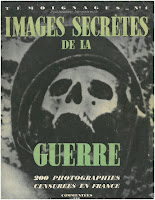
The cover page of the magazine with black and withe photo of a skull-looking mask in the center. All words on the cover are written in French. On the very top, it says témoignages number 1 in white letters. Below that, it says Images Secrètes de la Guerre in Green. At the very bottom, it says 200 photographies censurées en France. As I was looking for materials for a session with the World War I history course, I found this serial publication in our Rare Book Collections. Témoignages de notre temps is a compilation of about 200 photographs taken during World War I which had been censured by the French government during the war. Produced by the "Société Anonyme les Illustrés Français," this is the first issue of the bi-monthly serial. The photographs have come from various entities in different countries across Europe, ranging from an archive to an individual who fought in the war. The preface notes that these photos were originally taken for the purpose of documenting the reality of the war. The anonymous editors urge the readers to see beyond the heroic and glorious image of war that the French government had publicized. According to the preface, one of the editors worked for the French government's censorship department during the war, which allowed a certain level of access to many of the censored photos and documents. However, in most cases, attempts to publish these materials were frustrated as the French government was still reluctant to make them available for public even after more than a decade.

The magazine is divided into different chapters which attempts to debunk myths on specific aspects of the war that the French government had created through its censorship. Though it would be great to take a look at them in this post, some of the photos were just too gory (for instance, a trench full of ripped apart cadavers) so I have intentionally excluded them from this post.

In the first chapter, the magazine dispels the myth that the French and German soldiers on the front held a deeply-rooted hatred towards one another. Like in these photos, French and German generals stand side by side to chill or visit an injured soldier together.

Black and white photo of three military commanders standing in front of a what appears to be a metal container with a cross sign on it. One on the very right is wearing a German military winter uniform and the one right beside in the center is wearing a French military trench coat. Another guy is standing on the very right side with a thick but light-colored winter coat with a hard hat.
Black and white photo of a military hospital with a man lying on a bed in the very front of the photo. Slightly right to the man are standing two military generals. One on the right is wearing a German military uniform and another one on the right is wearing a French military uniform with a cross symbol on his arm. Behind these three men are nurses and other patients going in and out of the room.

Though it was strictly forbidden for soldiers from the Allies and the Axis powers to force prisoner to contribute to their military efforts, it was not rare to spot German prisoners of war working in a French munition factory or vice versa.

Black and white photo of a brick-building factory with containers in front of it. In front of the container, one the right side stands a stack of cylinder shaped military munition. In front of the container and to the left of the stack stand six men wearing factory boots, thick winter jackets and berets.

Another type of frequently censored photograph were those of the soldiers from the French North African colonies. The French government did not want to give an impression that the African soldiers were part of the war efforts, especially on the front.

On the far left corner of the image is a small black and white photo of an African man standing in a winter military suit. He is holding a thick white stick in his right hand. The rest of the image is a black and white photo of a train. From one of the windows, an African man in French military suit is standing, putting his arm out to wave a white stick. He is wearing a turban.

The magazine continues to break down the binary of the devil German and the righteous Allies by showing more humane side of the enemies. Rather than being tortured by atrocious German prison keepers, the British prisoners of war play cricket in the German prison camp.

Black and white photo of a man in white polo shirt and black pants throwing a cricket ball while other players in white clothing stand to hit the ball. The cricket players are surrounded by men in various clothing, some wearing military uniform and others wearing suits.

African prisoners of the war casually cruise down the streets of Berlin.

Black and white photo of seven African men walking down a street. They are all wearing turbans and wearing a thick black winter fur coat. Behind them passes by a tram.

The wartime press coverage of Paris often times hid the ugly aspects of the reality to convince people that France was in good shape. But these photos tell the story of wartime Paris that the government strove to hide.

Parisians were not always as poised as the government portrayed them to be. They ransacked stores with foreign-sounding names, though most of them were businesses operated by French citizens.


Though the government would have hated to admit it, the Parisians also suffered from bomb strikes and shortage of food supplies.

Black and white photo of a cement brick building which has a big door with walls on its sides, which are lower than the door. Above the door is a some type of seal sculpted with cement. In front of the door is a big hole almost twice the size of the width of the door, around which cements, asphalts and metal debris are lying around. A ladder is inside the hole. Five male pedestrians, all wearing fedoras, are passing by the hole but no one is directly staring at it.

The rest of the chapters explain Axis propaganda; marine warfare (it was the first war that submarines were used for military purpose); and the arts of espionage.

Reading this serial publication made me wonder what was the contemporary public's reaction to these photos. Would they have been appalled that the government had been hiding some aspects of the war? Or maybe, it already was not so much of a "secret" despite the government's efforts to make them so.

To look at the publication yourself, ask for Rare Book D501 .T46 No. 1 1933:Mai in our reading room.
Tuesday, March 22, 2016

Serialized Hate

Mein Kampf in exhibition case
The German copyright for Mein Kampf (My Struggle), Adolf Hitler's autobiography and master plan, has finally expired, and German scholars have just released a critical edition. But we have a copy that turned Hitler's propaganda back on itself: an unauthorized, war-time translation for a wary British public fretting over German expansion to the East. It is part of our current exhibition Light and Shadow in the Thirties.

In the early 1930s, Hitler refused to authorize an unexpurgated translation, allowing only a few positive abridgments. As Hitler's policies escalated with the annexation of Austria and the invasion of Czechoslovakia, English-speaking audiences demanded a full translation. The publication history is long and complicated -- there was a lawsuit, threats, and, for translator James Murphy, a narrow escape from Nazi Germany.

Rauner has James Murphy's translation, issued by the London firm Hurst & Blackett in eighteen parts. Our copy was probably published during World War II. Each cover boasts that the proceeds will benefit the British Red Cross -- not Hitler's German publishing house Eher Verlag. Mein Kampf became a bestseller in English, even after the war's outbreak, as Britains sought to understand their enemy's convoluted and hate-filled ideology.

The pamphlets use Hitler's face on every cover and stock photos of German sites fill the interior pages, showing how cheap and popular books depended on photography to increase their intellectual and cultural cache. "Illustrated" was just another selling point, just like the "Binding Cases" advertised on the back cover.

For Rauner's Mein Kampf in parts, see Rare Book DD247.H5 A326 1939, currently on display in the Class of 1965 Galleries. The exhibition comes down on April 3, 2016, as we install an exhibition by the first year seminar Anthropology 7: Values of Medicine.

To learn more about the publication history, check out James J. Barnes and Patience P. Barnes' Hitler's Mein Kampf in Britain and America: A Publishing History, 1930-39 (Baker Berry DD247.H5 A3426).

Friday, February 19, 2016

Light and Shadows in the Thirties

Boy Scouts crowd photographThe boys sit in rows, their knobby knees emerging from beneath their shorts as they wait further instructions. This photograph from the 1930s speaks to the power of youth organizations, and it comes from the 1939 brochure America's Answer. The Boy Scouts were America's Answer to fascist and communist youth organizations, instilling American boys with a correct sense of patriotism. However, the Americans weren't the only ones creating propagandistic photographic books.

The second photograph in this blog post comes from a series of pamphlets published by anti-fascists in Barcelona during the Spanish Civil War (1946-1939). It's a rallying cry against fascist brutality, featuring two slain fighters. The image is a memento of its time, when both automobiles and horses cruised the streets of Barcelona. These are just two images from our latest exhibition, Light and Shadows in the Thirties, which presents the wide variety of photographic books during the 1930s.

Rocked by the economic crisis of the Great Depression, nations questioned previous orthodoxies and experimented with new systems, often selling their solutions or sentimentalizing their problems using the power of the photograph. Light and Shadows in the Thirties presents these photographic books as a vital medium in this turbulent and pivotal decade.

Spanish Civil War battle
The exhibit was curated by Bay Lauris ByrneSim and will be on display in the Class of 1965 Galleries from February 16 to March 30, 2016.

The books featured in this post are: America's Answer. New York: Boy Scouts of America, 1939.  Rare Book HS3313.B69 1939. Visions de guerra i de reraguarda, Serie A. Barcelona: Editorial Forja, 1937. Rare Book DP269.15 .V57  v.1-8 Ap.1937-Oct.1937.

Tuesday, December 9, 2014

Welcome to Jenny Lind

A daguerrotype of Jenny Lind.In 1850, P. T. Barnum coaxed thirty-year-old Jenny Lind out of retirement for a grand tour of the United States. That tour, which earned Lind over $350,000, caused a popular sensation and exposed the potential force of the burgeoning American mass market. It also generated its share of souvenirs for her adoring public. Besides dozens of pieces of sheet music bearing her likeness, we also have a framed Daguerreotype of the Swedish songstress with a ticket to the June 20th, 1851, concert.

The cover for the sheet music "Welcome to Jenny Lind."
Even the abolitionist singing group, the Hutchinson Family, tried to cash in on her fame with their "Welcome to Jenny Lind." Sung "on the occasion of her visit to America," it was quickly issued as sheet music (Boston: Oliver Ditson, 1850).

A ticket for Lind's Second Grand Concert.To see the Daguerreotype and ticket, ask for Iconography 292. To see "Welcome Jenny Lind," ask for Sheet Music HF 73.

Tuesday, October 29, 2013

"Don't Fail to See It"

A black and white photograph of a highly ornamented stone archway. Before the novels and the Pulitzer, Edith Wharton made her mark by writing about garden design, interior decoration and what constituted good taste. Her first published book was The Decoration of Houses (New York: Charles Scribner's Sons, 1897) in which she tastefully railed against Victorian decorating sensibilities and advocated for the use of more open spaces that emphasized the room, not the furnishings.

A black and white photograph of a treed garden space.Wharton's next non-fiction work was a lavishly illustrated book about the architecture and surrounding gardens of Italian villas aptly named Italian Villas and Their Gardens (New York: Century, 1905). The book included numerous drawings and photographs, primarily by Cornish Colony artist Maxfield Parrish. In Rauner's collection of Parrish's papers are correspondence with Wharton about the book as well as some of the original plate negatives used as inspiration for his illustrations.

A handwritten letter.One particularly interesting letter "sums up" Wharton's impressions of the various villas in Florence. The Villa Medici gets a nod of approval - "Open certain days. Don't fail to see it." The Villa Albani is dismissed as "Hard to see and not worth while." The Villa d'Este in Tivoli is "Wonderful of course. Always open." Entries on other sites contain additional information about permits, whom to obtain them from and when to visit to avoid complications due to school calendars or other potential hazards.

Ask for ML-62, box 3, folder 43 to read the correspondence and Illus P249wha for the first edition of Italian Villas. The negatives are extremely fragile and are housed in Box 13 of the Parrish collection. A guide to the Parrish collection is available.