Tuesday, November 22, 2016

An Immigrant Story

Thanksgiving, the most American holiday, is, at its root, a celebration of immigrants making it in the new world. The story of the first Thanksgiving is a romanticized history of a past that so many people would love to hold as true: a group of immigrants come to a new world seeking a better life; they are helped by the established residents; and a feast is thrown to celebrate survival and the promise of future prosperity.

So, for this Thanksgiving, we turn to more promises: some of which turned out well, and some that did not. In the mid-nineteenth century, hundreds of books and flyers were produced to lure new immigrants to America. Areas in the Plains and the West wanted to boost population, and the industrial Midwest was hungry for cheap labor. In our collection are three guides to help the immigrant settle in America, all offering the enticement of economic prosperity. The 1848 Emigrant's Hand-Book for the United States opens with the U.S. Constitution, then systematically outlines all of the regions of the United States. Iowa as it is in 1856 is a "gazetteer for citizens, and a hand-book for emigrants." It contains extended descriptions of each town in Iowa, the qualities of the soils throughout the state, and is dedicated to those abolitionists committed to keeping Iowa free soil.
But the little pamphlet produced by a Dubuque, Iowa, real estate office best captures the spirit and the hyperbole of the time: Iowa, the "Great Hunting Ground" of the Indian; and the "Beautiful Land" of the White Man": Information for Immigrants (Dubuque: John Taylor, 1860). It boasts that "the quantity of good land entered in Iowa is so much greater than is required by the resident population" and can be obtained for as low as a dollar per half acre but will increase by "ten to twenty percent" annually. The climate is conducive to good health, there is timber land, plenty of water, excellent soil, good schools, and easy access to the markets via six railroads. Buy now, settle the great land, and become prosperous and free in "The Queen State of the West." Despite the motives of the publisher, you can see him playing into some of the same tropes of the original Thanksgiving story: it elides the troubled relationship between the "Indian" and the "White Man" to envision a land of opportunity where community is built and individual freedom is valued for everyone. Not always the truth, but a story retold each year as we feast.

To see Iowa from 1860, ask for McGregor 175. The Emigrant's Hand-Book is Rare E161.E5 1848, and Iowa as it is in 1856 is Rare F621.P23 1856.


Friday, November 18, 2016

Arctic Nights

Color frontispiece of sketch of "Gus" Masik in his cabin in Alaska. He is playing an accordian wearing hih boots with a big smile on his face. The cabin has a wood pile and a stove and Masik's modest belongng.The nights are getting really long as we approach winter. One of the nice things about having a huge polar research collection, is that whenever our northern climate starts to wear on you, there are plenty of harrowing stories in the collection about places much colder and much darker through the winter. Today we stumbled on a northern version of A Thousand and One Nights. But in the polar regions, one month-long night will do the job for a pretty long story.

Arctic Nights' Entertainments (London: Blackie and Sons, 1935) recounts the life and adventures of August Masik as told by him to Isobel Hutchinson over 25 days of darkness. Born in Estonia, "Gus" took to the seas as a young man. His travels took him into the arctic regions where he decided to stay, but he never settled. His life is full of harrowing journeys across the ice. A colorful storyteller, it is tough to judge when he is dead serious and when he is exaggerating for effect. But, if the Hanover winter gets to you, come into Rauner: Masik's tales will warm you up.

You can see the book by asking for Stefansson Alcove F 909 .M38.

Tuesday, November 15, 2016

Looking Ahead - A.D. 2001

A black and white cover of the Collier's Weekly Magazine. The word "Collier's" is written in big letters across on the very top of the page. Both sides of the title are decorated with illustrations of different farming tools and studying utensils. In smaller fonts, "weekly journal of current events"are written right below. The majority of the cover page is a black and white illustration with a caption that reads "captured Chinese flags." In the illustration, an endless row of soldiers are marching with flags of various designs, most of them depicting imaginary animals like dragon. In the front of the illustration stand people looking at the military parade. Norwich Public Library's book club visited Rauner for a session in September to take a look at materials on the development of science fiction as a literary genre. Many of Jack London's works were brought out for this session as his novels employ similar schemes that one can find in current science fiction stories, and thus are considered the predecessors of the science fiction genre. One of these works is a short story titled Relic of Pilocene, which was first published in Collier's Weekly Journal of Current Events in 1901. Though the story does not explicitly employ scientific inventions and technology, it does reference paleontology and its spirit of the wilderness adventure works in a similar way to the Star Wars movie series, imaginatively exploring the unknown world. In fact, Relic of Pilocene goes well with this volume of Collier's Weekly in that this volume was dedicated to recapitulating technological developments of the 19th century. The articles in this volume demonstrate technological developments in many areas such as transportation and communication from 1801 to 1901.

The most remarkable page in this volume was this imaginary illustration of what the technology in 2001 would look like. Frederick Strothmann, an American illustrator known for his World War I propaganda poster "Beat back the Hun with Liberty Bonds," drew this image with a caption that says "Broadway, New York, as it may appear a hundred years hence, when modern inventions have been carried to their highest point of development." In his drawing, Strothmann includes many subtle and not-so-subtle clues about what he thinks will be commonplace at start of the 21st century.

Page 29 of volume 26 of Collier's Weekly. It's a black and white entire-page illustration. In the background of the illustration loom tall, grey sky scrapers which completely covered the sky. The two buildings in the front of the illustration are connected with wires which holds floating capsule-looking trams. Some people are mail materials are floating in the bottom and middle of the illustration on hot air balloons. Large crowds are waiting for the floating capsule train on platforms protruding from the building on the left side of the illustration. The lower platform sign reads "Wall St" and the higher platform sign reads "Manhattan Air Lines." Different signs hung on the side of the buildings. On the very top left corner of the illustration, the sign reads "Youth Restored by Electricity While You Wait. 199th Floor." On the very left bottom corner the sign reads "To Europe, 6 Hours by Submarine Line." On the right bottom side of the illustration are two signs. One of them reads "Wireless telephone, local and Europe," and the other one in the bottom reads "Quick Lunch: Compressable Food Tablet."In some ways, it seems like our technology has reached its highest point. We do have skyscrapers that loom over the skyline, and wireless telephones do allow people from across the world to stay in touch. Though not exactly identical to Strothmann's vision, floating trams do exist in underground or above-ground versions in big cities across the world. The United States doesn't have submarine lines to Europe but underwater tunnels do exist in parts of the world, like that between the United Kingdom and France. Though not by hot air balloon, people, and mail, were able to travel by air well before 2001.

At the same time, some other projections are far from accurate and, in fact, we still believe that a few of these will be realized in the future. Some people still fancy the idea of compressable food tablets that provide all the nutrition we need without having to have a full meal, and some do argue that it could be possible in the near future. Unfortunately, I'm not sure if we will ever be able to restore youth by electricity, though it sounds very tempting!

Take a look at other cool illustrations printed in this volume by asking for London PS 3523 .O46 R45 1901.

Friday, November 11, 2016

A Break with Reality

The cover of the pamphlet, colored yellow with a interesting woodcut border and the full title of the text along with a brief abstract of its contents.
Never has a text seemed more relevant than this particular one does today. Entitled "A Secret Worth Knowing: A Treatise on the Most Important Subject in the World, Simply to Say, Insanity," this 95-page pamphlet was written by Green Grimes, an inmate of the Lunatic Asylum of Tennessee in 1846. In this fascinating little book, Grimes recounts his experiences that led to what must have been a psychotic break. After his father remarried when Grimes was fourteen, his older brother, Grimes's only confidant and protector, was driven away from the house by the new wife. On the brother's journey to his new apprenticeship with a local parson, he drowned while crossing a river. This initial trauma was followed by many other significant events which ultimately led to Grimes's breakdown and admittance to the insane asylum. In the introduction, Grimes notes that his goal for writing this book is twofold: to be a practical resource for others and to raise a small amount of money to provide for his five orphaned children.

After recounting his own story, Grimes goes on to describes many examples of insanity that he has
A woodcut image of the author, seated while wearing a jacket, waistcoat, and necktie and clutching a wooden walking cane and looking directly at the reader.
encountered or heard about during his lifetime, delineates the process by which people go insane, and then takes great pains to differentiate between insanity and "idiotism." Throughout his work, he attempts to encourage his readers who have family members suffering from mental illness by providing advice about how to care for and watch over their loved ones. Finally, he concludes by saying, "There is, perhaps, nothing short of the goodness of God that can effect a final cure of my disease. I am perfectly resigned to His will, and await his final coming and decision with hope."

To examine this subject, please come to Rauner and ask for Rare RC464 .G756 1846.

Tuesday, November 8, 2016

One War, Different Stories

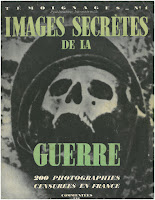
The cover page of the magazine with black and withe photo of a skull-looking mask in the center. All words on the cover are written in French. On the very top, it says témoignages number 1 in white letters. Below that, it says Images Secrètes de la Guerre in Green. At the very bottom, it says 200 photographies censurées en France. As I was looking for materials for a session with the World War I history course, I found this serial publication in our Rare Book Collections. Témoignages de notre temps is a compilation of about 200 photographs taken during World War I which had been censured by the French government during the war. Produced by the "Société Anonyme les Illustrés Français," this is the first issue of the bi-monthly serial. The photographs have come from various entities in different countries across Europe, ranging from an archive to an individual who fought in the war. The preface notes that these photos were originally taken for the purpose of documenting the reality of the war. The anonymous editors urge the readers to see beyond the heroic and glorious image of war that the French government had publicized. According to the preface, one of the editors worked for the French government's censorship department during the war, which allowed a certain level of access to many of the censored photos and documents. However, in most cases, attempts to publish these materials were frustrated as the French government was still reluctant to make them available for public even after more than a decade.

The magazine is divided into different chapters which attempts to debunk myths on specific aspects of the war that the French government had created through its censorship. Though it would be great to take a look at them in this post, some of the photos were just too gory (for instance, a trench full of ripped apart cadavers) so I have intentionally excluded them from this post.

In the first chapter, the magazine dispels the myth that the French and German soldiers on the front held a deeply-rooted hatred towards one another. Like in these photos, French and German generals stand side by side to chill or visit an injured soldier together.

Black and white photo of three military commanders standing in front of a what appears to be a metal container with a cross sign on it. One on the very right is wearing a German military winter uniform and the one right beside in the center is wearing a French military trench coat. Another guy is standing on the very right side with a thick but light-colored winter coat with a hard hat.
Black and white photo of a military hospital with a man lying on a bed in the very front of the photo. Slightly right to the man are standing two military generals. One on the right is wearing a German military uniform and another one on the right is wearing a French military uniform with a cross symbol on his arm. Behind these three men are nurses and other patients going in and out of the room.

Though it was strictly forbidden for soldiers from the Allies and the Axis powers to force prisoner to contribute to their military efforts, it was not rare to spot German prisoners of war working in a French munition factory or vice versa.

Black and white photo of a brick-building factory with containers in front of it. In front of the container, one the right side stands a stack of cylinder shaped military munition. In front of the container and to the left of the stack stand six men wearing factory boots, thick winter jackets and berets.

Another type of frequently censored photograph were those of the soldiers from the French North African colonies. The French government did not want to give an impression that the African soldiers were part of the war efforts, especially on the front.

On the far left corner of the image is a small black and white photo of an African man standing in a winter military suit. He is holding a thick white stick in his right hand. The rest of the image is a black and white photo of a train. From one of the windows, an African man in French military suit is standing, putting his arm out to wave a white stick. He is wearing a turban.

The magazine continues to break down the binary of the devil German and the righteous Allies by showing more humane side of the enemies. Rather than being tortured by atrocious German prison keepers, the British prisoners of war play cricket in the German prison camp.

Black and white photo of a man in white polo shirt and black pants throwing a cricket ball while other players in white clothing stand to hit the ball. The cricket players are surrounded by men in various clothing, some wearing military uniform and others wearing suits.

African prisoners of the war casually cruise down the streets of Berlin.

Black and white photo of seven African men walking down a street. They are all wearing turbans and wearing a thick black winter fur coat. Behind them passes by a tram.

The wartime press coverage of Paris often times hid the ugly aspects of the reality to convince people that France was in good shape. But these photos tell the story of wartime Paris that the government strove to hide.

Parisians were not always as poised as the government portrayed them to be. They ransacked stores with foreign-sounding names, though most of them were businesses operated by French citizens.


Though the government would have hated to admit it, the Parisians also suffered from bomb strikes and shortage of food supplies.

Black and white photo of a cement brick building which has a big door with walls on its sides, which are lower than the door. Above the door is a some type of seal sculpted with cement. In front of the door is a big hole almost twice the size of the width of the door, around which cements, asphalts and metal debris are lying around. A ladder is inside the hole. Five male pedestrians, all wearing fedoras, are passing by the hole but no one is directly staring at it.

The rest of the chapters explain Axis propaganda; marine warfare (it was the first war that submarines were used for military purpose); and the arts of espionage.

Reading this serial publication made me wonder what was the contemporary public's reaction to these photos. Would they have been appalled that the government had been hiding some aspects of the war? Or maybe, it already was not so much of a "secret" despite the government's efforts to make them so.

To look at the publication yourself, ask for Rare Book D501 .T46 No. 1 1933:Mai in our reading room.

Friday, November 4, 2016

1916 Election Day Music

Cover of "She's Good Enough to be Your Baby's Mother and She's Good Enough to Vote with You!" The image depicts a domestic scene with a smiling woman in a dress and her rosy cheeked infant looking out a window. The child is waving.This is just so troubling, while supporting a cause that's so right. In the presidential election of a hundred years ago, women still did not have the vote in most states. With the election in the news, it was a good opportunity to push yet again for women's suffrage. Good idea--long overdue. But the message this 1916 popular song conveys is not exactly liberating.

The woman's role is clearly defined in the image: at home, raising the family, smiling to the world. The rhetoric of the chorus then places the woman as a man's helpmate and little more:
She's good enough to love you and adore you,
She's good enough to bear your troubles for you;
And if your tears were falling today,
Nobody else would kiss them away.
She's good enough to warm your heart with kisses
When you are lonesome and blue,
She's good enough to be your baby's mother
And she good enough to vote with you!
A hundred years later, Americans have their first opportunity to vote for a woman as a major party candidate. Progress for sure. But Lord knows what we will think a hundred years from now about the rhetoric of this campaign season.

To learn the tune and read the rest of the song, ask for Rauner Sheet Music SC 4077.

Tuesday, November 1, 2016

Shall We Dance?

Woodcut image of a nobleman fighting with death. Death is a skeleton and is tugging on the nobleman's robes. The nobleman has a sword drawn and is trying to pull away from death. He has an anquished look on his face.It is the Day of the Dead, perfect for highlighting the recent acquisition of Imagines mortis (Cologne: Apud haeredes Arnoldi Birckmanni, 1557). It will warm your heart on a gray November day. The fifty-three woodcuts are based on Hans Holbein's famous Dance of Death series, but here are presented more in the form of an emblem book with each image captioned with a verse. Death shows no favorites, and comes for all: some seem quite willing to go, while others fight.

Woodcut image of an elderly man being lead off by a skeletal image of Death. The man is not putting up any fight but appears resigned to his fate.Image of Death (as a skeleton) attacking a figure that appears to be a king or the Pope. Other figures in the room look on aghast at what they see.
This is also a good opportunity to let you know about an upcoming conference that the Library is co-sponsoring: Lives and Afterlives in the Middle Ages: The 43rd Annual New England Medieval Conference on November 19th,. We will have an exhibit with more medieval and early modern death later this month.

To see Imagines mortis, ask for Rare N7720.H6 I434 1557.