Friday, September 30, 2011

The Eliot Bible

The title page for the Eliot Bible.If someone handed you the first Bible printed in America, you might be surprised to find that it was written not in English, but in Massachusett, an Algonquian language. Published in 1663, the Eliot Bible is one of the many treasures at Rauner Library and an example of the use of written word as a means of evangelism in American history.

John Eliot, the "Indian Apostle," came to America from England in 1631 with the goal of preaching in the New World. Although he first worked with the young colonists, the idea of evangelizing the natives was never far from his mind; he wrote, "I do very much desire to translate some parts of the Scriptures into their language and print some Primer in their language where to initiate and teach them to read." Eliot's ambition, says Cotton Mather, was to fulfill the words of the Massachusetts Royal Charter "To win and incite the Natives of that Country to the knowledge and obedience of the only true God and Saviour of Mankind, and the Christian Faith."

Eliot began this mission by regularly visiting the nearby Massachusett tribe for three or four days at a time, learning their language and teaching them his. With this knowledge, Eliot began the task of translating the Bible into the native Massachusett tongue, phonetically, using the English written language – a feat that took him ten years. This was also the first time that a Native American tongue had been given an alphabet and a written language.

The first page of Genesis in the Eliot Bible.

The translation would not have been possible without the help of John Sassamon, a member of the local tribe who could speak and write English. Sassamon was adopted by an English family after his own family succumbed to disease (most likely brought by the Europeans). Sassamon would later go on to be the first Native American to attend Harvard University.

One thousand copies of Eliot's "Indian Bible" were printed under the full title "The Holy Bible Containing the Old Testament and the New Translated into the Indian Language," by Samuel Green of Cambridge. It would take about 120 years until the first complete English edition of the Bible would be printed in America.
The leather spine for the Eliot Bible.

The main goal of the printing of the Eliot Bible was not to give Native Americans a Bible of their own, but to give English preachers a means to communicate the Word of God to the natives. The importance of the Bible today is not textual accuracy, but rather it is an emblem of early Colonial and Native American history.

Come by Rauner to see the "Eliot Bible" and hold a part of the history of America. Ask for: Rare BS345 .A2 E4 1663

Posted for Thea Stutsman, '13

Tuesday, September 27, 2011

Animal House

A color photograph of John Belushi and five men in police uniforms posing in front of a vehicle in the middle of a highly decorated street. In 1977, Patrick Murphy was a police sergeant in the city of Cottage Grove, Oregon when he was hired to coordinate security for the production of the movie Animal House. Based in part on Dartmouth class of 1963 co-screenwriter Chris Miller's experience in the Alpha Delta Phi fraternity. The production had settled on the campus of Faber College in Oregon as a location after having been turned down by twelve colleges in six states.

According to a fan website, Sgt. Murphy was also tasked to keep John Belushi happy and out of trouble. In addition to appearing in four scenes of the movie and allowing the crew to use his personal station wagon as a dolly, Murphy received an autographed original script signed by the entire cast with a letter of thanks from director John Landis. Addressing the letter to Sgt. Murphy and "all of the other Faber Policeman," Landis quips, "When you see the finished movie and you're all movie stars just remember who made you international celebrities."

A title-page for an Animal House script, signed several times to Sergeant Murphy.
Even though critics universally panned the movie upon its release, it went on to become a commercial success, grossing more than $90 million in its first year. It also launched the movie career of John Belushi and re-introduced toga parties to college campuses

To see the script and a call sheet from the movie ask for MS-1175.

Friday, September 23, 2011

Facebook of 1915

A simple illustration of two men carrying a large trunk. The man on the left is wearing light clothes and a hat. The man on the right is wearing a dark suit. Both are sweating. The image is captioned "Matriculation."Before their arrival in Hanover to meet in person and begin their Dartmouth careers, many members of the class of 2015 undoubtedly spent the past few months getting to know each other on Facebook. A hundred years ago, another group of '15s was the first class to get acquainted with the help of the Green Book, also known as the Freshman Book. As the foreword to the 1915 Green Book states:

The continual growth of Dartmouth College has made it harder and harder each year to learn the records and abilities of the entering class. This Year Book is published with the hope that it will satisfy a want for information in much the same way as does the Yale Blue Book and the Harvard Red Book. If it succeeds in giving its readers a good knowledge of the composition of 1915, we shall feel fully repaid.

A black and white photograph of a man in a suit and glasses. The portrait is captioned "Everett V. Lansom Treasurer of Class and Cheer Leader."
Unlike later volumes of the Green Book, the first one didn't include photos of every member of the class. Only the class officers, the 1915 football team, and Prof. Craven Laycock, Assistant Dean (and later of nose-rubbing-for-luck fame), are shown. The book provides each student's full name, nickname, fraternity, hometown, high school attended and activities in which they participated, and dorm address at Dartmouth. Particularly interesting is the section entitled "1915 Statistics," which includes data compiled from information provided by 353 members of the class. From this we learn that the class of 1915 came from 192 preparatory and high schools, of which "only 11 have a representation numbering five or more." The school that provided the most entering freshmen that year? Phillips Exeter (twelve). The book also provides information about the entering students' parents; for example, how many were college graduates (76 fathers -- of which 19 were Dartmouth men -- and 16 mothers), the schools from which they graduated, and fathers' professions. Data on the religious preference of class members is also provided. The 1915 book appears to have been published in the spring of 1912, as it also includes summaries of the class performances in track, football, basketball, and hockey.

In 2009 the College decided to stop publishing the Green Book (or 'shmenu, as it was sometimes called), so the class of 2012, who will graduate this spring, is the last class to have one.

A black and white photograph of seventeen seated men in dark clothes. One in the front holds a football with "1915" painted on it. The photograph is captioned "1915 Football team."
Get to know Jimmie, Ingy, Hutch, Skinny, Edge, Jiggs, Mudge, and generations of Dartmouth students who followed them by consulting the Dartmouth Green Books in the reading room of Rauner Library.

Tuesday, September 20, 2011

Donella Meadows

Four men and a woman posing for a photograph.In 1968 a global think tank was founded in Rome, Italy, concerned with humanity's lack of "forward looking analysis" in regard to its effect on the ecology of the planet. One of the early contributors to the program of the "Club of Rome" was Donella H. Meadows, a young environmental activist and teacher who worked with her husband, Dennis Meadows, and others at MIT to develop and interpret a computer model to calculate human economic expansion and its relationship to the ecosystem of the earth. The result was the controversial book The Limits to Growth, co-authored by Meadows. Always outspoken in her criticism of humanity's failures to recognize the damage it was causing to the earth’s environments, Meadows was appalled at the choice Family Circle magazine made in choosing a woman with four children as its "Homemaker of the Year." In a 1970 letter addressed to the magazine she writes:

If your homemaker of the year feels any responsibility to the human society of the future, she would not have more than two children. If she loves children and wants more than two, she can fill a great social need by adopting them. If she is a real citizen of this country and this world, she will have consumption habits which are very distinct from those of most Americans and those usually pictured in your magazine.

Donella and her husband Dennis practiced what they preached, living with friends on an organic farm in rural New Hampshire, while advocating, through their writings and teaching, for a sustainable world. In 1996 Meadows founded the Sustainability Institute whose headquarters are part of the Cobb Hill Cohousing community.

If you would like to find out more about this dedicated environmentalist and author ask for MS-1152, The Papers of Donella H. Meadows.

Friday, September 16, 2011

Still Trippin'

A group of men wearing backpacks, walking in a line.What had started with just 16 tripees and a few trip leaders had grown by 1970 to the point where nearly half of the incoming class participated in Freshman Trips. Today the program involves over 90 percent of the freshman class and more than two hundred upperclassmen student leaders.

A group of people dancing.
Over the years, the Dartmouth Outing Club has devised new and creative ways for freshmen to break out of their shells during their first days with their new Dartmouth peers. The first day in Hanover usually involves a variety of semi-embarrassing activities such as dancing on the lawn in front of Robinson Hall and humorously choreographed safety talks. After that they head out on their trips, which have evolved from just hiking to include a variety of activities including, kayaking, canoeing, fly-fishing, mountain biking, horseback riding, nature photography, organic farming and even nature writing and painting for the artistically inclined.

After two nights in the outdoors, the groups reconvene at the Ravine Lodge at the base of Mt. Moosilauke and are treated to stories from administrators, faculty, or alumni about their own Dartmouth experiences.

A man eating green eggs and ham.
In the morning, the freshmen enjoy a complete breakfast of green eggs and ham, inspired by Dartmouth alumnus Theodor Geisel (class of 1925), more commonly known as Dr. Seuss.

This common experience has become a vital part of acclimation to the Dartmouth community, and many first-year students make some of their best and longest-lasting friendships with their tripees. Because of this, Freshman Trips have come to symbolize the strong sense of community and camaraderie that brings former students back to Dartmouth year after year.
A group of people in outdoor gear, posing for a photograph.

Tuesday, September 13, 2011

Freshmen Trips and the War Years

A line of men walking along a bridge.
1946 Freshmen Trip
crossing the dam at Moosilauke
Roger Brown leading
By 1941, the popularity of the Freshmen Trip, which had attracted a mere 16 first-year students in 1935, had grown significantly, swelling the ranks to over 100 participants. Trip leader Harry Bond’s report on the 1941 trip included his concern that numbers over 125 could not be handled well. He felt that with too big a crowd, trips would be come “more like an army moving in maneuvers than a good friendly hike.”

The military allusion was prophetic; later that year, the United States entered World War II. The resulting decrease in civilian student population and the curtailment of travel, compelled the DOC to limit the 1942 trip to the first 50 applicants. The entire trip that year was based at Moosilauke (the hike up the mountain was described as not difficult: “girls frequently make the trip up and down the Mountain in a day”). Since Dartmouth accelerated its academic calendar during the war, the 1942 Freshmen Trip took place in July over the course of a weekend, returning the Class of 1946 to campus in time to register on Monday, July 6.

Allowed to use only one truck in 1944, the DOC was forced to limit the trip even more, to 30 students. However, it did not take long after the end of the war for Freshmen Trips to experience their due success. Within a decade, the number of students participating reached 200, divided into two sections of several trips each, all fed, transported, led up and down mountains, informed and entertained with the precision Harry Bond had feared… but which has done nothing to detract from the success and enthusiasm for this happy introduction to Dartmouth for over 70 years.

Friday, September 9, 2011

The First Tripees

A man hauling packs into the back of a truck.
1938 Trip
On September 10, 1935, a group of 16 freshman ventured into the wilds of northern New Hampshire on the first Freshman Trip. In the year 1934-35 the Outing Club was undergoing some internal scrutiny. There had been a “sharp decline in paid memberships” and the club was accused by some of “aloofness and unco-operativeness.” The first Freshman Trip was characterized in The Dartmouth as an “acquaintance trip” to introduce freshmen to the Outing Club and the “White Mountains and the territory.” Acquaintance trips had been tried before, but this trip was different as it was scheduled to take place before school was in session.

A group of men seated together outdoors.
1939 Trip

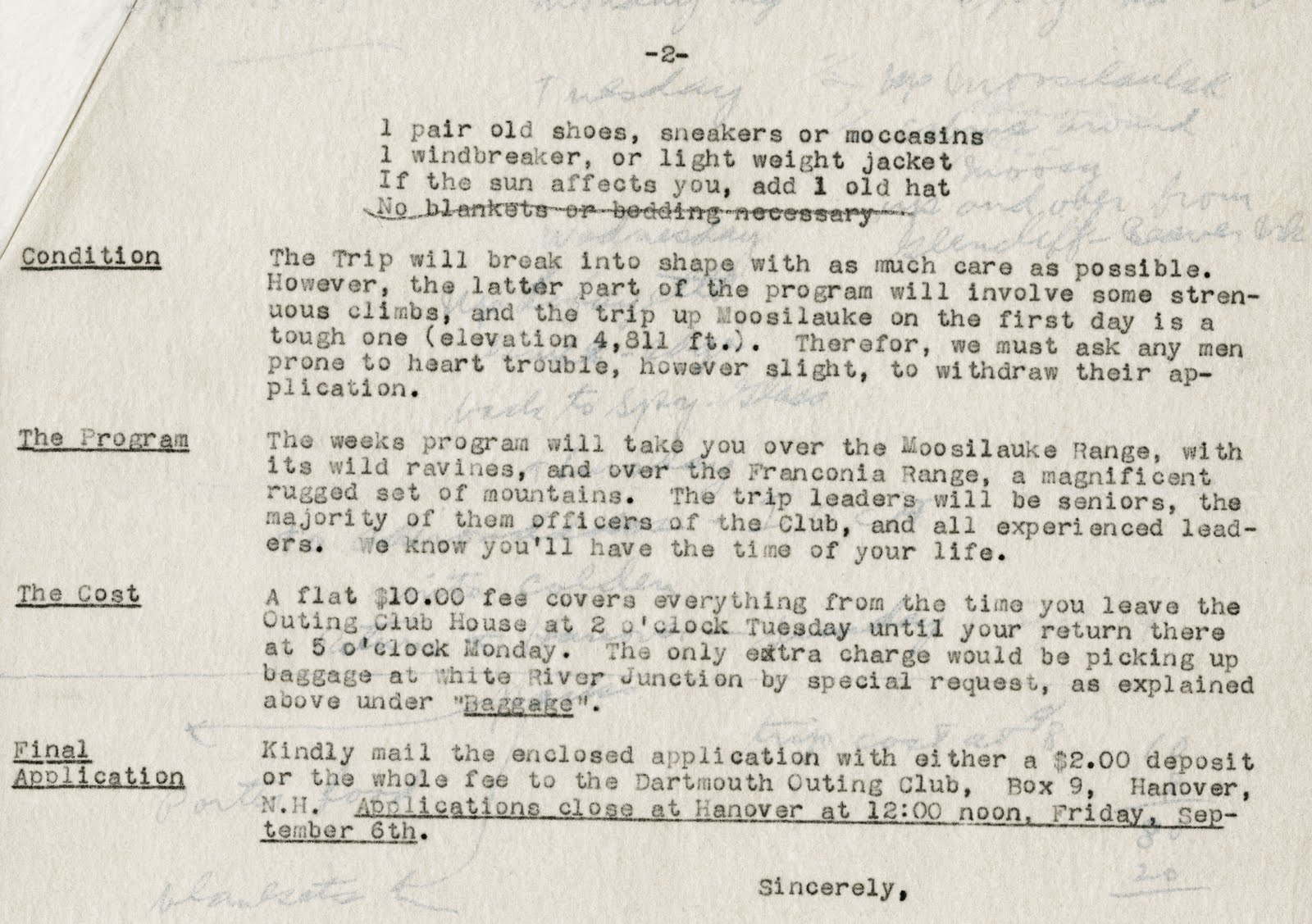
A page of typed text.
1935 application
The application for the 1935 trip notes that, “The trip will break into shape with as much care as possible. However, the latter part of the program will involve some strenuous climbs, and the trip up Moosilauke on the first day is a tough one.” The students arrived back to Hanover “sun and wind burned.” No mention is made of the success of the trip, but since the trips have now been going on for 76 years, we can assume it was a hit. Notably, one of the students on the trip was named Daniel Webster. This Dan went on to become a physician, not a statesman like his namesake, but it seems appropriate that the name Webster should be associated with the first Freshman Trip.

The records of the Outing Club are held in Rauner and a finding aid is available.