 |
| Green goggles and their box |
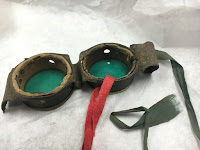
When Dorothy and her friends reach the Emerald City of Oz, they're each given a set of green spectacles. From behind these lenses, the entire metropolis shines with a verdant glow. We recently found some Oz-like glasses at Rauner!
These green spectacles belonged to Reverend Bennet Tyler (1783-1858), who served as the President of Dartmouth College between 1822 and 1828. Under his tenure as president, an official scholarship for indigent youth was established and Edward Mitchell, Dartmouth's first black student, was admitted. Tyler left after six years to return to the ministry.
So why did President Tyler need green glasses? Contemporary sources indicate that green glasses were often used for preserving sight or shading eyes from light (1, 2). Perhaps he was reading too much by candlelight? Perhaps he had suffered from snow blindness in a harsh Hanover winter?
 |
| Goggles from behind |
The green goggles come in a box from Pinkham & Smith Company (Prescription Opticians) from Boston, Massachusetts, perhaps indicating that these were a medical precaution. Like many contemporary spectacles, they don't have metal temples. Instead, President Tyler tied them around his head with a ribbon.
By the 1830s and 1840s, green glass had fallen out of favor, with author Francis West declaring that "while [green] is an agreeable color to look
at, is it a bad one to look
through," (3) and John Thomas Hudson writing that "through a green glass the countenance has a cadaverous hue" (4).
We'd prefer to think that President Tyler just wanted to view Dartmouth through green glasses (we do, of course, realize that these glasses pre-date Dartmouth's official adoption of the color green in the 1860s.) You can too, with Realia 277.
Notes:
1. Thomas Green Fessenden wrote that opticians recommended green glasses to "preserve sight in the case of very weak eyes," but that they were really better for providing shade to the eyes or used when the eye feels "uneasy." Thomas Green Fessenden, The Husbandman and Housewife: A Collection of Valuable Recipes and Directions, Relating to Agriculture and Domestic Economy, Bill Blake & Company, 1820, p. 182.
2. We also found an advertisement for green spectacles not only "for very weak and inflamed eyes," but also for "green light shades for the eyes," in the back of John Lorimer, A Concise Essay on Magnetism, with an account of the Declination and Inclination of the Magnetic Needle, and an attempt to ascertain the cause of the variation thereof, 1800 [no page number].
3. Francis West, A Familiar Treatise on the Human Eye, 1841, p. 33.
4. John Thomas Hudson, Spectaclænia; or the sight restored ... and preserved by the use of spectacles, etc. Simpkin and Marshall, 1834, p. 13.


 Recent happenings in the news made us remember an odd little relic in the collections: a ticket to Andrew Johnson's impeachment hearing in the U.S. Senate on April 29th, 1868. The blue printed ticket seems like it may not have been used; the stub is detached, but still present. We are not sure if the owner of ticket 729 bothered to show up or if the bearer managed to keep both portions of the ticket.


 Even though a library tends to be about books and the written word, there are always things that help to enhance or supplement a collection but just aren't books themselves. These oddballs are lovingly referred to as "realia" and range from closely-linked-to-books items to ones that leave you scratching your head and trying to figure out the connection.


