Friday, July 26, 2019

Institutional Indifference and the Spirit of Dartmouth

Newspaper article related to the Redding Report
All is well for the minority students at Dartmouth College. That is, at least, what an official recruitment video from 2018 implies. Black and brown students are dappled throughout the advertisement: they write in notebooks, sit at oak tables with emeralite lamps, walk in graduation robes (an African sash draped over their shoulders), and sport goggles while peering at beakers. Here are people totally unencumbered by their racial background, freely pursuing an elite education. In the College’s words, this is “What Makes Dartmouth DARTMOUTH.”

And yet just months after this video was published the Student Assembly sent a campus-wide email denouncing a spate of racial incidents and the institution's quasi-apathetic response. The expression of racism varied: it was found in vicious emails, in slurs on dorm room doors, or in “the impersonation of current students.” The result remained the same: the Student Assembly held that “these hate crimes wound our sense of community.” Perhaps what makes Dartmouth what it is can be found in these occurrences too.

First page of the Redding ReportThere is an eerie resemblance between this email and the Redding Report published 44 years earlier. Formally titled “Institutional Racism and Student Life at Dartmouth College,” the document enumerates a long list of racial abuses suffered by the black population at the hands of the school. According to the authors, “various minority students have reported being told by a professor, before he had seen any of their work, that he knew they would not do well in his course because they were non-white.” They wrote of one episode in which a group of black students asked to use the Cohen-Bissell lounge to fraternize but were pointed in the direction of the Afro-American Society basement instead. They observed the coaches (only one of whom was black) poorly treating black athletes (of which there were several). They worried about the lack of nonwhite faces on committees--even on the one claiming students would be judged by a jury of their peers. They felt the alienation black students endure as a result of estrangement from the “Dartmouth family.”

Just as the 2019 email contended that racism “detract[s] from our individual and collective security,” denying a sense of emotional well-being to students, the 1974 report argues that the psychological problems afflicting some of Dartmouth’s black community was partially caused by a “traumatic cultural shock.”

Another disturbing parallel connecting the decades-wide gap between the institute of the 70s and the one of today is the College’s response. The students of the former remarked that “whenever Dartmouth College has been able to escape the issue (of racial inequality), it has tried to do so,” and when the school has acted its attempts were “incremental in nature or founded in insincerity.” In a similar vein, the Student Assembly writes “an insufficient reaction has been made by the administration...to further prevent intolerant individuals from acting against the well-being and unity of the Dartmouth community.”

Pessimism lingers in the conclusion of the Redding Report, with the authors anticipating that the
college won’t act on its own volition. Their cause for concern was later justified, as it took six months for the College to respond, and even then one author felt “that the Administration had not dealt directly with many of the allegations contained in the report, merely shifting responsibility for responding to these allegations to various committees.”

The writers charge the school with contradicting itself, repeatedly failing to guard its more vulnerable offspring all the while advertising itself as welcoming everyone into its family. In a prophetic voice whose sterness carries through more than forty years, one author offers both a way to resolve this paradox and an ultimatum: “The college can continue to take insufficient action against discrimination on the campus, but will have to be honest with the minority applicants and matriculating students.” It remains to be seen if any asterisks or daggers will appear, small but certainly present, when the school attempts to rally unity with phrases like “What Makes Dartmouth DARTMOUTH.”

To read the Redding Report, come to Rauner and ask for D.C. History LD1441 .C384.

Posted for Alexis Reaves ’20, recipient of a Historical Accountability Student Research Internship for the 2019-2020 academic year. The Historical Accountability Student Research Program provides funding for Dartmouth students to conduct research with primary sources on a topic related to issues of inclusivity and diversity in the college's past. For more information, visit the program's website.

Tuesday, July 23, 2019

A Belated Burial

Photograph of Charles Stern in uniform
This past weekend, the remains of Charles M. Stern Jr., a member of the class of 1936, were brought back to his home town of Albany, NY, for reburial nearly seventy-eight years after his death. Stern had been one of many unidentified sailors who died upon the battleship USS Oklahoma when it was destroyed during the attack on Pearl Harbor in 1941. Four hundred and twenty-nine crew members were killed by Japanese planes during the surprise attack that claimed the lives of 2,403 soldiers and civilians. Stern's remains had been interred in a cemetery in Hawaii until relatively recently, when efforts began to identify those who had previously been classified as "missing in action."

Newspaper article relating Joan Mayer Stern's experience during the attack on Pearl HarborAccording to a Dartmouth Alumni Magazine obituary in the February 1942 issue, Stern was the first Dartmouth man to lose his life in the war. He had been working in advertising ever since graduating from Dartmouth, but in 1940 had enlisted in the US Naval Reserve Midshipman's school in New York. Soon after, he was assigned to Honolulu. The following year, he married a hometown girl, Joan B. Mayer, who had only just graduated from Vassar College in June of 1941. Only few months later, he would die in service of his country while his new bride listened to the explosions from their apartment only fifteen miles away in Waikiki. After several days of waiting for some sign or message of Stern's survival, Joan accepted the worst and returned home to Albany. Soon after, she took a job at the Grumman aircraft factory on Long Island. In 1943, she was informed by the Navy that a new destroyer escort was to be named for her husband. The USS Stern launched on October 31, 1943, was stationed in the Pacific, and performed numerous roles while supporting US troops in the Philippines and during the battle of Iwo Jima before being decommissioned in 1946 with three battle stars.

To read more about Stern's life and death, come to Special Collections and ask to see his Alumni file.

Friday, July 19, 2019

A Rosetta By Any Other Name

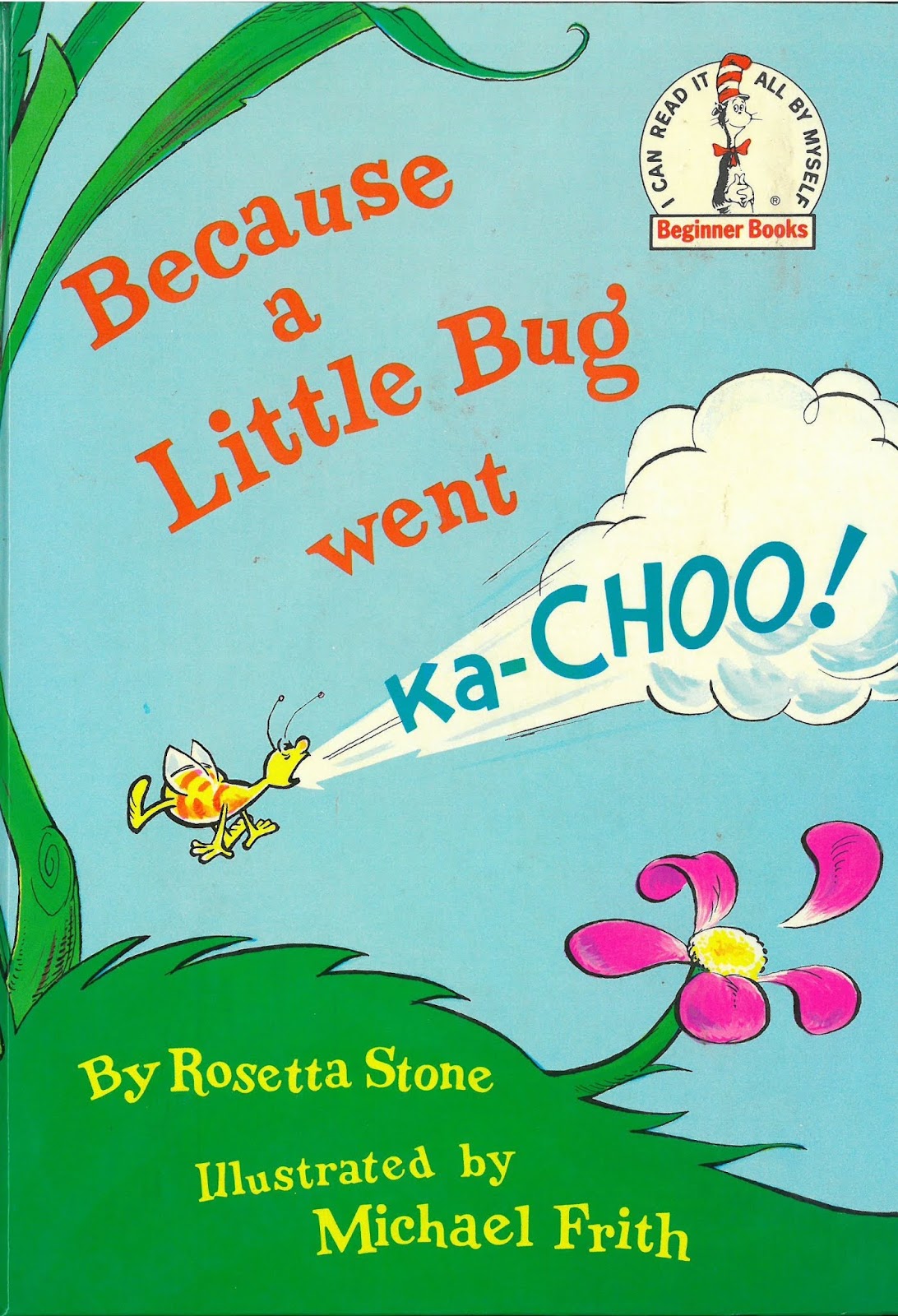
cover of "Because a Little Bug went Ka-Choo!"
On this day in 1799, the discovery of the Rosetta Stone was formally reported by Michel Ange Lancret to the Institut D'Egypte, a newly formed scientific organization that had been created by Napoleon for the express purpose of conducting research during his campaign in Northern Africa. The stone was discovered near what is now the Egyptian port city of Rashid and has proved invaluable in the translation of ancient Egyptian hieroglyphs, which had been inscrutable to Western scholars until this moment. Sadly, here in Special Collections, we don't have access to this sort of linguistic miracle. However, we do have our own Rosetta Stone of sorts.

Biographical notes inside the front cover of Stone bookAmong the numerous volumes in our Alumni collection is a children's bookwritten by "Rosetta Stone" and illustrated by Michael Frith. The book, titled Because a Little Bug Went Ka-choo!, was printed in 1975 by Random House as a part of its Beginner Books imprint. So, why do we have a book by Ms. Stone in our Alumni collection? Well, Beginner Books was founded in 1957 by Phyllis Cerf, Ted Geisel '25, and Helen Palmer Geisel. The first book published under that imprint was The Cat in the Hat. Whenever Ted Geisel illustrated his own works, he went by the well-known pen name "Dr. Seuss." However, when he wrote the books but didn't draw them, he went by pseudonyms. Perhaps his best-known one is Theo LeSeig, under which he wrote no less than thirteen books. However, he also wrote a single book as Rosetta Stone, which we have here in Special Collections.

One of Geisel's early cartoons from the Jacko-O-Lantern attributed to "T. Seuss."
As we've mentioned before, Geisel's habit of using playful pseudonyms for his work began during his senior year here at Dartmouth. He had run into a spot of trouble with the administration over a bottle of gin that appeared at a party he was hosting, and was henceforth stripped of extracurricular privileges. At the time, Geisel was the editor-in-chief of the Jack-O-Lantern (the student satire magazine). He promptly disregarded the administrative proclamation and instead continued to contribute drawings and cartoons to the magazine under a variety of fanciful names that included the use of his middle name, Seuss.

To take a look at the only Rosetta Stone we'll ever own, and the only book ever authored by Geisel under that pen name, come to Special Collections and ask for Alumni G277bec. All of the issues of the Jack-O-Lantern are on the reference shelves in the Reading Room if you'd like to see his student illustrations.

Monday, July 15, 2019

Targeted Hate

Cover of "Long Live the Kaiser"When the United States entered World War I in 1917, the propaganda machines clicked on. Here is an interesting little example created by the American Press Humorists. Long Live the Kaiser! claims to "have no quarrel with the German people, or the American people of German birth or ancestry," in fact, they assert that they "love" the Germans, except for one exception: the Kaiser.

While you have to admire the gesture toward the German people, the violence directed toward the Kaiser is a bit disturbing. On the book jacket he is headed to a certain fate in hell, and it just gets more brutal inside with cartoons and doggerel verses which all manner of harm on Wilhelm II. To see for yourself ask for Val 817R543 S85.

Friday, July 12, 2019

Painted Covers

Cover of Hurrah for Anything hand painted by Kenneth PatchenIt is our week for thinking about book covers. We just blogged a mundane 19th-century book jacket--here is the polar opposite. Kenneth Patchen is famous for his hybrid poem/images. As he wrote, he would draw, and those drawings illustrated the poems (or maybe the poem was an ekphrastic manifestation of the drawing...). Anyway, his books are commonly picture/poem throughout.

Handwritten colophon for Kenneth Patchen's Hurrah for Anything
Patchen's love of drawing spills out onto the covers. Rather than issue separate fancy editions for his books, Patchen took one hundred copies of the regular trade editions of nine titles and turned them into limited editions by painting their covers and adding a handwritten colophon. The result is a limited edition of 100 copies, each unique! Here is our copy of Hurrah of Anything, 1957.

Come in and take a look by asking for Val817 P271 R6.

Tuesday, July 9, 2019

Keeping the Merchandise Clean

Plain book jacket for Lafcadio Hearn's YoumaIn about 1920, flashy book jackets became all the rage. Publishers recognized that a dust jacket could do more than simply protect a book in transit. They put cool pictures on the front and studded the back with catchy blurbs, and the book jacket become a powerful point-of-sale marketing tool--and a collector's item as well.

It wasn't always so glamorous. In the 19th century, book jackets were pretty plain. They listed the author and title, and sometimes the publisher, but were not enticing in the least. Their whole point was to protect the cover during distribution and sale. As soon as any self-respecting book buyer got home he or she would discard the jacket and enjoy the pristine cover, spared the ravages of shipping and handling.

Plain jacket removed from book so flaps are shown. There is no type except the title, author and publisher on spine.
All of that makes late-19th-century book jackets very rare. We are lucky to have a handful scattered in the collections. Lafcadio Hearn's Youma (New York: Scribner's, 1890) is a prime example. You can see it yourself by asking for Val 816 H35 Z5.

Friday, July 5, 2019

Fireworks

Faculty notes on Treadwell hearingOn June 23, 1828, John Treadwell of the Class of 1830 set off fireworks near Dartmouth Hall. That doesn't sound like that big of a deal but, in this circumstance, it was. On June 24th, a special meeting of the faculty was called to discuss his case and, on June 26th, the faculty meted out a ten-week suspension from Dartmouth.

We have a small clutch of hastily written notes from that week. It appears Treadwell had exhibited a pattern of bad behavior during his time at Dartmouth. The fireworks were merely the latest disturbance. It appears the faculty had had enough, and they interrogated Treadwell. During the meeting, he "stated several manifest falsehoods," as documented in notes and dispositions.

Letter from Rev. PerryHe was banished to the "care and instructing of the Rev. Joseph Perry in Thetford, Vt." In October, Perry wrote a not-very-enthusiastic report to the faculty about young Treadwell's progress. While he had not "been altogether as industrious as would have been desirable and perhaps upon the strict principle might fall under the charge of some indiscretions," the good Reverend believes that Treadwell's former bad habits were likely the result of "unhappy connections."

Hmmm--we are still not sure what all he did, but either the faculty opted not to readmit or he decided not to return: he never completed his degree.

To try to puzzle it out yourself, ask for MS 828374.