Friday, June 9, 2017

Preparing for War: Commencement, 1917

line of students at commencement, some wearing military uniformsThe 1917 Commencement was a far different affair than what we will celebrate this year. One hundred years ago, the United States had just entered the first World War and the campus was becoming part liberal arts college, part military training camp. Dartmouth students were already well represented at the front in the ambulance corps, but members of the graduating class of 1917 were gearing up for active battle by drilling on the Green. For many, military uniforms replaced the traditional cap and gown at Commencement.

Students performing military drills in front of Webster HallThe most dramatic display of military preparedness on campus, though, was on the athletic fields. In the Spring of 1917, the War Department’s Students Army Training Corp Program at Dartmouth dug an intricate system of trenches on the fields under the leadership of Captain Louis Keene of the Canadian Expeditionary Force. Photos of campus make it look like an active war zone rather than a bucolic small town in New England.
Students digging trenches on campus

The campus photos from World War I are among the last batch being scanned and put online from our Archival Photofiles. You will be able to see them all online soon!

Tuesday, June 6, 2017

Dutiful Penmanship

First page of Nelson's letterAt a glance, this letter might seem like an off-putting mess of illegible scrawl, but you’d have to forgive the author; by the time he wrote it, he'd lost his dominant arm (and one of his eyes) to naval engagements during the Napoleonic Wars. Its humble appearance perhaps also belies the truly illustrious nature of its composer. Addressed to Admiral Sir John Knight requesting additional frigates for the British fleet and stressing the importance of maintaining good relations with North Africa, it was penned by the greatest British naval commander of all time, Vice Admiral Horatio Lord Nelson.

The letter is dated to September 30, 1805, and was dispatched from HMS Victory, Nelson’s flagship, from which he commanded the British fleet. Less than a month later, Nelson would be dead, shot on the deck of the Victory at the legendary Battle of Trafalgar against Napoleon’s French and Spanish forces. Trafalgar was an astonishingly decisive victory for the British, affirming their dominance of the sea and crippling Napoleon’s navy - and his dreams of an invasion of Britain - permanently. While the strategy Nelson chose to employ against his enemy was not entirely novel, it was the combination of his decisive action, boldness, and willingness to trust in the effectiveness and discipline of his captains that defined his virtuosity of command.

However, the win was to come at a heavy price. A little over an hour after he raised the famous signal
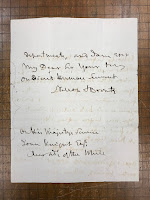
Second page of Nelson letter which includes his signature."ENGLAND EXPECTS THAT EVERY MAN WILL DO HIS DUTY" and opened the engagement, Nelson was shot by a French sniper. He died three hours later, long enough to hear of his victory over the French.

It's almost difficult to wrap your head around just how popular Nelson was at the time of his death (even Churchill after WWII doesn’t match him) and how keenly his loss was felt. Considered by many to be the embodiment of the fundamentally British nature, coupled with a life packed with adventure, heroism and scandal, it may come as no surprise that Britain went Nelson-crazy after the death of the admiral. Taken in context, this letter becomes more than a nest of scribbles, more even than a request for frigates and food. As a part of the material culture surrounding the life of Britain’s greatest naval commander, it joins the ranks of the "Cult of Nelson", giving the viewer a tangible link to the essence of what it means to be British, and to be a hero.

To examine Nelson's penmanship for yourself, come to Rauner and ask for Ticknor 805530.1.

Posted for Whitney Martin '17.

Thursday, June 1, 2017

So Pretty!

We don't have much to say about this item, except we can't believe how pretty it is. It has been kicking around in the collections for a long time in our uncataloged realia collection. We have been sorting through boxes of stuff this past year to see what treasures might be hidden away. Mainly we are finding things that people once thought were really important relics, but that have since become a little less than inspiring. We are also we are finding some gems and cataloging them.

Definitely jumping up toward the top of the list of awesome finds, is this herbarium of plants from Syria lovingly assembled by William Bird, a missionary from the Class of 1844. He had a decorative flair and wasn't afraid to make a statement with his samples.


It is cataloged and on the shelf now, so you can see it by asking for Codex MS 003273. It is well worth your time.

Tuesday, May 30, 2017

Survival

Inscription by A. Greely in his copy of "Arctic Voyages"We have a lot of books and manuscripts that are remarkable survivals. How they managed to make it through time and space and land safely in a library is a wonder in and of itself, but we just acquired a new item that endured an arctic expedition that only a handful of people lived through.

The Lady Franklin Bay Expedition, 1881-1884, (also known at the Greely Expedition) set out to establish a scientific observation station. It all started out smoothly enough, and they even established a new "farthest North." But things fell apart when relief ships were unable to reach the station and they had to flee to the south in hopes of rescue. Stranded with only minimal provisions at "Camp Clay," they slowly starved to death, and some resorted to cannibalism. Only six of the crew lasted long enough to be rescued.

We have a rich cache of materials related to their ordeal including David Brainard's diary from the last months of the expedition. The newly added item is Adolphus Greely's copy of The Arctic Voyages of A.E. Nordenskiƶld, 1858-1879 (London: Macmillan and Co., 1879) that he brought along on the journey. That it was carried safely home is astounding. As Greely notes:
This volume... was one of the few books in our library at Camp Clay, Grinnell Land, during the winter of 1883-1884. It shows marks of usage in keeping with the vicissitudes experienced by the loyal soldiers of the American army, and the faithful Eskimos of Greenland, who formed my command.
There is some marginalia, and the front cover is detached, but, all in all, the book did well. To see it, ask for Stef G625.L477 1879.

Friday, May 26, 2017

Monetary Policy for Dummies

Cartoon description of Tarrifs and their impact on economyIn his 1657 Lettres Provinciales, French philosopher and mathematician Blaise Pascal quipped: “I would have written a shorter letter, but I did not have the time.” This pithy expression captures the genius behind The Story of Bretton Woods (a topic we covered ourselves less graphically a few weeks ago). Equipped with 20 illustrated pages and simple vocabulary, this WWII-era pamphlet informed American children about the 1944 Bretton Woods Conference. The conference’s express purpose was to create a stable financial order for the postwar world. Explaining these ideas at any length is notable, but this pamphlet’s concision sets it apart.

cartoon depiction of economic warfare
For five cents per copy, parents could educate their children about “the kind of world we make for them now.” Yet, we suspect The Story of Bretton Woods had an ulterior motive. Stocked with the twin virtues of brevity and clarity, it could effectively mobilize the voting age population to support the conference’s legislation. We are uncertain whether the pamphlet targeted adults, but its educational value is clear 70 years later.

"Cover to Bretton Woods is no Mystery" depicting a baby reading a newspaperTo see The Story of Bretton Woods, ask for ML-3, box 108, folder 6. As bonus there is another example of Bretton Woods simply explained for lay people, Bretton Woods is no Mystery.

Posted for Drew Leonard '19

Tuesday, May 23, 2017

Bursting the Dartmouth Bubble

Image of title "A Dialogue written for commencement. D. College August 22, 1804. By Stephen Farley& Avery Williams."When Dartmouth was a young institution and still situated in a "wilderness" without easy access to Boston, New York, or even Lebanon (let alone radio, television, movies, or the internet), you could image the "Dartmouth bubble" would have been a lot worse than it is today. When you came to campus in 1800, there really wasn't much of anything you could do outside of the tiny town of Hanover. But, we have an amazing bit of evidence from 1804 that the students were looking outwardly and applying their education to the broader world. That year two graduating seniors wrote and performed, as part of their commencement ceremony, a blank verse work entitled "A Dialogue on the Revolution in St. Domingo between Toussaint and Dessalines."

Page one of the hand-written "Dialogue" from 1804.
What? Two guys in the boonies of New Hampshire portraying Haitian revolutionaries just as Haiti is establishing its independence? What? They hadn't been to Haiti on an FSP and didn't even have the internet to help them with their research? Such a very cool bursting of the Dartmouth bubble!

You can see the original by asking for DA-43, Box 3112. We also have an easier-to-read transcription prepared by Errol Hill in 1989 at DC Hist F1923.F35.

Friday, May 19, 2017

One Genius Too Many

Title Page of Book, reading "An Historical, Physiological and Theological Treatise of Spirits, Apparitions, Witchcrafts, and other Magical Practices. CONTAINING An Account of the Genii or Familiar Spirits, both Good and Bad, that are said to attend Men in this Life; and what sensible Perceptions some Persons have had of them: (particularly the Author's own Experience for many Years.) Also of Appearances of Spirits after Death; Divine Dreams, Divinations, Second Sighted Persons, &c. Likewise the Power of Witches, and the reality of other Magical Operations, clearly asserted. With a  Refutation of Dr. Bekker's World Bewitch'd; and other Authors that have opposed the Belief of them. By Jonh Beaumont, Gent. Praestat aliqua probabiliter nosse de rebus superioribus & Caelestibus, quam de rebus inferioribus multa demonstrare. Arist. Moral. 9. London: Printed for D. Browne, at the Black Swan without Temple-Bar; J. Taylor, at the Ship in St. Paul's Church-Yard; R. Smith at the Angel without Temple-Bar; F. Coggan, in the Inner-Temple Lane; and T. Browne without Temple-Bar, 1705.
We've recently acquired an interesting text that was authored by an equally interesting individual. John Beaumont was an English physician and geologist who was an early member of the Royal Society, a learned society for science that was founded in 1660 and is still in existence today. Beaumont lived in a small town in southwestern England called Ston Easton, within the county of Somerset. Many of his geologic interests centered around the exploration of limestone caves near his home, and he wrote several letters to the Royal Society that provided information about his discoveries. Robert Hooke, the Society's Curator of Experiments and the author of Micrographia, encouraged Beaumont to pursue further study of the natural history of Somerset.
an engraving that shows An Evil Genius on the left, who looks like a bearded man wrapped in an animal skin; and "2 Good Genii" on the right, both holding what appear to be cornucopia and wearing laurel garlands. The left-most of the two appears to be a young child while the right-most is a bearded man.However, despite his interest in rocks and stones, Beaumont's true fascination was focused upon more ethereal subjects. In 1705, at the age of fifty-five, Beaumont published An Historical, Physiological, and Theological Treatise of Spirits, Apparitions, Withcrafts, and other Magical Practices. In particular, Beaumont was interested in discussing what he calls genii, or familiar spirits. Distinct from our modern understanding of jinn or genies, which have their origins in Arabian and Islamic mythology, Beaumont's concept of genii is more in keeping with ancient Roman religion. For ancient Romans, a genius was a sort of guardian angel or spirit that served as a personal protector for every individual. Our current use of the term to indicate someone of exceptional ability or talent derives from the early Romans' attribution of the accomplishments of great individuals to their extraordinarily powerful genius, or guiding spirit. 
An engraving captioned "Jews going out in the Moonshine to know their Fortune". The image is of four men holding palm fronds and gesticulating at a shining moon that is half-hidden behind some clouds.For Beaumont, the existence of genii was more than an abstract theoretical notion; in his book, he identifies himself as someone who had the dubious gift of "second sight," whereby he was able to see a vast multitude of spirits all around him at all times. Beaumont states that "this gift is very troublesome to those that have it, and they would gladly be rid of it; for if the object be a thing that is terrible, they are seen to sweat and tremble, and screek at the Apparition." Over a three-month period, Beaumont claims that he was attended night and day by two spirits, who spoke with each other and a number of other spirits who came calling at his bedroom door. The spirits were dressed in "Womens Habit, they being of a Brown Complexion, and about Three Foot in Stature; they had both black, loose Network Gowns, tyed with a black sash about their Middles, and within the Network appear'd a Gown of a Golden Colour, with somewhat of a Light striking thro' it; their Heads were not drest with Topknots but they had white Linnen Caps on, with Lace on them, about three Fingers breadth, and over it they had a Black loose Network Hood."
Beaumont's experience with these genii naturally caused him some consternation, given his predisposition towards natural science, and so he attempts towards the end of his text to provide rational hypotheses for the existence of these spirits as well as providing examples from Judeo-Christian theology. Ultimately, you'll have to be the judge of whether he makes a convincing argument or not. Come to Rauner and ask for Rare BF1445 .B4 1705.