Friday, April 22, 2016

It's a Sailor's Life for Me

main body of indenture
Here at Rauner we've recently acquired a wonderful little manuscript from the late seventeenth century that fits nicely with one of the many classes that come through our doors every term. MSS 683430 is an apprenticeship indenture from England that was created during the reign of Charles II. An apprenticeship indenture was an arrangement whereby a minor, usually twelve to thirteen years of age, was contractually bound to a master craftsman by his parents or guardian who paid the master to train the young man or woman in a particular craft while providing for his or her basic needs.

Typically once the apprentice reached the age of twenty-one, he or she was released from their legal obligation to their master. Although quite common in England from the twelfth century onward, the apprenticeship model began to fall out of favor in the eighteenth century with the advent of the Industrial Revolution, which introduced wage labor and therefore made it difficult for skilled craftsmen to set up their own independent shops.

This particular indenture, signed on July 30, 1683, binds Thomas Barker to Richard Hains of Stepney
outside of indenture containing signature of justice of the peace
to learn the mariner's trade for the usual duration of seven years. The wavy top edge of the indenture is deliberate and was common for legal documents of the time. Once an indenture had been completed and signed by a Justice of the Peace, it was then cut down the middle in a distinctive pattern to create a unique two-piece puzzle that could be reconstituted on demand to confirm its authenticity. Typically, the apprentice's parents or parish church would hold one copy and the master would hold the other which was meant to ensure fair dealing. Our indenture was most recently employed in Carl Estabrook's "Britain and the Sea" history class, where students were able to examine it firsthand.

To explore the indenture yourself, come to Rauner and ask for MSS 683430.

Tuesday, April 19, 2016

The "Beaver Map"

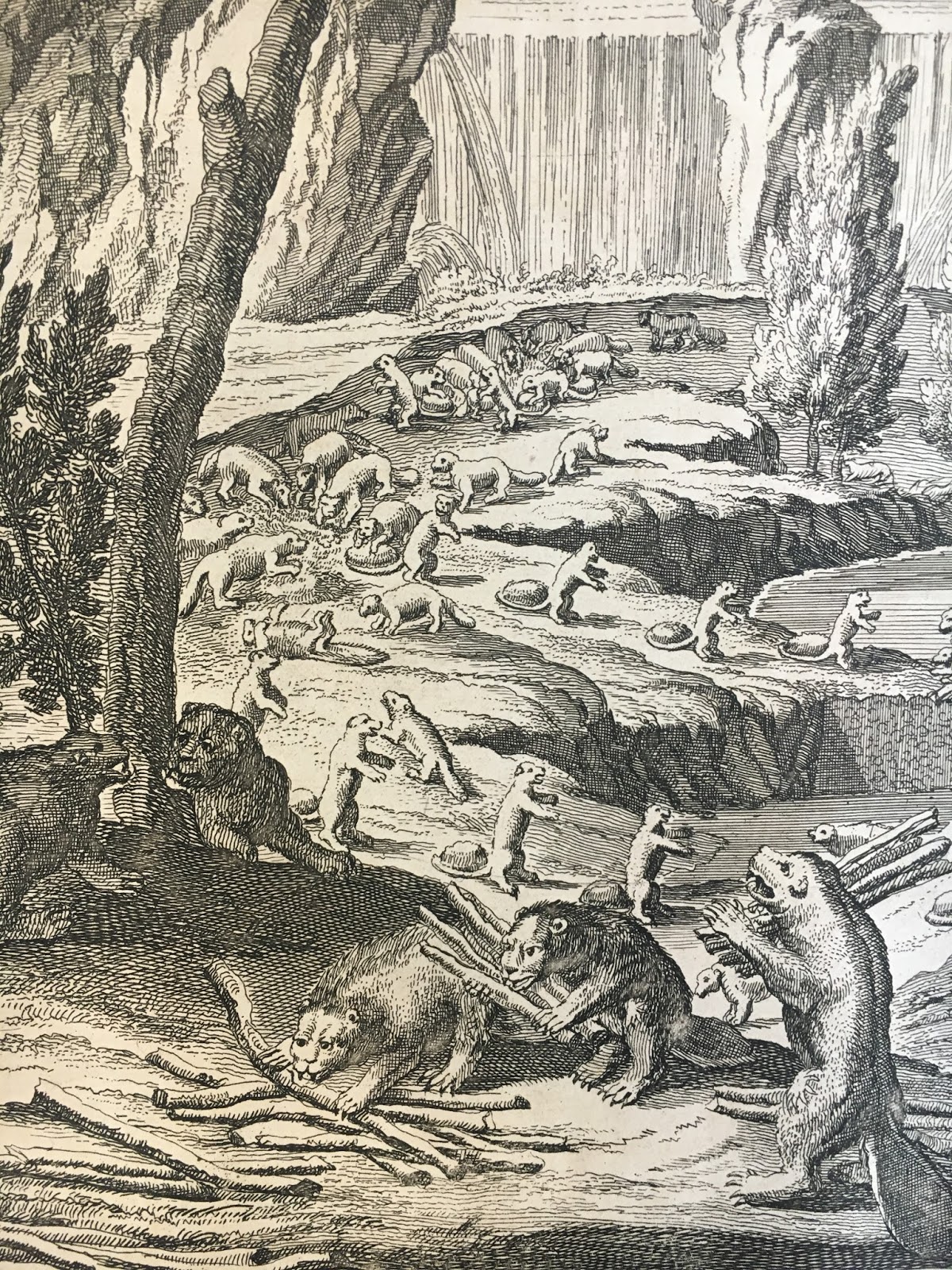
close up of Moll's beaver cartouche
"A View of Industry of the Beavers of Canada in
making Dams to stop the Course of a Rivulet..."
Today, beavers are a symbol of industry and hard work in the western world, but before Herman Moll's famous "Beaver Map," few Europeans even knew what a beaver was.

Herman Moll (1654?-1732) was a London-based cartographer famed for his accuracy. The "Beaver Map" is one of the first to show the extent of British settlement and colonization in North America after the Treaty of Utrecht in 1713 -- and Moll claims a bit more for the British than the French would have liked.
full spread of Moll map
The map's fame comes from the large engraving of beavers working near Niagara Falls (detail to the left). The beavers are seen gathering sticks in their arms and carrying rocks and mud on their tails -- an allegory for British colonization and the hard work of taming the wild North American landscape (and destroying extant civilizations). The beavers look a bit like lions or bears, but both their appearance and curiously human traits would have been unknown to a European audience. It turns out that Moll copied the beaver scene from a French  cartographer, Nicolas de Fer (1646-1720), who included a very similar engraving on a map in 1698. 

Our "Beaver Map" is contained in a version of The World Described : or, a New and Correct Sett of Maps: Shewing the Several Empires, Kingdoms, Republics...in all the Known Parts of the Earth seems to be an amalgamated edition of maps produced between 1709 and 1720. Each map is a different size when unfolded. For the map nerds out there, it also contains two Ortelius maps.

the dead beaver
A beaver casualty
Students in Professor Musselwhite's history class on America and Empire will be using many of our sixteenth, seventeenth, and eighteenth century maps to trace a specific space (a geographic formation, town, etc.) through time. The "Beaver Map" is in Rare Book G1015 .M6 1709.

Saturday, April 16, 2016

Learning to Curse in Russian

don't let the bastards get you down notesBondar's Simplified Russian Method sounds like a tame linguistic instruction manual. And it is. But Kenneth Roberts (1890-1972), a reporter and historical novelist who received an honorary degree from Dartmouth in 1934, wanted to learn a different kind of Russian.

In the front of Roberts's personal copy of Bondar's book, there are several taped-in notes. Each one contains some variation on the phrases "Don't let the bastards get you down" and "They're all a bunch of bastards." The notes contain the Cyrillic script for these two phrases and a pronunciation guide.

don't let the bastards get you downDuring World War I, Roberts served as a member of the Siberian Expeditionary Force. Was this part of his training? How he kept up his spirits in the field? The rest of the book is curiously unmarked.

To see the Roberts copy of Bondar's Simplified Russian Method, ask for Roberts Library PG2111 .B65 1917. We also have a Kenneth Roberts manuscript collection (ML-25), and have written about Roberts in the Library Bulletin, discussing his nickname "the irascible Mr. Roberts" -- which these notes seem to bear out!

Tuesday, April 12, 2016

Binding Matters

Image of unbound book from spineIt is just so tacky when the books on your shelf don't have the same aesthetic. That Penguin paperback looks so odd next to the Harlequin romance, and they both clash with the hardbound Harry Potter book you stayed up until midnight to buy when you were 12 years old. Such a fate never worried discerning 18th and early 19th century book buyers--they just made sure to get the proper binding right from the start.

Until a few decades into the 19th century, most books could be purchased sporting a simple, temporary paper wrapper or just in printing sheets, folded and side stitched. The buyer would then have a binding put on to match his or her taste and to express the value he or she placed on the book. If the book did not get bound, it usually fell apart or was badly damaged.

Image of side stiched binding knot
That's why we were so excited to receive a gift of a remarkable survival: The Beauties of Religion, by Elijah Fitch and printed by John Brown in Providence in 1789. The book is still in its original signatures, stacked up and casually held together with a simple side stitch. Oddly, it seems like it has been read--the pages have all been opened, and there are signs that the pages have been turned. Why wouldn't someone get it bound, or at least put on a study wrapper? We don't know, but we are happy to have such a  great example.

Title page of Beauties of Religion
To see it, ask for Rare PS744.F4 1789. For another good example see our Acts and Laws of the State of New-Hampshire from 1788.

Friday, April 8, 2016

Wonder Woman for President, 1972

First issue of Ms set on September 1972 issue of The DartmouthWhen we look back at major milestones in Dartmouth's history, we often get caught up in the local conditions that spurred the changes and forget about the broader cultural context. Dartmouth's decision to admit women is a case in point. The discussions we see almost always revolve around the campus response, the difficulties the first generations of women faced, and the impact on campus life. But, of course, the decision to make Dartmouth a co-ed institution occurred at a time when the nation as a whole was wrestling with issues raised by second-wave feminism.

That national context was one of the reasons we were thrilled to receive a mint condition inaugural issue from 1972 of Ms., the magazine that quickly became the primary venue for mainstream feminist thought.  Just a month later the first class of women enrolled at Dartmouth. The 1972 local news in the D resonates in new ways when juxtaposed with this new voice of a national movement. But also, the cover stories speak to the continued social and political battles of today: "Wonder Women for President," "Money for Housework," and "Gloria Steinem on How Women Vote."

Come see it, and the curious mix of ads it contains (Coppertone wasn't too sure how to speak to the feminist movement!) by asking for Rare HQ1101.M55 Vol 1, No.1, 1972.

Tuesday, April 5, 2016

Malcolm X at Dartmouth

Malcolm X at Dartmouth, January 26, 1965On January 26, 1965, Malcolm X visited campus at the invitation of the Undergraduate Council to offer Dartmouth students an alternative viewpoint to Martin Luther King, Jr. and James Farmer, both of whom had visited campus in the recent past. As you might expect, Malcolm X stirred up controversy with his lecture in Spaulding Auditorium and extended interview on the campus radio station, WDCR.

The D reported that Malcolm X promised "A Long, Bloody Summer," and a series of editorials and letters to the editor alternated expressions of fear, hostility and admiration. The D editorial board was unimpressed. They defended his right to speak on campus, but criticized his views: "His arguments were often irrational and his solutions, based on the ends to be achieved, often ignored the implications of the means to accomplish the ends."

Richard Joseph '65 offered a rebuttal to the editorial board under the disclaimer "THIS COLUMN DOES NOT NECESSARILY REPRESENT OR REFLECT THE POLICIES OF THIS PAPER" and letters to the editor supported Malcolm X. Just a few weeks later, Malcolm X was murdered. Dartmouth students, so recently debating his ideas, had to confront Malcolm X's life, death, and ideas on a personal level.

Come in and read the whole story in the D on our open reference shelves. To read the transcript of the WDCR interview, ask for the Malcolm X vertical file.

Friday, April 1, 2016

A Painful Cure

cover of Hervey's cureWhile researching early pharmaceuticals and medicines for a class, we came across a pamphlet bound in creased yellow wallpaper. Inside, it details a "Cure for Venereal Disease."

The cure includes syringing the penis with a mixture of flax seed, tea, and milk, before progressing to a mixture of "white vitriol" and "rain water." It sounds like a painful cure to a painful disease ....

There are also various warnings about food and drink. In the first week, you can drink a "very moderate quantity" of gin, but cannot drink rum -- "Drink no rum" -- or eat "very little salt pork."
open spread of Hervey's cure
During the class, we discussed how the lack of context changes our evaluations of the item. One student said that if it were made in the seventeenth or eighteenth centuries, it would seem more medically valid, whereas if it were from the nineteenth or twentieth centuries, he would view it as folkloric or somehow medically dubious.

Hervey Fisher was a Dartmouth Medical School graduate of the class of 1818. He became a practicing physician and died in 1847. This pamphlet isn't dated, and I'm curious whether it was produced while he was a student or a practicing doctor. Is a prescription for a patient? Notes from a lecture? The wear on the front cover seems to imply that it was used or carried, making me lean towards the former. If you have any theories, let us know!

To see the "Cure," ask for MS 002124. We also have a booklet of Hervey's lecture notes on surgery, chemistry, theory and practice of medicine, and "natural philosophy" from his time at Dartmouth (MS 002364).