Friday, September 9, 2011

The First Tripees

A man hauling packs into the back of a truck.
1938 Trip
On September 10, 1935, a group of 16 freshman ventured into the wilds of northern New Hampshire on the first Freshman Trip. In the year 1934-35 the Outing Club was undergoing some internal scrutiny. There had been a “sharp decline in paid memberships” and the club was accused by some of “aloofness and unco-operativeness.” The first Freshman Trip was characterized in The Dartmouth as an “acquaintance trip” to introduce freshmen to the Outing Club and the “White Mountains and the territory.” Acquaintance trips had been tried before, but this trip was different as it was scheduled to take place before school was in session.

A group of men seated together outdoors.
1939 Trip

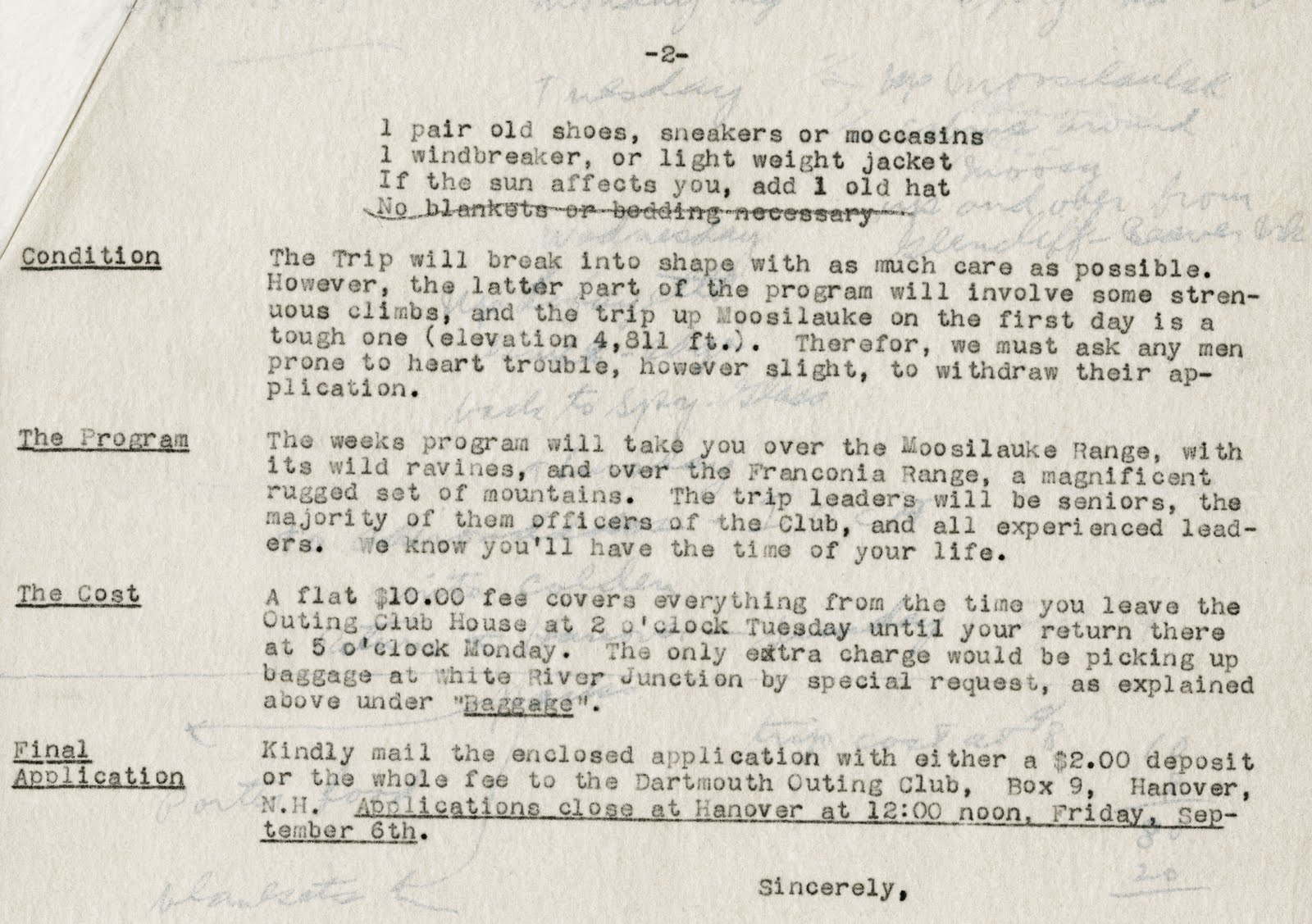
A page of typed text.
1935 application
The application for the 1935 trip notes that, “The trip will break into shape with as much care as possible. However, the latter part of the program will involve some strenuous climbs, and the trip up Moosilauke on the first day is a tough one.” The students arrived back to Hanover “sun and wind burned.” No mention is made of the success of the trip, but since the trips have now been going on for 76 years, we can assume it was a hit. Notably, one of the students on the trip was named Daniel Webster. This Dan went on to become a physician, not a statesman like his namesake, but it seems appropriate that the name Webster should be associated with the first Freshman Trip.

The records of the Outing Club are held in Rauner and a finding aid is available.

Tuesday, September 6, 2011

Churchill vs. Churchill

A photograph of a man.When you hear the name Winston Churchill, you probably start thinking about cigars, England, World War II, and other details associated with the former Prime Minister.  But what about the American author of the same name?

The American Winston Churchill (1871-1947) was the author of several national best-sellers, most of which are now unknown despite their incredible popularity at the time.  At the turn of the 20th century, the other Winston Churchill was just starting out in his career as a writer and publishers sometimes confused the two authors as both published under the name "Winston Churchill."  To remedy this situation, the two Churchills agreed that the British Churchill would add an initial - "S" for Spencer - to distinguish himself from the American, who had no middle name.
A photograph of a young man in uniform, labeled "Winston S. Churchill" by hand.
Winston S. Churchill
The two also corresponded about more personal items.  In this December, 1900 letter from Winston S. Churchill accepting a dinner invitation from Winston Churchill, Churchill writes "I look forward to making your acquaintance with particular interest, for hitherto we have known each other only by name and repute."
A handwritten letter.
Letter, December 1900
Winston Churchill later used the proceeds from his novels to build himself a mansion, Harlakenden House, in Cornish, New Hampshire.  He became an active member of the Cornish Art Colony, whose members included Augustus Saint Gaudens and Maxfield Parrish and also successfully ran for state office several times.

Dartmouth holds Winston Churchill's papers and a guide to the collection is available.

Friday, September 2, 2011

Fun Origami

A book of colorful, sculptural elements.This one counts as one of the oddest books we have ever acquired. It is almost difficult to call it a book any longer. Technically, Fun Origami (New York: Sally Agee, 1988) is an "altered book." The artist folded, cut and painted each page of a book she found then laid in bits of cut fabric, interesting papers and even a few snippets of instructions to guide the reader. The final book no longer really functions as a codex. It is very difficult to turn the pages, and it won't close. It has turned into an explosive collage of New York faces, conversations, and political and social statements of the late 1980s: "Nelson Mandela"; "Music on Voyager from the sun blew a bubble between the stars"; "Oh my, so cool, oh my."

Sally Agee earned a BFA from Syracuse University, then became a teacher. After extensive travel, and spending 15 years raising her family, she revived her art career by taking art classes. She says of her own work:
If I must describe it, I think I would say it was divided into textile design, book art, fabric art, and collage. But there is a lot of over lap and mixing, and that is the way I like it. I could never narrow down my interests.
The edges of "Fun Origami," which are colorful and somewhat lumpy.
To look through Agee's altered artwork, come to Rauner and ask for Presses A32agfu.

Tuesday, August 30, 2011

Freak Winds

A booklet titled "Freak Winds."
Souvenir booklet, 1938
Dartmouth dodged the bullet of Irene. For the most part the campus was spared any major damage, though the Dartmouth community is suffering. Neighboring communities were hit hard by the storm, and many staff and faculty are dealing with damaged homes, roads, and bridges. Even more are without power. For many, it was a pleasant surprise to arrive on campus yesterday after navigating through scenes of destruction to find the Green unscathed and awash with sunshine.

An open booklet, filled with pictures of downed trees.
From Freak Winds
The campus did not get off so easily in 1938. "The Long Island Express" ripped through and tore out trees, damaged buildings and crippled campus just as the Fall term was about to begin:
Set in the midst of a shattered and desolate countryside, Dartmouth awoke this morning under serene skies to look on a pitiful spectacle of wreckage on its campus which nevertheless gave no index of the wide confusion and destruction surrounding Hanover and extending over the whole northeastern tip of the United States.
A copy of The Dartmouth, with the headline Damage Wide-Spread throughout New England."
To learn more about the '38 Hurricane's impact on campus, ask for the Vertical File "Hurricane, 1938."


Friday, August 26, 2011

Pieces of Wood

A simple wooden knife, carved with the words "Dartmouth '94."We have a lot of pieces of wood in our collections. We never seek them out, they find us. That's because Dartmouth loves its trees, and when a particularly memorable tree goes down, students carry away bits as mementos. The scraps of wood represent much more than the tree, they evokes the students' Dartmouth experience.

No tree is more represented in our collection than the Old Pine. Struck by lightning on July 29, 1887, the Old Pine was severely damaged, then a wind storm in 1892 weakened it further. On June 23, 1895, the tree was cut down (the stump was treated, and still serves a ceremonial role in campus life) and students gathered bits of it as keepsakes. One piece was carved into a letter opener by a member of the class of '94. He later donated it to the College, and it now resides here in Rauner.

A photograph of the Parkhurst Elm.
Last week we all watched the "Parkhurst Elm" fall victim to Dutch Elm disease. We noticed a few students walking away from the site with small pieces of wood. A ceremonial bonfire? Probably not, more likely we will see one of those bits of the Parkhurst Elm again in 40 or 50 years in another form. And it will be too cool to throw away...
A photograph of the spot where the elm was, now cut down.

To see the letter opener, ask for Realia 117.

Tuesday, August 23, 2011

What's with the arrow in his head?

An allegorical representation of America, with her foot on a severed head.
In 1662, Joan Blaeu published his 11-volume Grand Atlas, Geographia. The frontispiece to the final volume depicted the New World in allegorical terms. America stands amid a scene of wealth and violence, her foot placed on the severed head of a European, an arrow shot clean through his skull.

A close-up of the head, shot through with an arrow and being hissed at by a large animal.
What is that all about? We have used it for years in classes where we discuss the various components of the image--the Conquistador ushering in Christianity, the bars of silver, the exotic caiman-like lizard--but it was not until this spring that we acquired the key, the 1618 edition of Cesare Ripa's Nova Iconologia (Padua: Pietro Paolo Tozzi, 1618).

A printed page including a woodcut of an Allegorical America. A head and lizard are at her feet.
The Nova Iconologia was first published without illustrations in 1593, then with 151 images in 1603. This 1618 edition contains over 300 woodcuts with descriptions that were used by artists and poets to make abstract concepts like the passions, virtues and vices, and even places, concrete in form. The book influenced late-Renaissance artists and is an essential guide to the imagery of the time. America appears on page 353, looking very much like Blaeu's later frontispiece. The detailed explanation of the iconography reveals that the severed head is all that remains of a victim of the barbaric cannibals.

To see the Blaeu atlas, ask for Rare Book G1015.B48 1662.  For the Ripa, request Rare N774.R52 1618.

Friday, August 19, 2011

The Pressure of Light

A photograph of a room of lab equipment.Ever think that you can feel the sun's rays beating down? While that impression may be illusory, visible light and all forms of electromagnetic radiation actually do exert pressure on a surface.

First predicted by James Maxwell in 1871, experimental evidence for the phenomenon wasn't produced until the turn of the century. The Russian physicist Peter Lebedev was the first to measure this radiation pressure and announced his findings in 1900 at a conference in Paris. The measurement was independently confirmed by two Dartmouth researchers in 1901 - Gordon Ferrie Hull and Ernest Fox Nichols (later President of the College, 1909-1916). Pictured here is the apparatus used by Hull and Nichols in their experiment, including the Nichols radiometer, which is now in the Smithsonian.

Hull and Nichols were apparently unaware of Lebedev's findings until after their discovery which they first published in an article titled "A Preliminary Communication on the Pressure of Heat and Light Radiation" in the November 1901 issue of The Physical Review (conclusive evidence was published in The Physical Review in July of 1903).  In a later article in The Astrophysical Journal, they wrote that "Unfortunately the proceedings of the Paris Congress did not reach the writers, nor any intimation of the methods or results of Professor Lebedew's work, until after the publication of their own preliminary experiments."
A photograph of three men.
Left to Right: E.F. Nichols, J.A. Brown, G.F. Hull, 1903
Rauner holds Gordon Ferrie Hull's papers which include correspondence, photographs and other material about his work with Nichols on radiation pressure, as well as Hull's later work in ballistics during World War I. In addition there is correspondence between Hull and various scientific notables, including Ernest Rutherford, George Hale, and Robert Milliken.

To read more about radiation pressure, ask for the Hull Papers (ML-47).  A guide to the collection is available.