Friday, October 4, 2024

A Slaver's Schematic

Much is known about the British and American abolitionist pamphlets and newspapers that circulated in Europe and North America during the early 1800s. One example, abolitionist Thomas Clarkson's 1808 schematic of the slave ship Brooks, depicted enslaved Africans crammed together in the hold like cargo containers without any room to move. That infamous engraving appears frequently in publications, presentations, and exhibits about the Middle Passage.

Here at Rauner, we have a publication, Affaire de la Vigilante (1823), with a similar engraving that was made by Charles-Philibert de Lasteyrie. De Lasteyrie was a founding member of the Society of Christian Morality, a group that started in 1821 with the aims of abolishing the slave trade, improving the conditions of French prisons, and providing aid to refugees, among others. Although this pamphlet is anonymous, it's a safe bet that it was written by a member of the Society, if not by de Lasteyrie himself.

Affaire de la Vigilante documents the capture of La Vigilante, a French slaver, by the British Navy on April 1, 1822, off the coast of Africa. The 345 enslaved people on board were liberated and then escorted to Sierra Leone. France had banned the slave trade in France itself in 1818, but would not require the same for French colonies until 1848. One scholar has suggested that France's lack of zeal in pursuing anti-slavery legislation for their colonies was because, in their minds, they connected the ban of slavery at home with Napoleon's defeat.

To explore a rare French abolitionist pamphlet, and to examine the schematic of La Vigilante, come to Rauner and ask to see Rare HT985 .A32 1823.

Friday, September 27, 2024

"I am now confused": The Complexity of Divestment

The student protest movement against apartheid in the 1980s was arguably one of the most memorable events on campus during the latter half of the 20th century. Most people who know of the movement understandably associate it with the attack on the student-built shanties on the Green during the early hours of January 22nd, 1986. That assault, and the national news attention it raised, was a flashpoint for the Dartmouth community about whether college divestment from companies doing business in South Africa would have an impact on apartheid or not. Three and a half years later, Dartmouth had completely divested itself of business connections to companies still working within the apartheid regime. A few years after that, apartheid in South Africa was eradicated.

Although 1986 was a significant year for Dartmouth in terms of anti-apartheid protest, discussion and debate over divestment as a meaningful lever for global political change already had been occurring on campus for several years. On January 21, 1980, the Student Council passed a resolution calling on the college "to divest itself of and join the boycott of all investments in firms with commercial ties to apartheid in South Africa." Optimistically, the Student Council's resolution envisioned this process concluding by May of 1981.

Three years later, divestment had not occurred but the topic was still of interest to the Dartmouth community: on May 17th, the Tucker Foundation sponsored a debate on divestment between Dartmouth professors Hoyt Alverson (Anthropology) and John Hennessey (Economics/Tuck). According to an account published by the Dartmouth, both speakers emphasized that they were "appalled" by the white minority government in South Africa but they disagreed on the most effective way to eliminate it. Alverson argued in favor of making a statement against South African apartheid through the College's investment policies; he pointed out that the country was a product of Western investment and therefore we are responsible for its current state. He also argued that US business investment in the country had not made life better for Black residents because it was primarily capital and not labor-based. Moreover, Alverson emphasized that US investment was used as justification for the continuation of the racist system of governance. Although Dartmouth alone would likely not have a measurable effect on US or South African policy, Alverson believed that the gesture would matter if other institutions also participated.

Hennessey countered by claiming that divestment is virtue-signaling and an empty gesture. He argued that selling off Dartmouth stock in those companies would simply make those shares available for purchase by someone else who might not be as concerned with the state of South Africa: "To divest is simply to give up the right to vote and participate in company policy formulation." Instead, Hennessey recommended that the college put pressure on those companies to change their policies and on Congress to regulate those businesses more strictly. He then asked, "What is moral purity? Does it mean refusing to touch all money with any South African ties?"

In a letter written to Hoyt Alverson after the debate, Professor William Dougan (Economics) concisely summarized the two perspectives: "You do have the 'symbolism' argument in your favor, and it is formidable. Hennessey's point, which is valid, is that in opting for a symbolic gesture you are forgoing an opportunity to exert more substantive if less visible effects." At the conclusion of the debate Fred Berthold, the acting Dean of the Tucker Foundation, likely spoke for many people when he said, "About three weeks ago I was an ardent advocate of total divestment....I am now confused."

To see documents related to the debate, including the letter from Dougan to Alverson, come to Rauner and ask to see the "Debate on Divestment folder from the Records of the Vice President and Treasurer (DA-2, Box 7880, "Debate on Divestment").

Friday, September 20, 2024

Exhibit: Bloody Books - Pulp Fiction in Victorian England

This exhibit presents the panoply of cheaply printed serial fiction that flooded the literary markets in early Victorian England. The British working class, increasingly literate and increasingly urban, represented a new market for reading material that catered to their interests and was affordable.

In response, savvy publishers began to print cheap magazines, long serials, and novels in parts during the 1830s and 1840s that were aimed initially at working-class men and then later at a juvenile audience. These texts were almost unwaveringly sensationalist and derivative in terms of content, often plagiarizing popular Gothic romance novels or summarizing lurid tales of true crime, ripped straight from contemporary newspaper accounts. These provocative and violent stories often sold for a mere penny an issue, and British society initially used a blanket term to describe the exceedingly popular but highly ephemeral genre: "penny dreadful".

The exhibit was curated by Morgan Swan and the poster was designed by Sam Miles. It will be on display in the Class of 1965 Galleries in Rauner Special Collections Library from September 16 through December 13th, 2024.

Friday, September 13, 2024

Exquisitely Stenciled

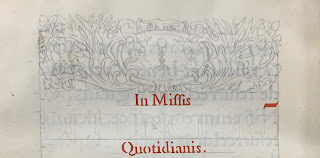
Decorated opening from Codex MS 003530This book is so cool, we can't believe it. It is a liturgical guide for feast days produced in the Benedictine monastery of Ambronay in 1740, and it is neither print nor traditional manuscript. Instead, the entire text was created using stencils on vellum. If you look closely, you'll see every letter is cut to make it hold together for inking. Imagine the work that went into creating this!

Detail of unfinished illuminationExtra interesting for us is that the illuminated decorations were never completed. That allows us to see the process they employed to create the book--sketching out the decorations, then carefully filling them in. It is another case of a devotional book being created as an act of devotion. Stunning, inspirational, and a joy to handle.

                                            Detail of unfinished illumination

Come in and ask for Codex MS 003530 to experience it for yourself.

Friday, August 30, 2024

A Dartmouth Professor's Horror Story

Dust jacket cover of The Cadaver of Gideon WyckIn 1934, Alexander Laing (1903-1976), a former Dartmouth English professor and educational services director, co-authored and edited a Depression-era book of gothic horror titledThe Cadaver of Gideon Wyck. Incredibly, the book reimagines both the President and Head of the Medical School at a small rural New England college as corrupt practitioners of the occult who perform secret experiments on unsuspecting townspeople while attempting to convince the scientific community to accept their parapsychological delusions.

Set at the fictional "University of Maine," Laing makes no apologies about the book being inspired by his experiences as both a Dartmouth student and faculty member. Given Dartmouth's history, naturally there is also a subplot involving a state legislator threatening to defund the college. The January 21, 1934, New York Times book review called the work "gruesome," "shocking," "grisly," and an "enthralling mystery yarn told with the skill of a master." It reportedly sold 200,000 copies and was a bestseller. The late-stage-Art Deco frontispiece of The Cadaver of Gideon Wick is also remarkable. It is illustrated by Lynd Ward, who would go on to become well-known in his own right for The Biggest Bear, among other works. The details of the etching accurately depict events of the book.Frontispiece to The Cadaver of Gideon Wyck

In a March 1934 edition of The Plowshare, Laing described himself as a former poet whose "first post-college job, in Wall Street, lasted two weeks." "For four years… [he] has held a kind of roving commission on the Dartmouth faculty, teaching no classes, but working informally with undergraduates interested in the arts." He goes on to say "[p]oetry… is still his profession, despite the necessity for supporting his family by more remunerative avocations." Laing mentions nothing about the identity of his secretive co-author, and nothing more would be known for the next twenty-five years.

Upon the 1959 publication of an edited version of The Cadaver of Gideon Wyck the mystery author was revealed to be Dartmouth alum Dr. George Young McClure '25. He passed away December 18, 1960, in Fayetteville, N. C., where he was chief pathologist at the Veterans Administration Hospital. According to his obituary in the November 1961 issue of the Dartmouth Alumni Magazine, McClure felt that the nature of the books might hurt his medical career, which included researching polio with the New York Department of Public Health and cancer research at Memorial Hospital in New York City.

To see a first edition of The Cadaver of Gideon Wyck from 1934, come to Rauner and ask for Alumni L144c. We also have copies of the 1960 and 1962 editions as well as the Alexander Laing papers (ML-77). Box 43 in particular contains dust jackets and other ephemera related to Laing's writing career.

Friday, August 9, 2024

"Students Ducked at Hanover Fire"

At Rauner, we have some collections of letters that Dartmouth students wrote home from college over the years, and they give an interesting look into what was on the students’ minds in those times, including their perspective on events. One of these students, Frank Whitcomb, class of 1911, wrote to his sister Helen about a fire in Hanover and how he thought it had been misrepresented in the news.

On the night of October 13th, 1910, the Tavern Block on Main Street in Hanover caught on fire. The Hanover fire department rushed to fight the fire. Various Boston newspapers (the title of this post is the headline from the Boston Journal) reported that hundreds of students also rushed to the scene of the fire and fought to hold the nozzle of the fire hose, until the firefighters had enough of the interference and sprayed the students with the hose to keep them away. However, Frank Whitcomb (among other students) took issue with this account, explaining that the students who showed up at the fire were simply “too eager to assists the volunteers,” so the firefighters needed to use the hose to make more room. He also pointed out to Helen that “the hose which did the most of the work of putting the fire out was manned by two students.”

The events that unfolded should have been simple enough, but how the story was told depended on who was telling it. This event prompted The Dartmouth (whose account Whitcomb agreed with) to publish an article calling for a system to ensure truthful reporting of College news.

To read Whitcomb’s letters, come to Rauner and ask for MS-1438. (Or, ask about our other collections of student letters!)

Friday, August 2, 2024

The 1951 ‘Oedipus Mac’ article: A student response to the Korean War

If you had opened up a copy of The Dartmouth one afternoon on April 29th, 1951, you would’ve seen the headline “Oedipus Mac: A Modern Tragedy” in the editor’s section. But, the article wasn’t telling the story of the mythical Greek king of Thebes. Rather, you would know that the “Mac” in the title referred to General Douglas MacArthur, who had a hero’s homecoming the week before in New York as a beloved commander in World War II, but now more importantly in Korea. The article read like a satire and a personal attack on General MacArthur, scandalizing many of its readers and causing them to scrutinize the publication’s student Editor-in-Chief, who was also a veteran. While it was typical to adhere to the patriotic anti-communism of the 1950s, this student response to the Korean War reveals that at Dartmouth, Cold War language was used to interpret and describe issues beyond the ideological matter of communism, bringing seriousness and backlash within the campus discourse.

The Korean War is often historicized in terms of Cold War geopolitics and as an ideological confrontation between the Soviet Union and the United States. However, there is growing literature on the fragmented reactions to the Korean War and the different versions of “anti-communism” that were becoming increasingly embedded in social norms, which heavily depended on the local contexts and memories of WWII. For instance, historian Masuda Hajimu has written about how the Korean War served as a catalyst for the materialization of the Cold War for millions of ordinary people while before, he argues, it was a genuinely imagined reality that only existed because people believed it did. Along these lines, what I’m interested in is how the local context of the U.S. university campus (Dartmouth’s in this case) responded to the Korean War as a site of overlapping intellectual and policy activity, which was typical of universities in the 1950s, in addition to being a site of student culture and dissent.

The sociopolitical atmosphere of the early 1950s makes the “Oedipus Mac” article — which was published under Editor-in-Chief Ted Laskin ‘51 — quite audacious in the context. In the satire, both MacArthur’s policies and character were criticized, at one point stating, “as long as he had command in Korea, the U.N. realized that there would never be peace, because MacArthur was the Far East Caesar who dreamed of empire from Hawaii to the Ryukyus Islands.” It went on to call out MacArthur’s belief in “the White Man’s burden and its corollary, the slave psychology of orientals” and referred to “the treatment of Negroes under his command,” citing Thurgood Marshall’s report for the NAACP. It’s clear that besides condemning the U.S’ involvement in Korea, the editor(s) of The D were more interested in critiquing General MacArthur as an individual, despite his national popularity. Furthermore, the references to MacArthur’s racist attitudes and discrimination in the U.S. military indicate that topics such as civil rights, which are often expressed as “domestic” issues and viewed as separate from Cold War thought, actually had much to do with this response to the war in Korea.

Certain alumni were outraged by the article, and many even decided to write to President Dickey complaining about it. One alum in the class of 1909 wrote a letter to the editor of the Alumni Magazine, expressing his “rage and disappointment” not only towards Ted Laskin, but also towards the college administration for failing to prevent the taint to Dartmouth’s name. He questioned, “can Dartmouth men take pride in recent news stories which indicate an active sympathy with Russian Communism?” This reaction is confusing at first as The D article didn’t reference “Russian Communism” at all. However, this alum’s response can be well-contextualized in the emerging notion of “common sense” in 1950s American society, which was that communists, socialists, and leftists were all under the control of Stalin; and with the onset of the Korean War, this perspective crystalized. The growing advocacy for civil rights and labor rights were also perceived to be destabilizing existing social norms and hierarchies, further inflaming and conflating American “anti-communism” (Masuda 2015). In this way, we can see how a critique of General MacArthur, during a time when the U.S. was at war in Korea, was reduced to a “sympathy for Russian Communism” through the logic of one reader. 

By examining this specific incident, it becomes clearer that we shouldn’t understand discourse on the Korean War simply in terms of Cold War geopolitics. One’s local environment and identity need to be considered when historicizing how the Korean War was “experienced”. For example, many African American veterans of WWII condemned the racism and inequality of the very institutions that individuals like General MacArthur defended (Suri 2009). Within the context of Dartmouth’s campus (and I suspect on more college campuses), responses to the Korean War were never about the mere question of condemning or supporting communism, despite the incredible effort by policymakers, administrators, and ordinary people to paint the issue as such. President Dickey ended up writing his own piece for the Alumni Magazine’s June 1951 issue in response to The D’s article and the alumni complaints. In response to that, Ted Laskin wrote a seven page letter directly to President Dickey. What I find fascinating is that this campus saga was ultimately triggered by a student response to the Korean War. And surprisingly, with each letter of criticism towards the student behind the article, it becomes increasingly clear that they did not quite stem from confidence in the American Cold War ideals, but more from an insecurity regarding the institution’s reputation and the ideology it claimed to uphold.

To read the original article and the documents surrounding this controversy, drop by Rauner to look at our copies of The Dartmouth and the Dartmouth Alumni Magazine and ask for DP-12, box 7110, "Criticisms and Suggestions - The Dartmouth."

Bibliography:

Hajimu, Masuda. Cold War Crucible : The Korean Conflict and the Postwar World. Cambridge, MA: Harvard University Press, 2015. doi:10.4159/harvard.9780674735941.

Suri, Jeremi. Henry Kissinger and the American Century. Cumberland: Harvard University Press, 2009. doi:10.4159/9780674281943. 

Posted for Rachel Kahng '25, recipient of a Historical Accountability Student Research Fellowship for the 2024 Summer term. The Historical Accountability Student Research Program provides funding for Dartmouth students to conduct research with primary sources on a topic related to issues of inclusivity and diversity in the college's past. For more information, visit the program's website.