Friday, February 9, 2024

Fill the Bowl Up?

Glass beer mug with Dartmouth seal etching"If every dormitory man had one identical piece of personal furniture, it was a beer mug."

In 1975, Norman Carpenter '53 was living in Minneapolis and working as an attorney when he decided to write back to his alma mater and raise the alarm about alcohol use at Dartmouth. Carpenter had been receiving treatment for alcoholism for nearly a year when he opened the 1975 Alumni Bulletin Newsletter. He noted with a new "sensitivity" that the commencement and reunion events seemed to all revolve around alcohol consumption. In response, Carpenter wrote to the alumni magazine to share his story and concern for the Dartmouth community's relationship with alcohol.

Carpenter conceded that there was no "hard evidence" that Dartmouth is where he developed a drinking problem. However, after starting treatment for alcoholism in 1974, Carpenter noted an outsized incidence rate of other Dartmouth men and spouses seeking treatment as well. Going back to his Dartmouth experience, Carpenter remembered efforts taken by the administration to limit alcohol use, like a restriction on cup size and restrictions on the times alcohol could be served in fraternities. Still, Carpenter claimed "the strong impression on an immature underclassmen was that acceptance on campus depended upon the ability to imbibe ethyl alcohol. Even among the less impressionable it must have seemed that drinking was integral to the social process, more especially at Dartmouth than at similar colleges." From there, the message of the letter was clear: "...if anything was missing at Dartmouth it was hard facts about alcohol."

While hard facts about alcohol were missing from Carpenter's Dartmouth experience, there was no shortage of drinking mythology to guide students' attitudes. In the alumni magazine, Carpenter's letter appears under the title "Fill the Bowl Up?," a reference that would have been instantly understood as a nod to alumnus Richard Hovey's song Eleazar Wheelock:

Eleazar Wheelock
Oh, Eleazar Wheelock was a
very pious man; He went into the
wilderness to teach the Indian,
With a gradus ad Parnassum, a Bible, and a drum,
And five hundred gallons of New England rum.
Fill the bowl up!
Fill the bowl up! Drink to Eleazar
And his primitive Alcazar
Where he mixed drinks for the heathen,
In the goodness of his soul.

In October 1976, the letter was reprinted in The Dartmouth under the name "No son-of-a-gun for beer," a nod to another quintessential Dartmouth drinking song:

A Son of a Gun
I wish I had a barrel of rum and
sugar, three hundred pound;
I'd put it in the College bell
and stir it 'round and 'round,
Let ev'ry honest fellow drink
his glass of hearty cheer,
For I'm a student of old
Dartmouth and a son of a gun for beer.

In the 1970s, these songs were popular and well-known. While historians agree that Wheelock arrived to Hanover with rum, there's no reason to believe he had 500 gallons. This type of embellishment reinforced Dartmouth's drinking mythology for nearly a century, and typified an environment where manliness was conflated with drinking.

After Norman Carpenter’s words were aired through The Alumni Magazine and The Dartmouth, a series of campus events highlighted discussions surrounding alcohol use and the role of fraternities on campus. The film Animal House, written by Dartmouth '63 Chris Miller, was released in 1978 and brought a national spotlight down on the fraternity system at Dartmouth. Only a week after Animal House aired on campus, Dartmouth faculty famously voted nearly unanimously to abolish Greek Life on campus. Spearheaded by English Professor James Epperson, charges were levied against the Greek system on the basis that fraternities perpetuated a culture of sexism, racism, homophobia, anti intellectualism, and alcohol abuse.

One side of a pamphlet for a 1982 "Alcohol at Dartmouth" conference. The cover shows an empty Dartmouth-branded plastic cup lying on the Green in front of Baker Tower.
The Board of Trustees voted against abolishing the Greek system with the provision that fraternities clean up their act, and a slew of committees were established to study the role of Greek Life on campus. One such committee was the Alcohol Concerns Committee, chaired by Steve Nelson (director of Student Activities at Collis). In January 1982, the Alcohol Concerns Committee held a three-day alcohol awareness conference. As part of the coverage for the conference, The Dartmouth published a profile on Norman Carpenter, claiming that his letter was a "major impetus for the formation of the Alcohol Concerns Committee." One of the capstone events of this conference titled "Alcohol at Dartmouth" was a panel of Dartmouth alumni who were recovering alcoholics, including Norman Carpenter and Chair of the Dartmouth Board of Trustees Sandy McCullough.
Detailed listing of events from the "Alcohol At Dartmouth" pamphlet.

In Norman's original letter, he wrote that he had no intention to "embark on a messianic course to reform" Dartmouth. Instead, he opened his story to the community to ask if it's Dartmouth's responsibility to educate students about the dangers of alcohol abuse. Years later this aim was realized.

To read more about the Epperson proposal, request box 8181 from the Office of Residential Life records (DA-670). To read more about the history of alcohol use on campus, request Rauner Vertical Files "Drinking I" and "Drinking II" (DA-857).

Drinking Songs found on the Dartmouth Review Website "Lost Songs of Old Dartmouth" (https://dartreview.com/lost-songs-of-older-dartmouth/).

Posted for Spencer Mancuso '25, recipient of a Historical Accountability Student Research Fellowship for the 2024 Winter term. The Historical Accountability Student Research Program provides funding for Dartmouth students to conduct research with primary sources on a topic related to issues of inclusivity and diversity in Dartmouth's past. For more information, visit the program's website.

Friday, February 2, 2024

A Donkey in the Chapel and a Pig on the Train

Newspapers illustration of donkey on stage with a studentNo one knew how the donkey had gotten into the chapel. But there it was, standing near the center of the platform, tied securely.

This storied incident took place one afternoon in the spring of 1888. In those days, the Dartmouth chapel was reserved on Wednesdays for a mandatory, school-wide meeting to hear the seniors perform their original oratories. This particular Wednesday, a live donkey had joined in on the presentations.

 Students could tell something was afoot even before they reached the chapel: as W. A. Charles, class of 1890, recounted, “cheers and loud laughter,” emanated from the hall. By the time W. A. Charles entered, the speakers and the English professor were seated on the platform, next to the animal. The only one missing was President Bartlett, who usually arrived at the last chime of the bell.

Newspaper article by W. A. Charles about Donkey on stageWord spread that the president was approaching the building, and the cheers died down. Bartlett entered, and the students stood, watching him ascend toward the podium. Then he caught sight of the donkey. There was a pause; a moment of hesitation. William A. Bartlett, class of 1882 (no obvious relation to the Dartmouth president), wrote, “The president and the animal regarded each other amicably.” Then, reports W. A. Charles, “the students broke into tumultuous yells and cheers.”

What happened next has been blurred by history. One version claims that the president said calmly, “Gentlemen, excuse me for disturbing your class meeting,” and then departed. As William Bartlett chronicles it, the president took the list of speakers in his hand and remarked, “As I call the names you may come up and stand beside your brother and declaim.” W. A. Charles’ remembers an entirely different version: in his account, the president held his hand for silence and then told the crowd, “I perceive one of the classes has lost a brother.” This, of course, provoked a “burst of applause” from the students.

Charles claimed that the speeches went on as usual, the seniors standing right next to the donkey: “whenever a hand was extended as a gesture, the donkey would stretch forth his head, apparently thinking he was to receive some food from the outstretched hand. The student would quickly withdraw his hand and sidestep a little, not knowing what the donkey would do, and of course at every opportunity the student body burst into wild laughter.” The speaker struggled through his oration, the donkey occasionally swished his tail or moved his head, the English professor sat quiet and sour, the audience eagerly awaited an occasion to erupt into giggles, and President Bartlett, by all accounts, never stopped smiling.

Over the next several decades, other animals would be roped into student pranks. According to The Dartmouth, a flock of turkeys was led into the chapel; horses, donkeys, and cows were left in Dartmouth hall; one skunk was hidden in an instructor’s desk; and another skunk–dubbed “Stinky”–was paraded around town, the pet of a student in the class of 1942.

The cleverest of animal “pranks” came in October of 1915. A group of Dartmouth students had been trying to find a cheap way to attend the upcoming away football game between Dartmouth and Amherst. According to the Washington Evening Star, the Interstate Commerce Commission “refused to allow students to ship themselves as livestock on freight trains,” which would have been cheaper than travel by passenger train.

But there was an exception for people caring for livestock. The students devised a plan to ship a small pig on a “special car” to Amherst, with “as many students as possible as caretakers.” If there was enough interest, wrote the Washington Evening Star, another pig would be bought and shipped in a second car.

"Rooters to Ride as Caretakers for Pig," Washington Evening Star, October 27, 1915

No word on what happened to the pig when it reached Amherst, but I’d like to imagine it enjoyed the football game and was not part of the celebratory post-game feast: Dartmouth won, 26-0.

To read more, ask for the “Student Episodes, Pranks, and Diversions” vertical file.

Posted for Kira Parrish-Penny '24

Friday, January 26, 2024

White Sheiks and Flappers

First page of letter from Eastman to WahsburnPreparing for a visit from a delegation of the Osage Nation, we made a stunning discovery in our collection: a letter written in November, 1924, from the Osage reservation by Charles Eastman, Class of 1887, to Carl Washburn, Class of 1925. Eastman was a Dakota Sioux who became a physician after he left Dartmouth. He was a life-long advocate for Indigenous rights, and frequently acted as an intermediary between the U.S. Government and various tribal nations. In 1924, the Department of the Interior sent him to Oklahoma to report on the conditions of the Osage at the height of the oil boom.

His description mirrors the opening scenes of Killers of the Flower Moon. He describes the sudden influx of phenomenal wealth and its impact on the community. He is obsessed with the cars--limos everywhere and a car for every member of the family!

Black Gold letter excerpt

He also visits Rosa Hoots, the Osage woman who owned and cared for that year's Kentucky Derby winner, the aptly named "Black Gold." Then there is his concern with the predatory behavior he sees: dope dealers and bootleggers everywhere, and "white sheiks and flappers" trying to marry into Osage families for their wealth.


Part of what makes the letter so great is its informal nature. Eastman was writing to a young friend who he had helped to get into Dartmouth. This is not his official government report, but an opportunity for Eastman to express his own amazement and concerns. If you have seen the movie or read the book, you have to take a look at this letter.

To see it, ask for MS 924110.1.

Friday, January 19, 2024

A Medieval "Book of Roots"

Original leaf written in Sephardic script on the right (ff. 264v) later replacement text written in Yemenite script on the left (ff. 265r)The Kimḥi family of Provence was a celebrated medieval Jewish family of biblical commentators and Hebrew grammarians. Rabbi Joseph Kimḥi and his two sons Moses and David were each renowned scholars in their own right, but Rabbi David Kimḥi (1160-1235 C.E., commonly known by his Hebrew acronym "Radak") was the most celebrated of all.

Rauner recently acquired a manuscript of Kimḥi's Hebrew lexicon, Sefer ha-Shorashim (literally translated as "book of roots.") First composed in the late 12th-early 13th century, the Radak's Sefer was one of the most influential Hebrew dictionaries in the medieval period. The entries are arranged alphabetically around the three-letter shorashim, or "roots," common to most Hebrew words, with quotes from religious texts and explorations of etymology.

Our handwritten copy of the Sefer was likely produced by a Sephardic Jewish scribe in Southern France or Northern Italy ca. 1370-1430 C.E., more than a century after Kimḥi’s death. Most of the pages are written in a consistent Sephardic semicursive script, on laid paper common in parts of France and Italy in the late 14th and early 15th centuries. It is possible that this scribe, like the Radak himself, was a descendant of Spanish Jews (Sephardim) who fled persecution and settled in the French region of Provence, which during the Kimḥis' time was a flourishing center of Torah scholarship known as Hachmei Provence.

By the 16th century, our copy had found its way from Provence to Yemen, where a Yemenite Jewish scribe painstakingly copied missing leaves and added some of his own marginal notes to the Radak’s text. Subsequent Yemenite owners of this Sefer also proudly scrawled their names and statements of ownership on the first and last leaves of the tome. After all, to own such an old copy of this famous work would have been quite the status symbol, testifying to the owner's material wealth, as well as his intellectual gravitas.

If you can read Hebrew but are still struggling to parse this 18th century inscription, there's a reason for that. It is partially written in Judeo-Arabic, a dialect of Arabic historically spoken by Jews in Arab countries, written using the Hebrew alphabet. Luckily, the dealer provided a translation of the message, which includes a fabulous book curse:

"I merited to purchase this Sefer ha-mikhlol through the labors of my hands. May the blessed Omnipresent give me the privilege to immerse myself in it—I, my descendants, and my descendants' descendants until the last generation. Amen, so may it be [His] will. He who takes it and does not return it—may his name and memory be obliterated from the world, and may he be bitten by a snake. But may the nation of God dwell in peace. [Signed] the humble Joseph, son of our teacher Shuker al-Sarem, may his Rock and Redeemer keep him and may his end be good."


Joseph ben Shuker al-Sarem's 18th century inscription wishing book thieves a snake bite.

To see our copy of the Sefer ha-Shorashim, come in and ask for Codex 003515.

Friday, January 12, 2024

Winter 23 Exhibit: The Whirligig of Time

Last year marked the 400th anniversary of the printing of William Shakespeare’s First Folio. To commemorate the occasion, students in Professor Matthew Ritger’s F23 ENGL 15 Shakespeare course curated seven mini-exhibitions that look through a variety of lenses at the connections between Shakespeare and Dartmouth College.

Their collaborative effort, titled “The Whirligig of Time: Shakespeare in the College Archive, 1623-2023,” is on display in the Class of 1965 Galleries here at Rauner through March 15, 2024. For more information, including a handlist of materials, exhibit case text, and a downloadable version of the exhibition poster designed by Sam Milnes, visit the website. If you'd like to see Shakespeare's First Folio, which isn't in the exhibit, come into the Reading Room and ask anyone at the reference desk.

Tuesday, January 2, 2024

Catching a Break

Rebound cover of Catcher in the Rye, red calfskin with gold toolingOn January 1, 1953, J. D. Salinger left New York City, where he was born and raised, and relocated to the small town of Cornish, New Hampshire. Coincidentally, New Year's Day was also his birthday. Salinger was known to be a private person and the enormous success of his novel Catcher in the Rye (1951) had brought him too much attention in his hometown. So, he escaped the big city to live in a tiny cabin with no heat or running water. Cornish already had a positive reputation among creatives; it had been the residence of sculptor Augustus Saint-Gaudens and the Cornish Artists' Colony before the collective's gradual dissolution in the early 20th century. Several months later, in April of 1953, a collection of his short stories, Nine Stories, was published. Salinger lived in Cornish until his death in 2010.

Here at Rauner, we have first editions of Catcher in the Rye and Nine Stories, both signed by Salinger in Hanover on December 17, 1953, nearly a year after he had made the switch to rural life. The circumstances surrounding the autographs are unclear, but we love to imagine this reclusive writer availing himself of our resources during his first year here in the Upper Valley. To see our copy of Catcher in the Rye, ask for Rare PS3537 .A426. Our first edition of Nine Stories is Rare PZ4 .S165 Ni 1953.

Thursday, December 21, 2023

Yule and Misrule

Lankes woodcut of "Yule! Yule"With the holidays incoming, we're taking a moment to share some festive illustrations from the papers of J.J. Lankes. Lankes was a 20th century American artist who worked primarily in woodcuts like the ones shown here, and illustrated the writing of authors such as Robert Frost.

Both of the prints selected here refer to older folk customs associated with the end of the year. The first shows a costumed procession, including a man on a hobby horse, playing music and holding up greenery, accompanied by the words "Yule! Yule"!" This might be a representation of a mummer's play or a wassailing group, both raucous theatrical performances conducted in England around Christmastime.

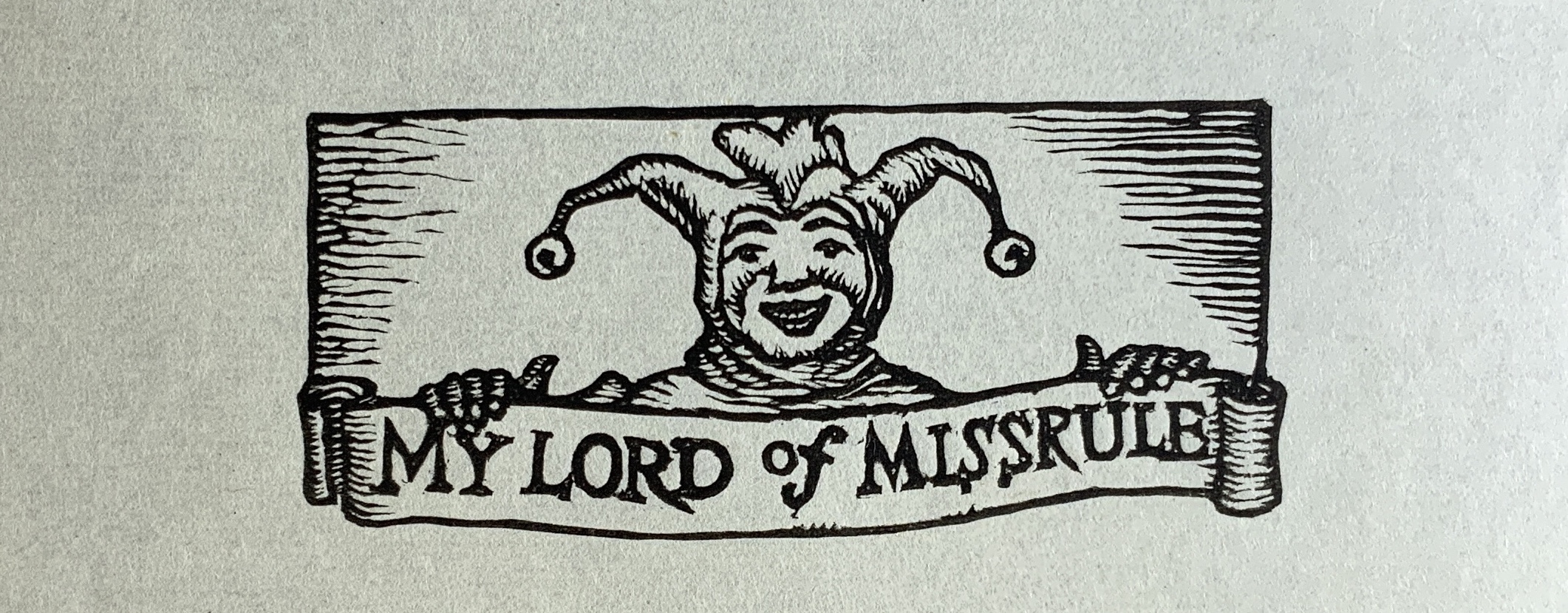
The other print we've pulled out today is "My Lord of Missrule." This little jester would have appointed, likely from the lower clergy, as a sort of officiant for the Feast of Fools, a medieval celebration conducted on the 1st of January.

Lankes woodcut of "The Lord of Misrule"

To check out these illustrations (and others!), ask for MS-1115 Box 7 Folder 6.