Friday, September 15, 2023

Between Worlds: An Inspiring Alumnus

Envelope for letter from Pierce to Thayer
At the end of August, we hosted a class for the First Year Student Enrichment Program (FYSEP) for first-generation students in which the students worked through Rauner’s archives on alumni/ae. We had too many first-generation alumni records to include in the session, so as the new students arrive on campus, and classes begin for the fall term, we’d like to share a letter from Maris B. Pierce, a first-generation member of Dartmouth’s class of 1840, to his friend and classmate, Loren Thayer. In the letter, written from Buffalo N.Y. in 1838, Pierce writes that he is attending a council discussing the Treaty of Buffalo Creek and cannot return to Dartmouth until it concludes. See, Pierce wasn’t just a Dartmouth student; he was also the Chief of the Seneca Nation. And with the title of Chief came responsibilities. Pierce notes this split identity as he writes,

“I shall endeavor to return to Hanover as soon as I can leave the place [and] the Council. I am a chief, therefore it is difficult to leave them before it closes…No man regrets so much as I do, of my absence from the College. But I am placed over this people to see that the republic receive no detriment.”

Not only did Pierce fulfill his chiefly duties, but he also spoke out for his beliefs. In his letter to Thayer, Pierce references a speech he had delivered in 1838 at Buffalo, expressing his anti-land-removal stance. This address in particular made its way to the local newspaper, The Daily Buffalonian, and inspired many of his peers. One of his Dartmouth classmates, E.F. Slafter, wrote (“[on] behalf of the Junior class”) a note to Pierce stating his gratitude for Pierce’s inspiring words:
First page of the letter from Pierce to Thayer

“We would express our hearty thanks for your eloquent and highly valuable address delivered at Buffalo, N.Y. upon the condition etc. of your people Which we shall ever read it with the deepest interest both from its own intrinsic value and the sympathy we feel for your people it will even feel to bring to mind the pleasing associations of College life when we assemble in the same halls of learning and were bound together by a common bond of interest and pursuit.”

After graduating from Dartmouth College in 1840, Pierce pursued law and continued to fight for the Seneca Nation and its land rights. He used his Dartmouth education to become a mediator between the two cultures as he argued against Seneca land removal. In addition, Pierce became an interpreter for the Seneca Nation and the U.S. government, a role perhaps hinted at by his time at Dartmouth. As shown by his transcript for his freshman and sophomore years, Pierce was not only a high-achieving student (with a GPA higher than his classmates), but also had exceptional language skills, receiving an exquisite 4.0 in the language column:


While Pierce graduated in 1840, we can still learn from him today. Pierce’s experience mirrors the struggles of many students today, particularly first-generation students: many times, issues at home can compete with educational commitments—and sometimes a student’s home community needs to take precedence over the student’s individual betterment, as was the case with Pierce. Like students today, Pierce also had to balance responsibilities on both sides of his life. In addition, throughout his career, he brought his Dartmouth education and his inherent passion to the larger community and applied it to every aspect of his work life: his writings, his speeches, his tribal negotiations.

Moreover, Pierce shows us that Dartmouth students don’t need to wait for graduation to have an impact on a surrounding community: his inspiring speech against land removal was delivered in Buffalo while he was still a sophomore in college.  Pierce continued this tradition of advocacy long after he graduated, bringing what he had learned at Dartmouth to bear on every aspect of his adult life. His example is an inspiring one for Dartmouth students from all backgrounds and walks of life.

If you’re interested in reading Pierce’s letter to Loren Thayer or a facsimile of E.F. Slafter’s letter to Pierce, come to Special Collections and ask for Mss 838517 and Mss 838540.2 (a transcription is included for both). If you want to see Pierce’s grades as recorded in the College’s Merit Rolls, ask for DA-80, Box 3292 (look for 1837, Freshman Class, and 1838, Sophomore Class). For more about Pierce’s life after Dartmouth, ask for his Alumni File.

Friday, September 8, 2023

Dante and Doré

Dante and Virgil observe a group of tortured souls on the ground. Above them, a headless figure holds out its own decapitated head.Sometimes we just want to look at something beautiful. Sometimes a thing that is beautiful is also grotesque. This week we're looking at the art of Gustave Doré and his interpretations of some of the most disturbing imagery of medieval literature: Dante's Inferno.

Doré (1832-1883) was a prolific French artist who provided lavish illustrations for over 50 books during his lifetime, not to mention his work in other mediums. His engravings tended to adorn works of classic literature, and if you've seen Dante illustrated before, there's a good chance that it was Doré you were looking at. His style, finely detailed, dark, and dramatic, is a perfect fit for the Italian poet's vision of Hell.

Written in the early 14th century, The Divine Comedy (of which Inferno is only the first part) follows the author's pilgrimage to the underworld, making his way through each circle of Hell before he is able to move on to Purgatory and then to Heaven. Guided in this first stage of his journey by the poet Virgil, Dante sees and describes layer after layer of sinners in torment. Doré's depictions of each circle are appropriately disturbing and atmospheric. We could say more here, but we really just recommend taking a look for yourself.

Lucifer, shown as a winged, horned giant, is trapped up to his waist in a lake of ice.

To see Doré's version of Dante's Inferno, ask for IllusD73dan.

Friday, September 1, 2023

Picturing Truth

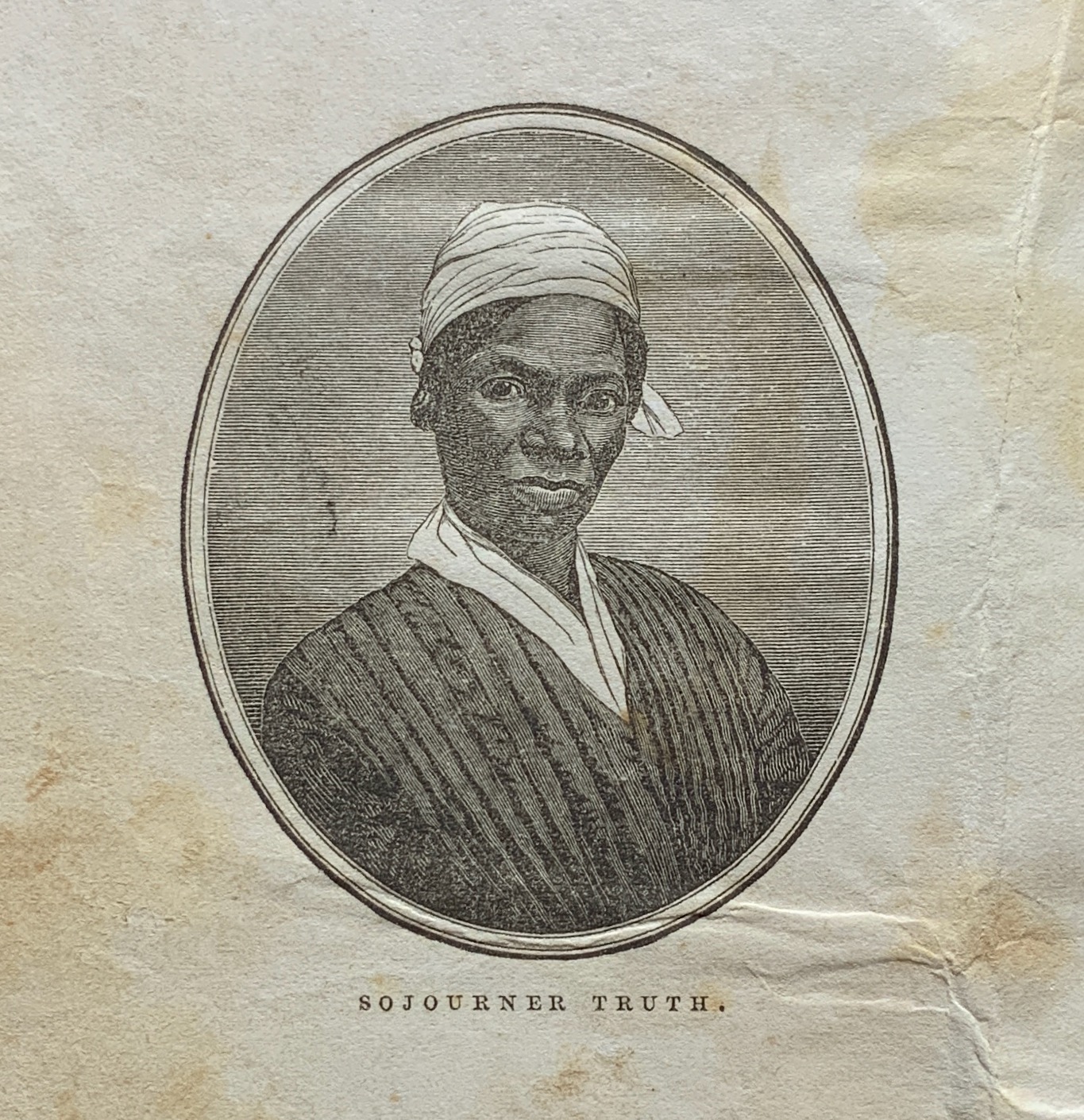
Frontispiece to Narrative of Sojourner Truth, 1850
Being bookish types, we are kind of obsessed with the physical manifestation of texts. What makes so many books so special is the interplay between the text and the book itself. Recently we were fortunate to acquire a first printing of the self-published Narrative of Sojourner Truth: A Northern Slave (Boston: The Author, 1850). It is slender work, just 144 pages, but loaded with power. Sojourner Truth had that amazing sense of righteousness, and enough experience on the stump and at religious gatherings, to really pour it on with force.

Title page to Narrative of Sojourner Truth, 1850
The book does its part to help, and since she was involved in the whole enterprise, you know she must have had a say in how it looked. The cover is pretty basic mid-19th century fare. A floral embossed decorative binding with a gold-stamped title. But then you open it up and there you are, face to face with Sojourner Truth and you are immediately struck with her charisma. She owns the narrative and you are going to listen to what she has to say. Opposite is the title page, asserting her identity as "A Northern Slave" but clearly no longer enslaved. As the narrative attests, she walked away from that and became a fighter for the enslaved and for women. But your eyes can't help but go back to the image. The head wrapped in a scarf, tilted just enough to know she is evaluating YOU, giving you a stare that dares you to just try to read her story and not become a convert. 

Come be confronted by Sojourner Truth yourself by asking for Rare E185.97 .T87 1850.

Friday, August 25, 2023

Rockin' Operatic Style

Image of Jen de Rezke as Raoul in Meyerbeer's "The Huguenots"This week we stumbled upon a charming little photograph album in our Codex collection. The contents are very niche and extremely fabulous: signed publicity photos of opera singers who performed during the 1899 season for the Metropolitan Opera Company. The book was compiled by a young Edith Lauterbach, whose father, Edward Lauterbach, was legal counsel for the Met as well as a member of the Board of Directors. As such, Edith knew many of the world-famous performers personally. The book came to us through the generous donation of Edith's husband, Clarence "Mac" McDavitt, a member of the class of 1900.

Each photograph of a performer in the album, usually in costume, is accompanied by a brief biography along with their notable areas of expertise and, in some cases, their birth name. For example, the renowned American soprano Lillian Nordica, who slayed as Brunhilde, was born Lillian Norton and hailed from the rural hills of Farmington, Maine. Our favorite fashion statements from the season are Jean de Reek, a Polish tenor who is rocking the thigh-high boots with a pair of short shorts, and Andreas Dippel, a French tenor who somehow manages to project a convincing "legendary warrior" vibe despite his lace-up heels.

To explore the world of opera costumery at the Met in 1899, come to Special Collections and ask to see Codex 003337.

Friday, August 18, 2023

Incapacitated from Thoughtful Labor

A graphite sktech of a ship burning.William H. Gilder wrote to the U.S. Navy on February 26th, 1883 following two letters demanding his report on recent activities in the Arctic. "I would respectfully ask the acceptance of my resignation... I beg leave further to state that the delay in forwarding my report to the department has been owing to an ailment contracted in the north, and resulting from a diet of raw meat, which has incapacitated me from thoughtful labor." Gilder had traveled on the U.S.S. Rodgers up to the Bering Strait in 1881, part of one search effort for the missing Jeannette Expedition.

Early in the trip, Gilder was stationed on the Siberian coastline with a few other men and a cache of supplies while the Rodgers moved on in its search. He and his compatriots would establish one potential refuge for the survivors of the missing expedition, should they be found. As such, he wasn't on the Rodgers when it caught fire and was destroyed, forcing the rest of the crew to abandon ship. He did, however, hear of the event soon after from another crew member. Gilder had previous experience with long-distance sledge journeys in the Arctic, having once covered 3,251 miles during a search for the lost Franklin expedition, so it made sense that he was the man to make the long journey to the closest telegraph station, notifying the Navy of this most recent disaster. 

To get Gilder's account of that journey, you'll just have to come in and read his report for yourself. There are other items stored with it, including a sketch of the Rodgers burning, diagrams of sledges, and a rough map of the bodies eventually recovered from the Jeannette expedition. Ask for Stefansson Mss-45, Box 2.

Friday, August 11, 2023

Before the Book Arts Workshop

Colophon for Three Poems by Robert Frost
The Book Arts Workshop in Baker Berry is one of the most loved spaces on campus. Students and community members can learn to set type, print something cool, and even bind it. It has been around in various forms since the late 1930s starting its life as the "Graphic Arts Workshop." Answering a reference question earlier this week, we stumbled on a tantalizing bit of the Workshop's prehistory in the activities of the "Daniel Oliver Associates."

In 1934, a group of students enrolled in Art 58 formed a book collecting club. They took as their namesake a Dartmouth alumnus, Daniel Oliver, from the class of 1785. Daniel had donated his large personal collection of books to the young Dartmouth Library while he was still a student. The group devoted their meetings to discussing book collecting with visiting practitioners of the book arts. Then they decided to try their hand at printing a book. They worked with Harold Rugg in the Library to secure rights to three poems by Robert Frost. According to the 1935 Library Bulletin, they set the type by hand, printed 125 copies of the book in the Library. We can't be sure, but this may mark the first bit of student printing to occur in the Dartmouth Library, and perhaps it served as inspiration for the thriving Books Arts Workshop we know today.

The Daniel Oliver Associates were kind enough to donate copy number one of their book to the Library and Frost inscribed the book to Baker Memorial Library on the title page. You can see the signed copy by asking for Frost PS3511 .R94T5 1935. There is also some correspondence between Harold Rugg and Frost in our Robert Frost Papers, MS-1178, Box 9, Folder 30. The minutes and constitution of the Daniel Oliver Associates in DO-67, Box 6600.

Friday, August 4, 2023

Earthsea at Dartmouth

A still from the short documentary "Picture Business," showing a seated Michael Powell.
In 1980, the British director Michael Powell came to Dartmouth as its Artist-in-Residence. Powell had
been in the picture business in one form or another since 1925, beginning to direct projects in the 1930s. By the time of his visit, he had made many successful movies, five of which remain on the British Film Institute's Top 100 British Films list. 

While at Dartmouth, he would develop a small-scale project with a group of students: a scene from Ursula K. LeGuin's Earthsea Cycle. LeGuin's classic fantasy series was one that Powell had been interested in adapting previously, and it made for a good opportunity to give students hands-on experience with the film-making process under the guidance of a seasoned director. The final film is lost, but you can see pieces of it, along with behind-the-scenes footage and Powell's own thoughts on the series and film-making in a brief documentary from our collections, digitized here.

For the Earthsea fans, you can read the script for the film, adapted from a scene in The Tombs of Atuan, in the Film and Media Studies records. Ask for DA-815, Box 31316, Folder 9.