Friday, May 19, 2023

"Riot at Dartmouth College"

Masthead to the Liberators, April 9, 1841
Image of "Riot at Dartmouth College" article
Usually when we learn about a student protest, we are fairly sympathetic to the students' indignation, but not this time. Back in March of 1841, a group of abolitionists visited Hanover for an anti-slavery convention to debate and vote on this resolution:

"Resolved, That American slavery is a complication of the foulest crimes, such as robbery, adultery, man-stealing and murder and ought therefore to be immediately and unconditionally abolished."

That shouldn't have been very controversial among the student body. There were plenty of ardent abolitionists on campus. But when the convention started, the hall filled with Dartmouth students who began whistling, stamping their feet, clapping and carrying on with "other disgracefully indecorous, (not to say riotous,) conduct." Why? Well, one of the speakers had dissed Dartmouth President Nathan Lord and the students were not going to have any of it. They caused such a commotion that the speakers were disrupted and eventually the convention had to abandon its efforts.

Parker Pillsbury reported on the incident for The Liberator. He ended with a jab at Dartmouth's favorite son:

A few such scenes as that I have attempted to describe, would give Dartmouth College a reputation as lesting as it would be infamous. Daniel Webster did her no injustice when he stood on the Mason and Dixon's line and pledged the North to the interests of the unrighteous despotism of the South. Let him and the College wear the laurels they have won. Their acts are recorded, and posterity will do them justice.

Close up of Parker Pillsbury quote about Dartmouth

Nine years later, Webster would further infuriate the abolitionist movement with his impassioned plea to the Senate to pass the Fugitive Slave Act. Things changed on campus--in 1855, the student body tried to chase the same president from his office for his pro-slavery views, and in 1862, he was forced to resign by the Board of Trustees (if you want to learn more about about it check out this podcast episode).

To see Parker Pillsbury's account in The Liberator, ask for DC Hist. LD1438.3 .P557 1841.

Thursday, May 11, 2023

Dartmouth’s Jewish Quota on the National Stage

First page of Hopkins' letter to ShumlinA legendary figure at the College, Ernest Martin Hopkins served as Dartmouth’s president from 1916 to 1945. Although he had hoped to gracefully turn the helm over to his successor once the Second World War ended, the run-up to Hopkins’ retirement in October 1945 proved to be anything but graceful.

On February 10 of that year, Hopkins was one of 300 educators to receive a telegram from the Independent Citizens Committee of the Arts, Sciences and Professions decrying a potential hard quota on Jewish applicants to New York medical schools. The cable asked the educators to join with the Committee in condemning the restriction of any religious or racial group’s enrollment in schools. In a response sent that same day, Hopkins declined the Committee’s request, stating:

Understand complexity of problem and am sympathetic with purposes you have in mind. Cannot join with you however if your protest is against proportionate selection for I believe nothing would so increase intolerance and focus racial and religious prejudice as to allow any racial group to gain virtual monopoly of educational advantages offered by any institution of higher education.

While Hopkins doubtless considered the matter closed, Herman Shumlin, a Director of the Committee, was substantially upset by the president’s reply. On March 26, Shumlin, who was Jewish, sent a letter declaring his refusal to purchase a subscription to Americans United for World Organization, an internationalist organization that Hopkins chaired. Shumlin wrote to the organization’s Executive Vice President, Ulric Bell, that he failed to see how “such an organization can do good when the Chairman … is, himself, a prejudiced man,” citing Hopkins’ declination to condemn quotas. Bell forwarded this letter to Hopkins.

A vociferous writer of letters and an uncommonly outspoken and assertive man, the 67-year-old Hopkins then took it upon himself on April 2 to write to Shumlin, unprompted, to elaborate upon and explain his position. Hopkins’ letter went unacknowledged for nearly two months, until, on June 2, Shumlin made his reply, in which he assailed Hopkins’ proffered explanations and justifications. He wrote: “I am filled with anger against you and shame…”

Second page of Hopkins' letter to ShumlinBy August 7, Shumlin had turned his correspondence with Hopkins over to the press, for on that day the New York Post and on the next day PM (another NYC-based newspaper) ran articles which blasted Hopkins’ letter to Shumlin as bespeaking clear anti-Semitism in Dartmouth’s admissions. Thus began a maelstrom in the national news for the next several weeks. Hopkins’ letter to Shumlin instantly received wide exposure—even as the first atomic bomb had been dropped only a day earlier and the second was to follow on August 9.

Hopkins’ letter to Shumlin undoubtedly read then, as it does now, as a troubling and often quite startling consideration of its subject matter. Incredibly, it seeks to justify Dartmouth’s anti-Semitic quota as a means of preventing anti-Semitism! Writes Hopkins: “I should not be willing to see the proportion of the Jews in the College so greatly increased as to arouse widespread resentment and develop widespread prejudice within our own family.”

Hopkins cautions Shumlin that, in Germany after the First World War, there was a dramatic increase of anti-Semitism due to “the soldiers finding all their institutions and all of their professions dominated by a race [the Jews] which numbered only one per cent of the population.” To prove this, Hopkins cites (fallacious) statistics given by Australian sociologist Stephen Roberts in his book The House That Hitler Built (1938).

As PM was quick to point out, German institutions were not, in fact, dominated by Jews “in 1919 or 1933 or any other time. Hopkins got his figures from Roberts. Roberts got his figures from an article by Alfred Rosenberg in the Voelkischer Beobachter for Aug. 20, 1933. One would think that the president of an American college would be a little embarrassed about spouting the Hitler-Rosenberg line … that anti-Semitism is the fault of the Jews.” Shumlin had earlier observed the same in his reply to Hopkins: “It is fantastic to me that a man in your position can, at this date, make use of the very allegations which were used by Hitler and his accomplices.” To be sure, Hopkins argues in his letter that, in their “aggressiveness,” those Jews advocating increased Jewish admittances to schools “are raising anti-Jewish prejudice to a level that it has never before reached in this country.”

The New Republic highlighted as well the important detail that Hopkins “appears to assume, flying in the face of all anthropological science, that the Jews are a race.” Hopkins’ suggestion that admitting more Jewish students would make Dartmouth an “urban college” also has racial undertones. Of course, it was the Nazis who suggested that Jews were a separate and inferior “race,” and hence Hopkins’ phrasing may be said to echo the idea of racial anti-Semitism.Third page of Hopkins' letter to Shumlin

It was not until President Hopkins’ retirement was announced on August 30 that the media onslaught began to subside (the War, it should be noted, ended three days later, dominating coverage). However, Dartmouth, President Hopkins, and his ultimate successor President Dickey continued to receive a voluminous quantity of letters from concerned alumni and other parties regarding Dartmouth’s admissions procedures. In personal replies, Hopkins backtracked from his subscription to the Roberts book’s statistics but cited them as “commonly accepted” and thus dangerous even if inaccurate. He also continued to deny that Dartmouth’s practices amounted to the imposition of a “quota.”

To see some of Hopkins' correspondence about the Jewish quota, ask for the two "Criticism" folders in DP-11, box 6073; the two "Criticisms" folders in DP-12, box 7094; and MS-1359, box 4, folder 38 ("Jewish Controversy").

Posted for Matt Skrod ’24, recipient of a Historical Accountability Student Research Fellowship for the 2023 Spring term. The Historical Accountability Student Research Program provides funding for Dartmouth students to conduct research with primary sources on a topic related to issues of inclusivity and diversity in the college's past. For more information, visit the program's website.

Friday, May 5, 2023

Deflating Misogyny

"Reaction To A Sink Night Letter" article in The Dartmouth“There was a lot of trashing,” recalled one woman in Boston Magazine about her freshman year at Dartmouth. “It was not uncommon–I’d say it happened several nights a week–for drunk guys to come by and scream, ‘Hey you cohogs [ie, coeds]! Get out here and spread your legs. That’s all you’re good for, anyway!”

It was 1972, the year that the College matriculated its first cohort of female students. While this year marked an historic and pivotal moment in the institution’s history, the integration of women to Dartmouth was far from seamless. The College enrolled only about 250 women that first year, resulting in a skewed gender ratio of just one female student for every nine male students.

Throughout the early 1970s, the campus climate was palpably charged. Women’s dorms were broken into and vandalized. “It was not unusual to go home and find your wastepaper basket full of vomit, in protest of your being there,” remarked one woman who came to Dartmouth in 1973. Men coated the toilet seats with honey in one dorm and displayed an axe on the front door of another. Entering the dining hall, a female student could face jeers, cat calls, food fights, or a group of fraternity men holding cards numbered 1-10 to rate women as they walked in. Men urinated on women’s bikes and, in some cases, on women themselves. One woman recalled her third night on campus, when she was blindfolded, kidnapped, and left in the middle of a field with a fraternity pledge class. She and the group had to hitch-hike back to campus.

Woodward Hall letter
Hover to view image.
April 1973 brought one of the most brazen instances of harassment from those first few years. It was the morning after “Sink Night,” the culmination of rush, when pledges commit to their fraternities. A letter addressed to “C***s” was slipped under the door of every room in the all-female Woodward Hall. It demanded that women make certain changes in order for “all of us to live in harmony.” Among the demands:

  1. Women go topless in the dining hall (“Perhaps you consider this unreasonable – well, f*** you”);
  2. Women’s “services” be made available at all times; 
  3. The women’s softball team play naked on the green (“C***s with large floppy tits may wear bras. The butt area must remain uncovered”); and
  4. Women perform oral sex on President Kemeny, so that he might “lose his f** tendencies.”

The letter further commanded women to “reform accordingly” or “deal directly with the syndicate.” “These are not idle threats,” it warned. “Our movement is large.”

On April 11th, three days after the incident, a letter titled “Reaction to Sink Night Letter”, was published in The Dartmouth by junior Barbara Dills. She condemned the Woodward letters as acts of violence and “manifestations of a deep and serious disease, which it seems the fraternity system as it exists at Dartmouth tends to perpetuate.” She added: “Along with my anger, I must feel compassion for these sick souls who can never know the ecstatic beauty of shared love.” Dills then boldly announced that she was “not the least bit intimidated,” writing, “I openly challenge every ‘man’ involved in this act to express these sentiments put forth in the circular to my face. If no one ‘rises’ to this challenge, I shall be convinced, as I already suspect, that their sickness is merely compounded by weakness and cowardice.”

She ended the letter simply and powerfully: “I live in 309A So. Topliff.”

This April, fifty years later, I spoke to Dills about her time at Dartmouth. She was on campus for only one year, 1972-73, through an exchange program that Dartmouth coordinated with Smith and other women’s colleges. She spoke of Dartmouth fondly, but also vividly recalled the hostility and resentment that certain members of the Dartmouth community directed toward female students.

When I asked her about “Reaction to a Sink Night Letter” and her decision to disclose her dorm location, she told me she didn’t run the idea past anyone; there was never hesitation in her mind. “I just kind of boldly did it… I don’t know if it was a combination of naiveté and strength. But I think what I wanted to do was call their bluff.” 

Around midnight a few days later, Dills was sitting in her small dorm room in Topliff when she heard a pounding on her door and recognized loud male voices. Despite the racket, Dills wasn’t scared. She opened the door to two extremely drunk men hurling the c-word at her and referencing her letter in The Dartmouth.

Dills responded, “Why don’t you come in and sit down?”

The two men seemed shocked that Dills didn’t scream back at them. “I completely disarmed them,” she recalled. “They were like two little puppy dogs.” Dills felt she was “in her power.” Stunned, they walked in and took a seat.

“I just said, you know, ‘So what right do you think you have to treat people like this?’” The men didn’t have an answer.

“It was like they were just sitting in front of their mother scolding them…They just became these completely different people,” Dills told me. “We had a short conversation and then they just kind of went away with their tails between their legs.” After the two left, she remembered thinking, Did that just happen?

Dills was never threatened again, and didn’t recall any similarly offensive letters during her time at Dartmouth. This incident just confirmed for Dills the suspicions she had already voiced in her letter in The Dartmouth: “It was so revealing of how basically impotent the force was against [coeducation] at Dartmouth.”

To see the Woodward Hall letter, come to Rauner and request the "Women of Dartmouth" vertical file. To see Dills' letter in The Dartmouth, come look at our archives of The Dartmouth for 1973.

Posted for Kira Parrish-Penny ’24, recipient of a Historical Accountability Student Research Fellowship for the 2023 Spring term. The Historical Accountability Student Research Program provides funding for Dartmouth students to conduct research with primary sources on a topic related to issues of inclusivity and diversity in the college's past. For more information, visit the program's website.

Thursday, April 27, 2023

(In)Equity Found in the Margins

1972 was a landmark year for both Dartmouth and the United States at large regarding women’s equity in education. Not only was it the first year women were admitted as students at Dartmouth, but it was also the year that Title IX was passed. Title IX is intended to provide for equity in any education program or activity that receives federal funding. Over the coming years, and even decades, the most hotly debated aspect of Title IX became its coverage of women’s sports. Dartmouth, a school with a long history of athletic achievement and long-held pride in its education of young men as a school for men alone, was grappling with these issues and more as they tried to integrate women into the student body in general while simultaneously opening up opportunities for women in sports.


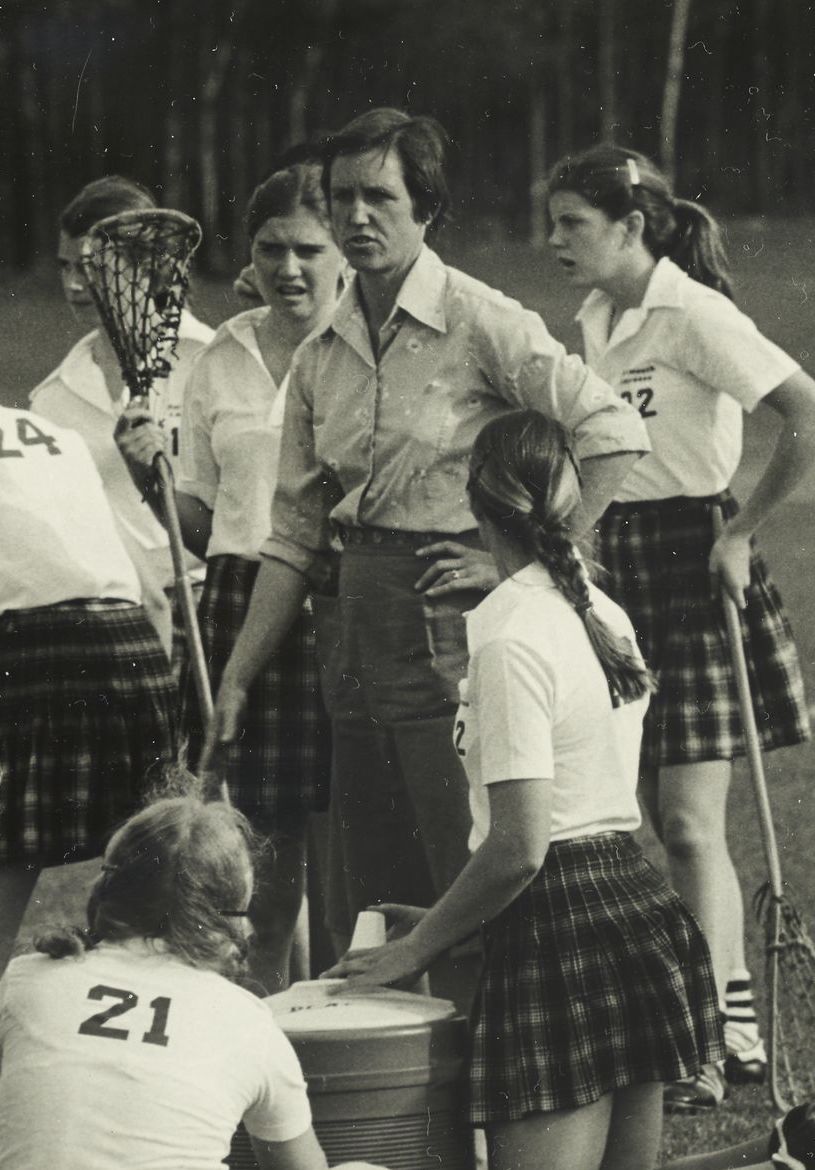
Photograph of Agnes "Aggie" Kurtz coaching the Dartmouth women's lacrosse team
Dartmouth hired their first female athletic department member in the summer of 1972, Agnes ‘Aggie’ Bixler (later Kurtz). She came in as an Assistant Athletic Director, but it was clear that her charter was to begin the women’s sports program at Dartmouth. In that first year, she managed to start six intercollegiate teams and continued to grow the program over the years as the female student body at Dartmouth grew, the athletic department’s number of female staff members grew, and the desire and opportunity for athletic participation continued to grow as well. In these years though, Dartmouth’s athletic department, often seen as one of the “last bastions”2 of male pride at Dartmouth, was not altogether excited for integration. As the most outspoken region of campus against coeducation in the first place, the athletic department was slow to support women’s sports once coeducation was implemented. There was never outright hostility, but instead, everything fell to the women to ask, and if they didn’t ask, the men certainly did not go out of their way to provide.

Instead, Aggie had to build the program nearly autonomously, which had its benefits. Unlike at schools where there was heavy oversight and the women “had a much harder time because the male athletic director was trying to do everything,”3 Aggie had control. That autonomy also had its pitfalls though. As Aggie explained in an interview reflecting on her time as an administrator in the department, “You had to find out what was going on and what could be done and then push for it because they weren’t about to tell you.”4 The men were often not intentionally obstructive, but there also was not a clear desire on their part to actively engage with the progression and development of Dartmouth’s women’s program. Thus the marginalization of women in sports continued, and it is in the margins of internal departmental memos that the true nature of women’s athletic development at Dartmouth becomes clear.

On February 2, 1977 the Athletic Director Seaver Peters wrote a memo to Margaret Bonz, an Affirmative Action Officer for the college about the Title IX Implications for the DCAC (Dartmouth College Athletic Council). CC’d on the notice were Aggie Kurtz and Frank Smallwood. This memo was written in response to an earlier memo about the needs expressed by Margaret Bonz on behalf of the women’s athletic program to DCAC. A copy of Peters’ response to the requests by the women are then covered in handwritten notices in the margins by, presumably, Agnes Kurtz. In many of the internal memos between members of the athletic department, especially Agnes Kurtz and Seaver Peters, there are similar notes in similar handwriting, and as only Aggie Kurtz and Frank Smallwood received carbon copies of this memo, the onion skin source is most likely commented upon by one of them. These notes reveal an altogether different, and not entirely seamless relationship between women in the athletic department (Agnes Kurtz) and the predominantly male leadership of the department itself.

On page 2 is the clearest indication of the baseline “if you don’t ask we won’t give” attitude of the department. Peters’ memo explains away the small support budget for women by saying “I simply must rely on the assistant director responsible for women’s athletics to adequately reflect her needs in the annual budget presentation.” This comment is then surrounded by the notes:

“No!” And “after a verbal reply that we not get another full time sec[retary] but use Laura plus part-time help”

Annotated excerpt from Seavers' memo to Bonz
 

This attitude of the women must ask is thereby clearly stated, but then simultaneously called into question. Maybe, the women did ask and the department denied, so the relationship between women’s athletics and the department at large was even more uneven than it seems. The other notes in the margins of this document further convey the contentious atmosphere between men’s and women’s sports in early eras of Title IX at Dartmouth. Many of the comments are slight adjustments to language which can change the perspective from clearly equal to clearly unequal:

Annotated excerpt from Seavers' memo to Bonz

Annotated excerpt from Seavers' memo to Bonz


 blatant refutations of Peters’s points:

Annotated excerpt from Seavers' memo to Bonz

Annotated excerpt from Seavers' memo to Bonz

or further clarification on the realities of unequal situations:

Annotated excerpt from Seavers' memo to Bonz
 

From this memo, and many others like it, we can see that the relationship between men’s and women's athletics at Dartmouth was certainly more contentious than the official notices make it seem, and that responsibility for the progression of women’s athletics fell nearly entirely on Agnes Kurtz and other women. The slow progress made for women’s athletics in this era was hindered either actively or inactively by the men in the Athletic Department, and the number of women on campus was so small that the number of women in the Athletic Department remained few, so even as women’s representation grew incrementally, women remained in the margins of the department. So, in order to see the true work and fight that turned an all male department in an all male school learning to become coeducational, one must look to the margins, both figuratively and literally.

To see the 1977 memo from Seaver Peters to Margaret Bonz, ask for the Dartmouth College Athletic Council Records (DA-169), Box 8055, Folder "Affirmative Action 73-76". To explore the oral history interviews with Agnes "Aggie" Kurtz or Mary Kelley, ask for DOH-13 (Kurtz) and DOH-296 (Kelley).


Posted for Sara Pickrell ’24, recipient of a Historical Accountability Student Research Fellowship for the 2023 Spring term. The Historical Accountability Student Research Program provides funding for Dartmouth students to conduct research with primary sources on a topic related to issues of inclusivity and diversity in the college's past. For more information, visit the program's website.

Friday, April 21, 2023

The Philosophy of Botany

A detailed engraving of a sunflower next to a sunflower seed.As spring creeps in, we're taking a look at some of the more exuberant botanical books in our collection. Today, it's Robert John Thornton's 1799 The Philosophy of Botany, This volume contains an exploration (lavishly illustrated) of the different kinds of seeds one can observe in nature, the casings those seeds tend to come in, and the transformation of a seed into a plant. Later in Philosophy, the focus shifts to cross-sections of roots and branches. The illustrations become increasingly geometric and abstracted in attempting to show their audience a microscopic view of plant structure, until at the end they snap back out and devote several pages to recognizable, whole plants.

To see something lovely, come in and ask for Rare Book QK92 .T5 1799.

A series of engravings depicting various types of seeds.A cross-section of the root of a sunflower.A bean plant germinating from three different angles.

Friday, April 14, 2023

What to Take on a Hike

Page one of What to Take on a Hike
It feels like early summer today, so our thoughts turned to the outdoors. What better place to look for inspiration than the MacKaye Family papers (ML-5). In 1921, Benton MacKaye wrote an essay called "A Project for an Appalachian Trail." His audacious proposal gave birth to the AT which cuts right through campus. The proposal is very cool, but we got more excited by his four-page, single-spaced, typed list of "What to take on a hike." 

What better place to start than bacon: "I have tried the Deerfoot which comes all sliced, but find that it runs pretty fat, and prefer a straight flick." (If anyone knows what "straight flick" means when applied to bacon, let us know!) He also suggests a lot of cereal, condensed soups peanut butter ("the more granular sort"), and Swiss cheese as a special delight for the first few days.

For gear, there is of course a good knife, a compass, watch and map, but also a revolver. For clothing he has a lot to say about boots:

Heavy porpoise boots worn sufficiently to be already comfortable, fitted with long porpoise lacings, and heavy rubber soles reaching back to heel, and rubber heels. Great care needs to be taken in fitting this sole else it will peel off in the first day. It should be glued, kept under pressure over night and be riveted on besides. I am strongly opposed to hobnailed boots believing them practically useless and even dangerous besides heavy and uncomfortable. Incidentally they are not so nice for the other fellow when you accidentally tread on him.

Page four of What to Take on a Hike
Page three of What to Take on a HikePage two of What to Take on a Hike

In August the thru hikers start inhabiting the Green--making the trek in 1920s' gear sounds impossible, but the smell of bacon each morning would be nice!

Ask for ML-5, Box 97, folder 29, to get ready for your next leisurely.

Friday, March 31, 2023

Memorial Markers for World Fellowship

A card memorializing Julius and Ethel Rosenberg.The World Fellowship of Faiths in Albany, NH, was established in the late 1930s as a retreat focused on social justice issues. We've written a little about the World Fellowship before, but today we'll look at their "Save and Name a Tree" campaign. Cutting of the organization's pine and maple groves for lumber was "repeatedly urged" as a source of addtional funding, until the campaign began in 1943:

"We are reliably informed that about $3.50 is all that one of the World Fellowship's noblest, old, majestic pines would net us if slaughtered for lumber... we invite our friends to contribute Ten Dollars or More to Save a Tree and to place upon it, permanently, a small, modest marker bearing the tree's name (determined by the donor) with the donor's name and the date of his contribution."

The Charles F. Weller papers include mock-ups for the markers that would go on these trees. Most function as memorials, including beloved pets, family members, historical figures, and whole groups. Going through the markers is a fascinating peek into who and what members of the World Fellowship considered important in the 1940s and 1950s.

A small card memorializing "Clippy," a beloved dog.

To check out the markers, ask for Box 5 of MS-1295, the Charles F. Weller papers.