Friday, May 21, 2021

Fiasco at Fredericksburg

First page of Sargent's letter to Maria, 17 Dec 1862This week we had the opportunity to visit a local 5th-grade classroom via Zoom to talk with them about the American Civil War. The students looked at and analyzed an image from Gardner's Sketch Book of the Civil War, read a military map that provided information about Corinth, Mississippi, and interpreted a personal letter written by a Union soldier, Ransom F. Sargent, to his wife Maria.

Sargent was a Fife Major of the 11th New Hampshire regiment, Company F, and was in his mid-twenties when he joined the army. His letters home to Maria are a wonderful firsthand account of several important battles that Sargent witnessed, including the disastrous Battle of Fredricksburg, the Siege of Vicksburg, and the Siege of Petersburg. Despite the seriousness of his situation, Sargent also discussed smaller and more personal issues in his letter, including news about other New Hampshire men that he knew and comments about what was going on back in New London, New Hampshire, where Maria awaited his return.

For the 5th-grade class, we both transcribed and provided color scans of a letter he wrote outside Fredericksburg, Virginia, on December 17, 1862. In the letter, Sargent reflects on the recent loss by the Union, saying to Maria: "I long to know what the papers say about this battle. Believe me if they call it anything but a terrible slaughter and defeat into the bargain they very much misrepresent the matter. If ever the works behind Fredricksburg are taken it must be done by some strategy. It never can be taken by storm as last Saturday’s battle proves which cost New Hampshire the lives of more brave and true men than the whole of theaccursed South is worth in my opinion."

Soon after the loss at Fredricksburg, Burnside was relieved of his command by President Abraham Lincoln and replaced by Joseph Hooker. Despite the embarrassment of this demotion, Burnside went on to have a successful political career; was elected to the governorship of Rhode Island after the war and concluded as well as serving as the first president of the National Rifle Association in 1871.

To read more letters by Ransom Sargent to his wife Maria, come to Rauner and ask to see MS-38.

Tuesday, May 18, 2021

Many Paths for Persistent Protest

What is the legacy of student mobilizing and protests on Dartmouth’s campus? How have the historic student demonstrations for black liberation and equity informed our current campus climate and administrative demands? Dartmouth has a vivid history of student protests. From the disruptive protest of William Shockley’s black inferiority psychometrics speech and the Parkhurst student occupation—both occurring in 1969—to the Dartmouth Review protests of the 1980’s and Occupy Wall Street protests of the 2000’s, Dartmouth’s students have continued to be vocal and consistent in challenging administrative oversight and advocating for the wants and needs of the student body, specifically those that are structurally unprotected and oppressed.

A standout moment in Dartmouth’s history of accountability was the publishing and dissemination of The Redding Report in 1974. Previously reported on in a blogpost by Alexis Reaves ‘20, this report —written by Eileen Cave, Monica Hargrove and Judi Redding—was structurally inspired by and stood as an analysis of the McLane Report, created by administration in 1969 as the first notable administrative push to address and combat racial inequality on Dartmouth’s campus. It was this 1969 report that established the committee on equal opportunity at the end of the civil rights movement; this committee was charged with researching and strategically executing provisions to increase black, native and local low-income student admission rates, increase faculty diversity and address the specific cultural needs of minority students on Dartmouth’s campus.

The notable publication of The Redding Report by three black, female students in 1974—a mere two years after women were allowed admission into Dartmouth College—served as a distinctive and divergent form of student protest that placed the student voice in direct conversation with administrative decision-making. Co-opting the committee report structure to exemplify the black student’s voice subverted the exclusion and secrecy of administrative action and set a precedent for student protest mobilizing. The Redding Report was reproduced and disseminated by the Afro-American Society, along with other allied organizations like the Interracial Student Group, to reach and inform the members of the student body and administration; this literature distribution protested notions of exclusion and put the experiences and voices of black and native students at the forefront for the student body to consume and reckon with internally. The Redding Report signified an instrumental point in Dartmouth’s legacy where the standard for accountability extended beyond self-imposed regulation and promises to the equipment of media and published discourse in influencing systemic change.

A visual indicator of this report generating shifting notions of protesting strategy are seen in the two differing styles of The Redding Report. The first and original formatting, in the typical report fashion, utilized a typewritten, 21-page essay form that from its beginning to end, detailed the shortcomings of McLane Report’s implementation, common campus-wide discrimination practices and proposed solutions to combatting institutional inequity; this is the style found in the President’s Records (Call Number DP-13) as means of emulating and communicating within in the conventional format of the administrative office in pushing for accountabilty.

The second format of the Redding Report was the style used in information dissemination by allied student groups; this form which is found in the Dean’s records (Call Number DA-8) takes on a more informal and accessible design, being dispersed more like a newspaper than the traditionally dense report to aid in its ease of consumption by student and community members. In a novel student protesting methodology, immense consideration was taken into the duality of information diffusion for the two differing yet intended readers of this exposition. The first being the administration, wielding the power and resources to conduct change and the second being the student body, the guiding force to advocate for and realize needed institutional transformation as the direct benefactors of administrative policy. Taking it upon themselves, the student authors of The Redding Report and the groups tasked with uplifting and dispersing documentation of the non-white student experience at Dartmouth, uniquely protested against Dartmouth administration’s stagnancy while highlighting the broken promises and standardized strategies used to push aside and neglect anti-racist policy implementation.

Posted for Kiara Cannon '22, recipient of Historical Accountability Student Research Fellowshipfor the 2021 Spring term. The Historical Accountability Student Research Program provides funding for Dartmouth students to conduct research with primary sources on a topic related to issues of inclusivity and diversity in the college's past. For more information, visit the program's website.

Friday, May 14, 2021

In Celebration of Nonsense

This past Wednesday was Edward Lear's birthday! Although the 19th-century English author is probably best known nowadays for his nonsense song "The Owl and the Pussycat," he was also an artist, illustrator, and musician(!). We have a wonderful selection of Lear's numerous books of nonsense rhymes and verses here at Rauner, including The Pelican Chorus, which was illustrated by L. Leslie Brooke.⁠

To explore Lear's works from our collection, start by searching the library catalog online to find the ones that interest you most. Then, come to Rauner and ask to see such wonderfully nonsensical titles like The Pelican Chorus (Sine Illus B764pel) or the work that started it all for Lear, A Book of Nonsense (Illus L477b).

Friday, May 7, 2021

A Case Against Fraternity Desegregation

Page one of White's letter
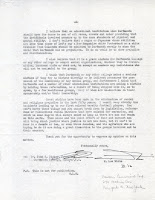
On November 9, 1950, Dartmouth alumnus W. Lee White wrote a letter expressing his displeasure with a proposal enacted by Dartmouth's undergraduate council. The effect of the proposal was grand: initiating action to eliminate the discriminatory membership clauses in a number of the college's fraternities. He addressed the letter to his undergraduate brothers of Dartmouth's Kappa Sigma fraternity chapter. White himself was a member of Kappa Sigma as an undergraduate, graduating from Dartmouth in 1912. Though the letter was primarily sent to Kappa Sigma, White CCed John Sloane Dickey, the president of Dartmouth at the time, and his words were clearly intended for the ears of Dickey and Dartmouth's administration. White wrote the letter after receiving correspondence from Kappa Sigma on October 28, informing him of a proposal to be adopted by the undergraduate council as the result of a student referendum on the issue of fraternity discrimination. This referendum was held on March 1, 1950, and received votes from 90% of the student population. The majority vote led the undergraduate council to enact the following proposal: "The Interfraternity Council would withdraw recognition of any fraternity at the end of a given year if they had not made every possible effort short of disaffiliation from their national organization to eliminate discriminatory clauses."

The referendum was staged due to the desire of students to eliminate discriminatory clauses held in the constitutions of some of Dartmouth’s fraternities at the time. These clauses were established by the fraternities to prevent membership from men belonging to various groups of "race, religion, and national origin," and were most often found in chapters with national affiliation. These national fraternities were widely prejudiced, generally restricting membership to "white, Christian born males."

In his letter, White voices his opinions on the matter of racial and religious discrimination, referring to both the fraternity system and the greater United States. He utilizes his perspective and personal anecdotes in an attempt to argue that the enactment of the proposal by the undergraduate council would be unwise for the college and its students. One of his points of disapproval in the adoption of the proposal was his belief that Dartmouth's administration, through direct or indirect means, was forcing the fraternities to conform to the college's wishes and remove their discriminatory clauses. White's argument, however, was based on a misconception of the true driving force behind the fraternity desegregation movement. 
Page Two of White's letter
Though Dartmouth’s administration acknowledged the issue of fraternity discrimination on campus as early as 1945, the acknowledgment was internal. Formal action on Dartmouth’s campus to desegregate its fraternity system was initiated entirely by students. Following the 1950 referendum, the investigations into each fraternity - to assess their progress towards the elimination of their discriminatory clauses - were led by a Discrimination Council composed of undergraduates appointed by the Interfraternity Council and the Undergraduate Council. The fraternity desegregation movement remained student-led, with approval from some faculty and administrative members, until May 6, 1954. The college enacted no official policy on fraternity discrimination until this date, and the policy resulted from a second student referendum and recommendation given to the Board of Trustees by the undergraduate council. You can find further information on the second referendum in the "Going Local: Desegregating Dartmouth's Fraternities" article here on Rauner's blog site. 

Dickey's presidential records have significantly aided my research during the Historical Accountability Student Research Program Fellowship, in which I am researching diversity and inclusion in Dartmouth's fraternities throughout the 20th century. As President of Dartmouth throughout the fraternity desegregation movement, Dickey's records contain an abundance of correspondence with college officers, students, alumni, and national fraternity representatives over the matter. W. Lee White’s letter is held in Dickey's files. Furthermore, Dickey played a major role in eliminating discriminatory clauses from fraternity chapters after the second referendum. He personally presented the results of the second student referendum to the Board of Trustees, spearheading the Board's decision to make the referendum's recommendation official college policy. 

While Dickey received many letters from alumni in support of fraternities disaffiliating from their national chapters and removing their discriminatory clauses, W. Lee White's words parallel those of many national fraternity representatives and other alumni who wrote Dickey with disdain for the movement to eliminate the discriminatory clauses. Pro-discrimination letters like W. Lee White's provide evidence of the strong opposition Dickey and the college received during the fraternity desegregation period, and they document the severe divide in attitude over the issue by members of the Dartmouth community—all of which the college was able to overcome after more than a decade of conflict. 

I invite anyone further interested in fraternity desegregation to consult Rauner’s extensive collection of records.

Posted for Christian Dawkins '22, recipient of a Historical Accountability Student Research Fellowship for the 2021 Spring term. The Historical Accountability Student Research Program provides funding for Dartmouth students to conduct research with primary sources on a topic related to issues of inclusivity and diversity in the college's past. For more information, visit the program's website.

Friday, April 23, 2021

Tempestuous Beauty

A woodland scene with numerous fairies by Rackham from The TempestArthur Rackham is widely known as one of the most important illustrators from the "Golden Age" of British book illustration, which spanned from 1890 until almost 1920. Rackham's work often appeared in children's books, especially his images of fantastical fairies. He usually began his illustrations with a pen or India ink drawing, followed by layers of watercolors that created a subtle and pleasing melding of colors.

A scene from Rackham's The TempestHis popularity began to decline in Great Britain roughly around the same time as the close of the aforementioned Golden Age, and Rackham decided to capitalize on his growing fame in the United States. To that end, he created a gorgeous series of both line drawings and ink-and-watercolor images for a special limited edition of what is generally accepted to be Shakespeare's play, The Tempest. Although ostensibly for an adult audience and made to represent the work of a Western literary icon, Rackham's unique style is so quickly identifiable that it's hard to think about the Shakespearean characters he represents; instead, we find ourselves envisioning his previous illustrations and not Prospero or Caliban.

There were only 520 copies of this book made for sale: numbers 1-260 were sold in England and the rest in the US. Rauner Library is fortunate to have number 299. To see our copy, ask for Illus R115sh.

Friday, April 16, 2021

"Whan that Aprille..."

Think fast! What language is this story written in? If you guessed, "English," you're right. If you guessed, "Middle English," then we're really impressed! Middle English was a form of the English language that was spoken from the time of the Norman Conquest in 1066 until the late 1400s. It eventually morphed into Early Modern English, which is what Shakespeare and his ilk spoke.⁠

The arrival of a Norman ruling class in England in 1066 meant that Old Norman, a dialect of Old French, quickly became the preferred language of the island's elite. It wasn't until the late 1300s, when Geoffrey Chaucer began writing in Middle English instead of Old French or Anglo-Norman, that the English language regained some measure of respectability as a vehicle for intellectual and artistic expression⁠

Tomorrow is National Chaucer Day, which celebrates the anniversary of the first time that Geoffrey Chaucer read his Canterbury Tales aloud to the Court of King Richard II in 1371. To celebrate we're sharing an image of a page from the first printed edition of Chaucer's Canterbury Tales. The book was printed in London in the 1470s by William Caxton, who is reputed to be the first person to introduce the printing press to England. ⁠

To see our single leaf of this landmark work of book history, ask for Hickmott 201.

Friday, April 9, 2021

All Snow and No Skiing

photo of Malcolm McLane in military uniformHave you all ever heard of Malcolm McLane? He was a New Hampshire boy, a member of Dartmouth's class of 1946, and a skiing enthusiast. He was also an aviator during World War II who was shot down over Europe and spent months in a German POW camp until he and others were liberated by the Russian Army in 1945. Today, for National Former Prisoner of War Recognition Day, we honor his memory and those of many other Dartmouth alums who served their country faithfully and endured bleak conditions as captives in a strange land.

Born in 1924 in Manchester, New Hampshire, McLane attended high school at St. Paul's School in Concord before coming to Hanover for his college education. While at Dartmouth, he was captain of the Dartmouth College Ski Team and continued his dedication to the sport for the rest of his life; in 1960, he served as an international alpine ski official at the Olympic Games in Squaw Valley, California, and was eventually inducted into the Ski Hall of Fame in Ishpeming, Michigan.

Despite this lifelong pursuit of skiing, McLane's access to the pastime was disrupted in the fall of 1942, when he was sworn into the United States Air Force as an aviation cadet. After flying 73 combat missions in P-47 fighter planes over France and Germany, his plane was shot down on December 23rd, 1944, near Trier, Germany, during the Battle of the Bulge. He was freed on the evening of April 30th after over four months of confinement in Stalag Luft I, a German prisoner-of-war camp near Barth, Germany.

McLane sent several postcards to his mother in Manchester during his imprisonment, most of them only a sentence or two in length. In those messages, he chose not to describe the harsh conditions of the camp
(probably to alleviate his mother's worry) and instead sighed over the fact that, despite the preponderance of snow in January, he wasn't able to go skiing in it. This observation was likely equal parts truth and a desire to protect those he loved.

Even if you haven't ever heard of Malcolm McLane before, you've probably heard of his daughter, who is an ardent advocate for the rights of US war veterans, both nationally and in her home state: Ann McLane Kuster, a member of Dartmouth's class of 1978, currently serves as the U.S. Representative for New Hampshire's 2nd congressional district (and has since 2013).

To explore Malcolm McLane's papers at Dartmouth College, come to Rauner and ask for MS-1051.