Friday, July 19, 2019

A Rosetta By Any Other Name

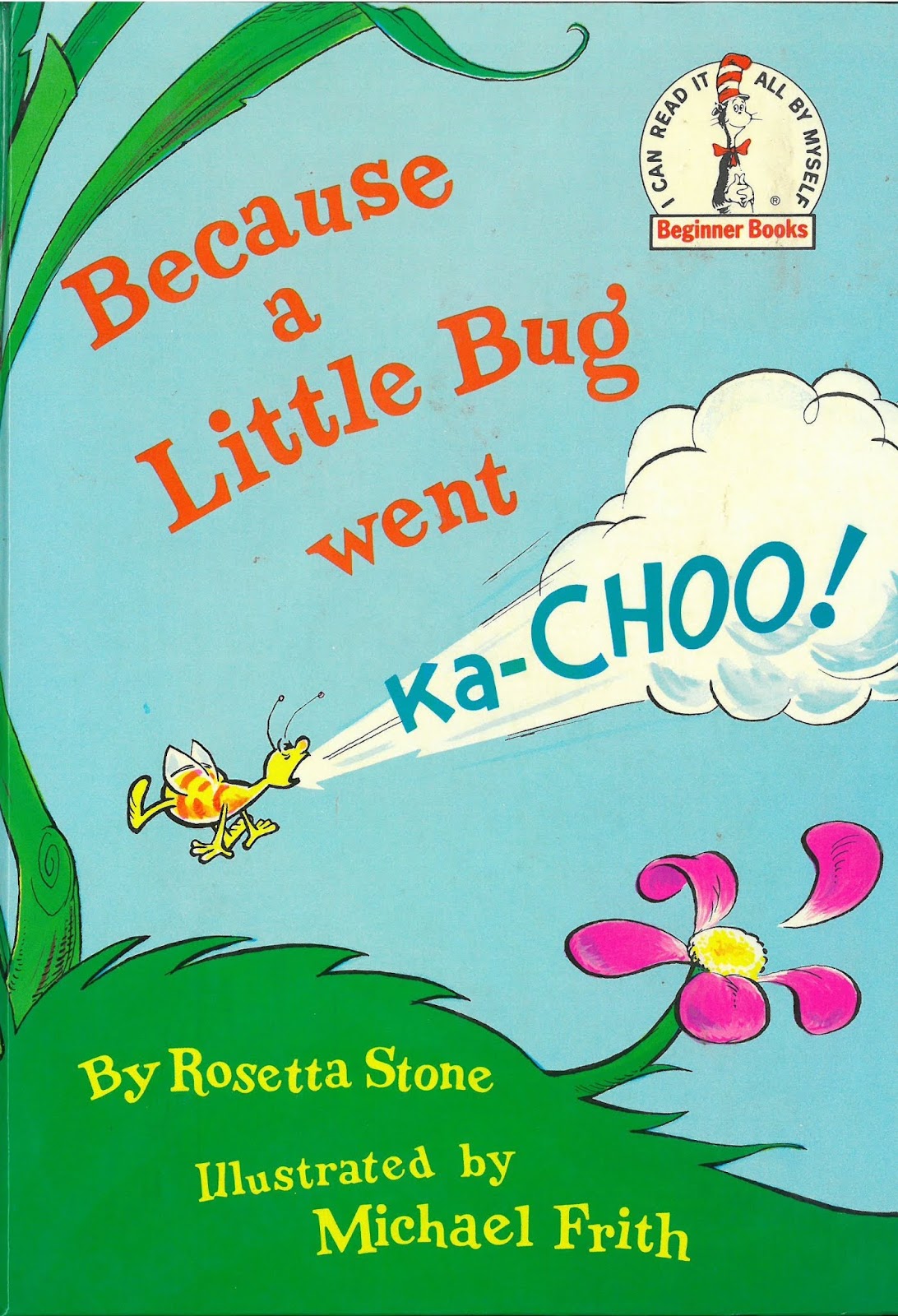
cover of "Because a Little Bug went Ka-Choo!"
On this day in 1799, the discovery of the Rosetta Stone was formally reported by Michel Ange Lancret to the Institut D'Egypte, a newly formed scientific organization that had been created by Napoleon for the express purpose of conducting research during his campaign in Northern Africa. The stone was discovered near what is now the Egyptian port city of Rashid and has proved invaluable in the translation of ancient Egyptian hieroglyphs, which had been inscrutable to Western scholars until this moment. Sadly, here in Special Collections, we don't have access to this sort of linguistic miracle. However, we do have our own Rosetta Stone of sorts.

Biographical notes inside the front cover of Stone bookAmong the numerous volumes in our Alumni collection is a children's bookwritten by "Rosetta Stone" and illustrated by Michael Frith. The book, titled Because a Little Bug Went Ka-choo!, was printed in 1975 by Random House as a part of its Beginner Books imprint. So, why do we have a book by Ms. Stone in our Alumni collection? Well, Beginner Books was founded in 1957 by Phyllis Cerf, Ted Geisel '25, and Helen Palmer Geisel. The first book published under that imprint was The Cat in the Hat. Whenever Ted Geisel illustrated his own works, he went by the well-known pen name "Dr. Seuss." However, when he wrote the books but didn't draw them, he went by pseudonyms. Perhaps his best-known one is Theo LeSeig, under which he wrote no less than thirteen books. However, he also wrote a single book as Rosetta Stone, which we have here in Special Collections.

One of Geisel's early cartoons from the Jacko-O-Lantern attributed to "T. Seuss."
As we've mentioned before, Geisel's habit of using playful pseudonyms for his work began during his senior year here at Dartmouth. He had run into a spot of trouble with the administration over a bottle of gin that appeared at a party he was hosting, and was henceforth stripped of extracurricular privileges. At the time, Geisel was the editor-in-chief of the Jack-O-Lantern (the student satire magazine). He promptly disregarded the administrative proclamation and instead continued to contribute drawings and cartoons to the magazine under a variety of fanciful names that included the use of his middle name, Seuss.

To take a look at the only Rosetta Stone we'll ever own, and the only book ever authored by Geisel under that pen name, come to Special Collections and ask for Alumni G277bec. All of the issues of the Jack-O-Lantern are on the reference shelves in the Reading Room if you'd like to see his student illustrations.

Monday, July 15, 2019

Targeted Hate

Cover of "Long Live the Kaiser"When the United States entered World War I in 1917, the propaganda machines clicked on. Here is an interesting little example created by the American Press Humorists. Long Live the Kaiser! claims to "have no quarrel with the German people, or the American people of German birth or ancestry," in fact, they assert that they "love" the Germans, except for one exception: the Kaiser.

While you have to admire the gesture toward the German people, the violence directed toward the Kaiser is a bit disturbing. On the book jacket he is headed to a certain fate in hell, and it just gets more brutal inside with cartoons and doggerel verses which all manner of harm on Wilhelm II. To see for yourself ask for Val 817R543 S85.

Friday, July 12, 2019

Painted Covers

Cover of Hurrah for Anything hand painted by Kenneth PatchenIt is our week for thinking about book covers. We just blogged a mundane 19th-century book jacket--here is the polar opposite. Kenneth Patchen is famous for his hybrid poem/images. As he wrote, he would draw, and those drawings illustrated the poems (or maybe the poem was an ekphrastic manifestation of the drawing...). Anyway, his books are commonly picture/poem throughout.

Handwritten colophon for Kenneth Patchen's Hurrah for Anything
Patchen's love of drawing spills out onto the covers. Rather than issue separate fancy editions for his books, Patchen took one hundred copies of the regular trade editions of nine titles and turned them into limited editions by painting their covers and adding a handwritten colophon. The result is a limited edition of 100 copies, each unique! Here is our copy of Hurrah of Anything, 1957.

Come in and take a look by asking for Val817 P271 R6.

Tuesday, July 9, 2019

Keeping the Merchandise Clean

Plain book jacket for Lafcadio Hearn's YoumaIn about 1920, flashy book jackets became all the rage. Publishers recognized that a dust jacket could do more than simply protect a book in transit. They put cool pictures on the front and studded the back with catchy blurbs, and the book jacket become a powerful point-of-sale marketing tool--and a collector's item as well.

It wasn't always so glamorous. In the 19th century, book jackets were pretty plain. They listed the author and title, and sometimes the publisher, but were not enticing in the least. Their whole point was to protect the cover during distribution and sale. As soon as any self-respecting book buyer got home he or she would discard the jacket and enjoy the pristine cover, spared the ravages of shipping and handling.

Plain jacket removed from book so flaps are shown. There is no type except the title, author and publisher on spine.
All of that makes late-19th-century book jackets very rare. We are lucky to have a handful scattered in the collections. Lafcadio Hearn's Youma (New York: Scribner's, 1890) is a prime example. You can see it yourself by asking for Val 816 H35 Z5.

Friday, July 5, 2019

Fireworks

Faculty notes on Treadwell hearingOn June 23, 1828, John Treadwell of the Class of 1830 set off fireworks near Dartmouth Hall. That doesn't sound like that big of a deal but, in this circumstance, it was. On June 24th, a special meeting of the faculty was called to discuss his case and, on June 26th, the faculty meted out a ten-week suspension from Dartmouth.

We have a small clutch of hastily written notes from that week. It appears Treadwell had exhibited a pattern of bad behavior during his time at Dartmouth. The fireworks were merely the latest disturbance. It appears the faculty had had enough, and they interrogated Treadwell. During the meeting, he "stated several manifest falsehoods," as documented in notes and dispositions.

Letter from Rev. PerryHe was banished to the "care and instructing of the Rev. Joseph Perry in Thetford, Vt." In October, Perry wrote a not-very-enthusiastic report to the faculty about young Treadwell's progress. While he had not "been altogether as industrious as would have been desirable and perhaps upon the strict principle might fall under the charge of some indiscretions," the good Reverend believes that Treadwell's former bad habits were likely the result of "unhappy connections."

Hmmm--we are still not sure what all he did, but either the faculty opted not to readmit or he decided not to return: he never completed his degree.

To try to puzzle it out yourself, ask for MS 828374.

Tuesday, July 2, 2019

Money Talks

First page of "Satan Absolved"
One of our lesser-known book collections in Special Collections is the Wilfrid Scawen Blunt collection. It was given to the college in 1940 by legendary Dartmouth professor Herbert West, a member of the class of 1922. The Blunt collection contains seventy-seven volumes of first-edition works by the author, including presentation copies and other rare issuances of his work.

Born in Sussex, England, in 1840, Blunt was publicly known for his anti-imperialistic stance towards European global dominance. His scathing condemnation of European self-righteous expansion frequently emerges in his writing. In his work Satan Absolved, Blunt refers to the phrase, "White Man's Burden," which was a term coined by Rudyard Kipling in an 1899 poem published about the Philippine-American War. The phrase was seized upon by expansionists and imperialists as a justification for the often violent subjugation and subsequent financial exploitation of other nations and peoples, under the pretense of bringing to them the "gift"
Page of "Satan Absolved" that discusses White Man's Burden
of civilization. Blunt places this concept in the mouth of his character, The Lord God, in Satan Absolved, who says:

This Anglo-Saxon man hath a fair name with some.
He stands in brave repute, a priest of Christendom,
First in civility, so say the Angel host
Who speak of him with awe as one that merits most.

In response, Blunt's character Satan rails against this thinly-veiled notion of white supremacy: "Their poets... write big of the 'White Burden.' Trash! The White Man's Burden, Lord, is the burden of his cash."

Page of "Satan Absolved" that shows the "horse" correction to the proofIn addition to his anti-imperialism, Blunt also dallied with the Islamic faith, and wrote a book titled The Future of Islam. He and his wife, Lady Anne Noel Blunt, lived for a long time just outside of Cairo, where they established an Arabian horse-breeding farm that was partially responsible for saving the Arabian breed from extinction. Blunt's love of horses is evident in Satan Absolved. Here in Special Collections, we have a proof copy of the poem containing numerous manuscript corrections. In one of Satan's responses to The Lord God, he originally speaks of "Large hearted elephants, the wolf, the wolverine." However, in our version, Blunt has crossed out the wolf and the wolverine and instead substituted "the horse how near divine."

To examine his other corrections and emendations of his poem, or to read Satan's withering critique of imperialism in full, come to Rauner and ask to see Blunt 31, copy 2.
Friday, June 28, 2019

Students for Social Alternatives

Newspaper photo of table at registrationThis week marks the 50th anniversary of the Stonewall riots in Greenwich Village. The mass demonstrations were a crucial turning point for the gay rights movement, leading to mobilization and advocacy and creating the foundations for today's LGBTQIA+ activism. The ripple effect hit some college campuses almost immediately, but took some time to reach Hanover. On January 2nd, 1978, Stuart Lewan '79 publicly asserted the presence of Dartmouth's gay community by pitching a table at Winter term registration for a new "Gay Student Support Group." A sign over his head proclaimed, "Get on Down and Party with the Students for Social Alternatives." 55 students signed up for the promised regular newsletter.

Lewan followed up with an editorial in the January 6th issue of The Dartmouth entitled "Helping gays adjust to Dartmouth." He starts with a nod to Stonewall by bemoaning, "So, about 10 years after most other colleges of similar prestige, Dartmouth is giving birth to its first gay student group. Why has it taken so long?" He then lists all of the things that gay people feared at Dartmouth and beyond, and calls for broad campus support of the community, but most importantly for Lewan, he calls for the gay community at Dartmouth to come out of the closet, claim its place on campus, and support each other to fight back against fear.

Helping gays adjust to Dartmouth editorial
There is a militant tone to his editorial--and it provoked some predictable backlash in the letters to the editor, but Lewan's work, along with that of fellow student leaders, helped begin the long process of opening the campus and making it someplace where more people could feel welcome. You can learn a lot more about Stuart Lewan by listening to his oral history on the Dartmouth SpeakOut site.