Friday, August 3, 2012

Games of the XIII Olympiad

An illustration of a nude man pulling at the base of a small tree. In the background two man handle a horse.Actually, there wasn't a 13th Olympiad since the year was 1944 and World War II was still in progress. Instead of holding the Games in London as planned, the International Olympic Committee held a much smaller "Jubilee" in neutral Lausanne, Switzerland to celebrate the fiftieth anniversary of the first modern Olympiad.

Several commemorative items were issued as part of the celebration including this collection of odes by Pindar titled Olympiques (Lausanne: Èditions A. Gonin, 1944). Illustrated by Swiss artist Hans Erni, the book included all fourteen of the Greek poet's Olympian victory odes - each dedicated to a specific athlete's triumph in the ancient Olympic Games. Erni's illustrations include the mythical founding of the games by Heracles as well as selected depictions of the heros. The volume also contains a brief history of the ancient games and Pindar as well as an analysis of each ode.
An illustration of a nude man with his arms around a horse's neck, slightly overlap with a man waist-deep in water.

Interestingly, there appears to be no mention of World War II or any explanation of the circumstances surrounding the cancellation of the 1944 Games.

Ask for Rare Book PA 4275 .F8 E76 1944.

Tuesday, July 31, 2012

Mencken's Tessie

A printed name and address.We recently acquired a small, but rich collection of letters by H.L Mencken. While Ambrose Bierce is the 19th-century's greatest curmudgeon, surely Mencken deserves consideration for the the title in the 20th century. He is known for his harsh criticism, cutting wit, and general intolerance for the American middle class (the "booboisie," as he famously called them). But in this letter from May 21, 1921, we see mourning and emotion cloaked in his typically urbane prose:
Our old dog Tessie died on Sunday. A tooth abcess [sic] developed gangrene and the horse-doctor gave her a sniff of prussis acid. She went out instantly. Tessie was 16 years old, a great age for a dog. She never married. We miss her enormously. Sunday afternoon my brothers and I buried her in the garden, and today I ordered a small tablet to be set in the wall, thus "1905 - Tessie - 1921". Tessie was a Presbyterian.
The signature on the letter.

Twain could hardly have done better. The letters will join our existing Mencken Collection, ML 693, which will be the subject of another posting.

Friday, July 27, 2012

Cartesian Diver

A page of illustrations showing a chemist at work, various pieces of equipment, and a faun.We just acquired a very curious little book. Die Glasschmelzkunst (Vienna: Schultz, 1769) is a manual for 18th-century do-it-yourself chemists. It provides detailed instruction for manufacturing thermometers, hydrometers, barometers and even glass eyes. But it was figure 15 in the illustration here that caught our attention.

A closer image of the faun.
At first we wondered if it was some kind of little science faun to consult when things went terribly wrong, but then we dug out our German dictionary and read the text. It is a model of a Cartesian Diver, a figure with a hollow tube inside with an opening on one end.  If you place the Diver in a closed container of water (a two-liter water bottle would work great, but not in the 18th century), it will float. When you squeeze the bottle, the pressure will drive water up into the tube and compress the air. The Diver's overall water displacement will change, and he will slowly dive to the bottom of the bottle (or quickly, if you squeeze really hard). It is a great way to measure pressure.

You can come in and see it now by asking for Rauner Rare TP 859.2 .B11 1769.

Tuesday, July 24, 2012

Nelson Brown Doodles

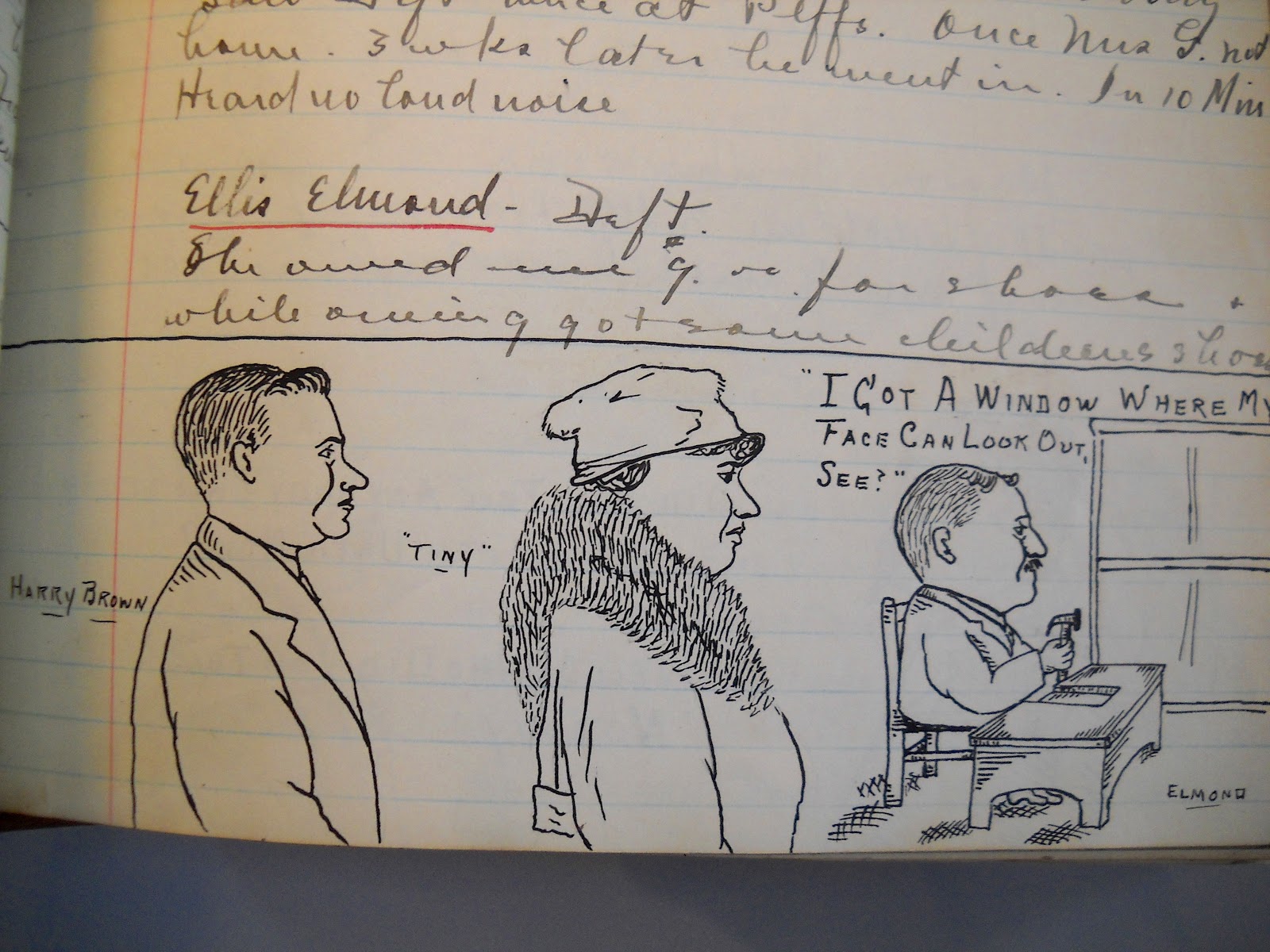
A sketch of an older woman in a hat with handwritten text.This week we finished re-processing the papers of Nelson Pierce Brown, Dartmouth class of 1899. The papers document Brown's career as a judge on the Massachusetts Supreme Court and his lifelong relationship with Dartmouth, including a few diaries and photo albums of his four-years as a student. After Dartmouth, Judge Brown went on to marry Margaret Tucker, daughter of President Tucker in 1903 and graduated Harvard Law. After being appointed as the Middlesex Co. District Attorney in 1912 and Assistant to Attorney General Henry C. Attwill in 1915, Brown was appointed to the Massachusetts Supreme Court in 1918. He served for 29 years.

But, here at Rauner, our favorite thing about this collection (besides Brown's enthusiastic desire to keep incredibly detailed and organized documentation of his life) was his budding interest in court sketching. One of Brown's self-bound trial notebooks contains a letter from a comic artist from the Boston Post, which appears to be in response to an earlier inquiry from Brown regarding mail-order drawing instruction. The artist suggests to Brown that practice is a sure-fire way to develop his skills and signs off with a little sketch of his own.

A series of sketched portraits and handwritten text. A pair of portrait sketches and some handwritten text.
A sketch of a suited man seated in a chair and reading.

Well, apparently Judge Brown took the advice and the results are found all over the margins of Brown's trial books. They are filled with small drawings and sketches of various members in the courtroom. From lawyers to witness, no one was exempt from the artistic study of Judge Brown, it seems. Many of his sketches come complete with witty captions and quotations. And some are even treated to a full shading. We invite you to stop by to check out these cool doodles and perhaps they might inspire some work of your own!

A series of sketched portraits and some handwritten text.

Just ask for manuscript collection MS-189! A finding aid for the collection is available.

Friday, July 20, 2012

Faking It

The cover for "The Dance of Death.""DANCE, v. i.: To leap about to the sound of tittering music, preferably with arms about your neighbor’s wife or daughter. There are many kinds of dances, but all those requiring the participation of the two sexes have two characteristics in common: they are conspicuously innocent, and warmly loved by the guilty." -- Ambrose Bierce, The Devil's Dictionary

Ambrose Bierce was an American journalist, literary critic, and satirist during the end of the 19th century. Known to many as "Bitter" Bierce, he is now perhaps best known for his much-anthologized short story "An Occurrence at Owl Creek Bridge" and his satiric book of definitions known as The Devil's Dictionary.

Less well known is a work written by Bierce and his co-conspirator, Thomas A. Harcourt, called The Dance of Death. Purportedly penned by one William Herman and published in 1877, the book was a hugely successful hoax that argued for the abolition of the waltz because the dance was a "dark vortex, within whose treacherous embrace so many sweet young souls have been whirled to perdition."

The cover for "The Dance of Life."
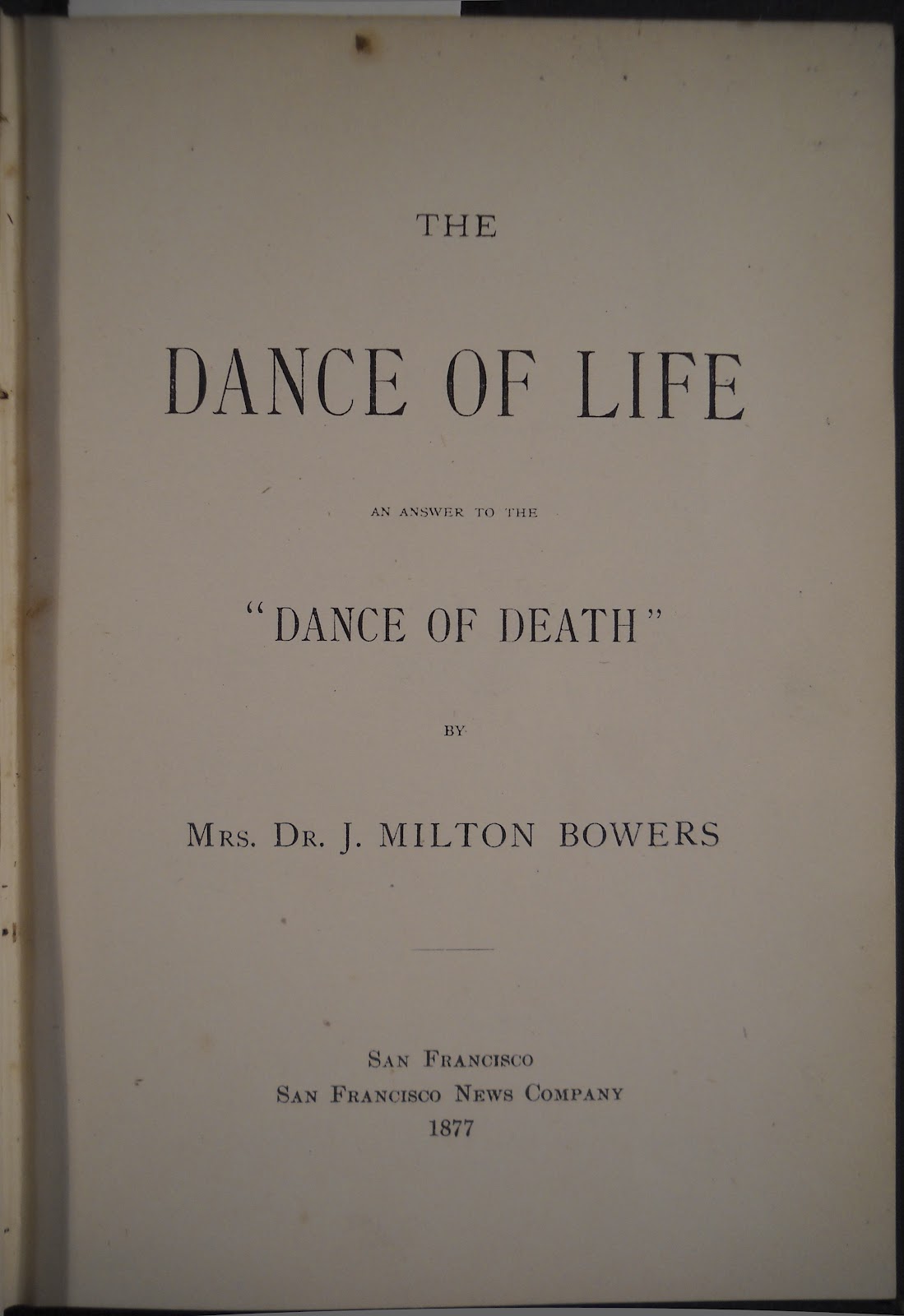
The instant popularity of The Dance of Death resulted in an impassioned rebuttal that was published the very same year. The Dance of Life, by a Mrs. Dr. J. Milton Bowers, was written "to check the insolence of a Philistine." To that end, she dissects their book chapter-by-chapter, providing strident counter-arguments throughout. Still, despite Mrs. Bowers's fiery invective (or perhaps on account of it), there are some who believe that the second book itself was also a brilliant hoax, written by either Bierce or someone who knew him.

The title page for "The Dance of Life."
Ambrose Bierce vanished some time after December 26th, 1913, while traveling as an observer with Pancho Villa’s army in Mexico, so unfortunately we'll never know whether The Dance of Life was a sincere if naïve defense or a second hoax that is still claiming unwitting victims. To see an extremely rare author’s copy of The Dance of Death, inscribed by Bitter Bierce himself, waltz over to the library and ask for Rauner Bierce 11. To see The Dance of Life, ask for Rauner Bierce 46.

Tuesday, July 17, 2012

Annus Mirabilis Papers

An open book of printed text.In 1905, during his now famous stint in the patent office, Albert Einstein published four articles in the scientific journal Annalen der Physik. This series of articles is often referred to as the Annus Mirabilis (extraordinary or miracle year) papers - reflecting their enormous impact on several key areas of modern physics.

The first article to be published was Über einen die Erzeugung und Verwandlung des Lichtes betreffenden heuristischen Gesichtspunk (June 9, 1905).  This paper discussed the photoelectric effect (electrons can be ejected from a material if a sufficiently energetic beam is focused on the material) and demonstrated how observations of the phenomena could be explained by postulating that light is composed of discrete packets or quanta whose energy is determined by the frequency of the ray.  Einstein ultimately received a Nobel Prize for this work.

The second article dealt with Brownian Motion - the movement of particles suspended in a fluid medium whose motive force is imparted by bombardment of the atoms of the fluid itself.  Entitled Über die von der molekularkinetischen Theorie der Wärme geforderte Bewegung von in ruhenden Flüssigkeiten suspendierten Teilchen (July 18, 1905) this paper strongly supported the idea that the atom was a real entity and also lent support to the field of statistical mechanics.

The third article discussed special relativity. Zur Elektrodynamik bewegter Körper (September 26, 1905) demonstrated that Maxwell's equations for electricity and magnetism and the laws of mechanics could be reconciled at speeds approaching that of light, which was a fixed constant and so the same for all frames of reference.

An open book of printed text and equations.
The final paper of the "miracle year" was titled Ist die Trägheit eines Körpers von seinem Energieinhalt abhängig? (November 21, 1905).  In this article Einstein presented one of the most famous equations of all time: E=mc2 (energy can be equated to the mass of an object times the square of the speed of light).  This energy is known as rest energy and is distinct from an object's kinetic and potential energies.

To see all the original publications ask for Rare Book QC1 .A6133 v.322 no.6 (photoelectric effect), Rare Book QC1 .A6133 v.322 no.8 (brownian motion), Rare Book QC1 .A6133 v.322 no.10 (special relativity) and Rare Book QC1 .A6133 v.323 no.13 (mass energy equivalence).

Friday, July 13, 2012

Non-Athletics

A book cover bearing a cartoon of a man in a dress and stockings on a stage, titled "Non-Athletics."While looking for something else this morning, we stumbled across this provocative illustration from the 1921 yearbook,  The Aegis. Wow, what does this say about students who were not athletes? It is easy to read a lot into this image, but it does demand some context.

Up until the 1920s the Dartmouth Players were an all male theater group (they began inviting women from other colleges to take the female roles later in the decade). On an all-male campus out in the "wilderness," cross dressing was not as uncommon as you might expect. Many of our student scrapbooks from the early part of the 20th century show pictures of male students camping it up in drag.

A printed cast of characters.
So, on one level, this is just a humorous depiction of one of the most important non-athletic extra-curricular activities on campus--the theater. On another level it is an example of the prevalent chauvinism of the era, one that was played out intensively on an all-male, elite campus.  By that reading, if you are not an athlete your masculinity is in question.