Wednesday, October 2, 2013

Not Your Usual Alice

A stylized color pencil drawing of a girl floating through the air.When most people think of Alice's Adventures in Wonderland, their minds jump to either John Tenniel's classic illustrations or the Disney Alice of 1951. We have blogged about our flapper Alice, and Barry Moser's rendition, and here is another Alice, altogether different.

A color pencil drawing of a girl and some kind of animal outside a house. This 1930 rendering of Alice is considered to be among the finest productions of Harry and Caresse Crosby's Black Sun Press. Established in 1927 by the Crosbys as a vehicle for their own writing, but also to distribute the work of their ex-pat compatriots, Black Sun allowed the Crosbys to have control over editorial decisions and production. This particular book is one of their more ambitious attempts, and something of a curiosity. The text was not new and it fit only marginally with the literary visions of the writers associated with the Press. The delicacy of the binding and lavish production surely kept it out of the hands of children. It appears to be more an elaborate vehicle for six lithographs by Marie Laurencin.
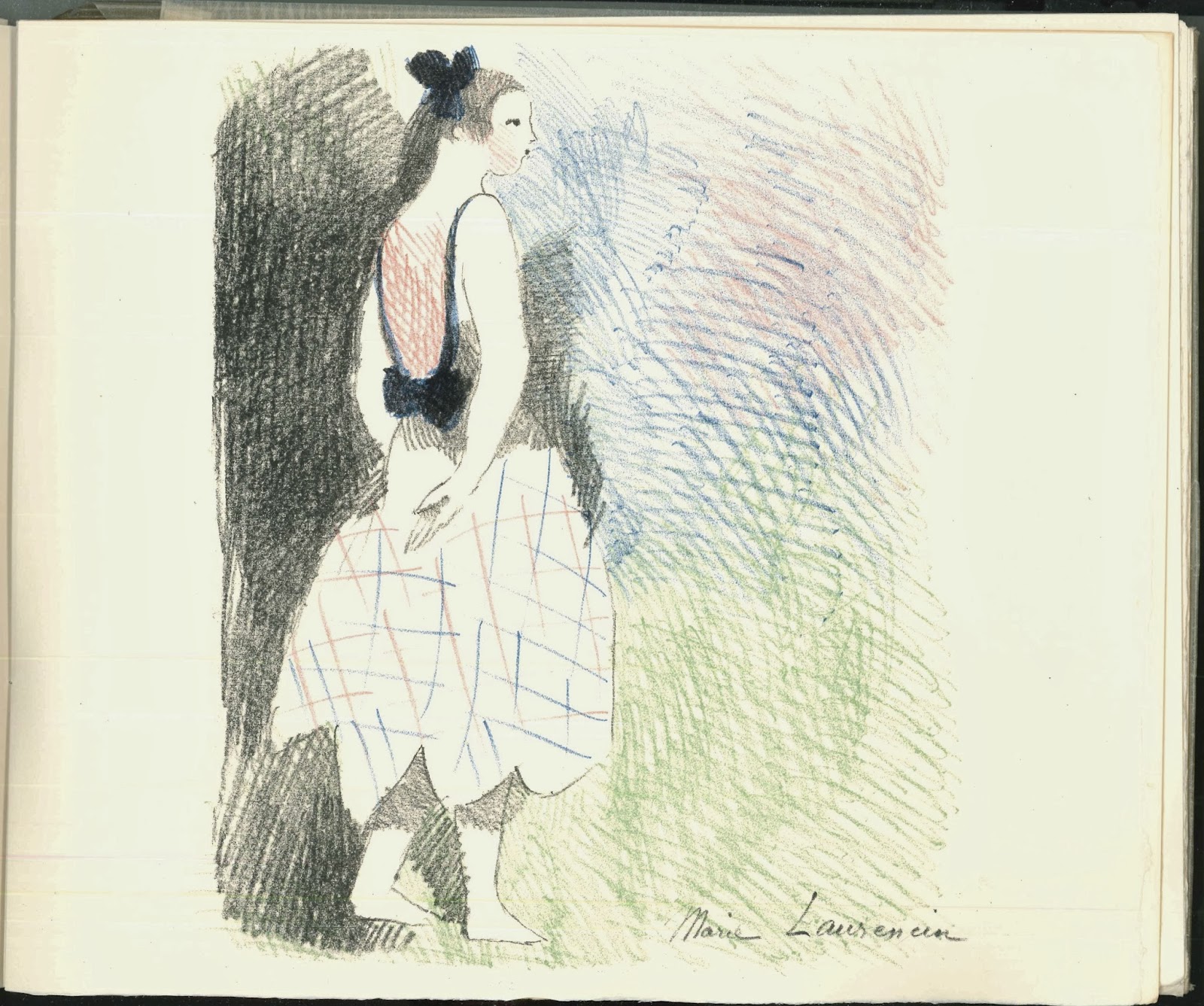
A color pencil drawing of a girl.A color pencil drawing of a girl and a woman in a crown.

Laurencin does fit in with the Black Sun Press style and vision. She exhibited with major cubist artists of the time, was romantically involved with Guillaume Apollinaire, and was part of the Paris avant-garde.

You can see it by asking for Presses B561d.

Friday, September 27, 2013

Boundaries

A black and white photograph of men and surveying equipment in a wooded area.In 1933, George Howard Richardson became the official surveyor of the town of Littleton, NH. A native of the state of New Hampshire, George had followed in his father's footsteps when, after graduating from Dartmouth College in 1914, he became a surveyor. He worked primarily in Coos and Grafton Counties and over the years accumulated a large collection of survey plans, not only from surveys that he conducted but also from surveys conducted by his father William, Ray T. Gile and many others. By the time of his death in 1979, the collection contained more than 3000 survey plans and plat maps covering private and public properties throughout northern New Hampshire and Vermont, including properties in the White Mountains such as the Mt. Washington Observatory and the Mt. Pleasant Hotel. Towns surveyed include Littleton, Lisbon, Haverhill, Dalton, Easton, Franconia and Bethlehem, NH.

The surveyors whose maps were collected by Richardson did not often venture south. However, between 1909 and 1918, the Richardsons spent some time in Windsor, Vermont, where they surveyed the Evarts property, the LaFountain Woolson property and the Toll Bridge property, off the Cornish-Windsor Covered Bridge.

A surveyor's map.
A printed form with handwritten notes.
In addition to the survey plans, the collection contains deeds and land descriptions - some dating back to the late 18th and early 19th century - as well as field notebooks by Richardson, William Richardson, Chester Abbot, Percy E. Smith and Ray T. Gile whose work included the setting of the boundary between New Hampshire and Massachusetts during 1891-1901.

You can find the finding aid under MS-740, The George H. Richardson Surveying Collection.

Tuesday, September 24, 2013

Why Wolves Don't Roam Dartmouth

A handwritten statement.We just acquired a very simple little document that says so much. On one side is a statement from the constable of Chesterfield, New Hampshire, attesting that Abner Ally brought to him on December 12, 1778, one dead adult male wolf. The other side is a receipt from Nicholas Gilman dated March 13, 1779, for ten pounds given to Abner Ally for killing a wolf.

A handwritten receipt.
Ten pounds! That was just a little less than a sergeant in the British army would have earned in a year. Abner Ally must have protected that scrap of paper very carefully for the long winter until he could collect his bounty (marked on the document with the hole punch).

A printed page on "An act for repealing the laws relating to Wolves."
This sent us searching into our copy of the first published laws of the newly formed state of New Hampshire from 1780. Sure enough, on November 28th, 1778 (just two weeks before Abner killed his wolf), the state passed a law offering a bounty of ten pounds for a full-grown wolf, and five pounds for a whelp.

The law fulfilled its intent. The state paid its last bounty in 1895 and wolves are only just now beginning to return to the area.

You can see it by asking for Ms 778662.

Friday, September 20, 2013

Lemons for a New President

A giant hand in red ink grasps a lemon tree . Below the image are two quotes on the Lemon incident in black.
Stephen Harvard, Class of 1970
"It appears that Dartmouth has bought another lemon for President." These words do not refer to Dartmouth’s newest President, Philip J. Hanlon, Class of 1977, but they do refer to man who was president of the College when Phil was a student, John Kemeny.

In May of 1970, just two months into his new presidency, Kemeny found himself facing a major crisis. The US incursion into Cambodia on May 1 followed closely by the shooting of four students at Kent State by Ohio National Guardsmen had students around the country, and at Dartmouth, threatening to strike. In his oral history Kemeny states "I think in a very real sense, I feel that I fully assumed the duties of president of Dartmouth College in the half hour between 8:30 p.m. that Monday and 9:00 p.m." In following hours he made the bold decision to cancel classes for the coming week to facilitate discussion and allow tempers to cool.

The Manchester Union Leader, then a Nationally known newspaper with a reputation for being one of the most conservative news outlets of its time, ran a front page editorial with the headline "Dartmouth Buys Another Lemon." In a perfect example of the old adage, if life gives you lemons, make lemonade, both students and faculty adopted the lemon as the symbol of the week. Students made tee shirts and posters and a delegation of faculty presented Kemeny with a miniature lemon tree.

Tom Roos and President Kemeny shake hands in front of a small table with a potted lemon tree.
On behalf of his colleagues, Professor of Biology, Tom
Roos presents President Kemeny with a miniature lemon tree.
The week happened to culminate with Green Key weekend and the students asked their new President to speak. At the end of his speech Kemeny threw lemons out to the crowd. Many of these were brought back to him by students to be autographed.

We certainly hope that President Hanlon will not have to face a similar crisis so early in his tenure. But if he does, he only has to look to Kemeny for an example of how best to deal with it.

Listen to Kemeny describe the "lemon incident," or read the entire transcript.

To see the Stephen Harvard poster ask for Broadside 970240


Tuesday, September 17, 2013

A Letter From Judy

A typed letter in verse.One is repeatedly surprised by unexpected human connections that come to light among our manuscript holdings, to wit, a short letter from Judy Garland to the author, Charles Jackson, thanking him for a Christmas gift and a poem he wrote just for her. Jackson met Garland in Hollywood in 1944 when he was there for several months during the filming of The Lost Weekend, the movie version of his bestselling novel of the same title, which remains an iconic example of the literature of addiction. (One wonders if Judy read it?)

A brief, typed letter.
Jackson lived from 1944 - 1954 in Orford, New Hampshire, and during that time, became friends with Herbert West, Class of 1922, long a Professor of Comparative Literature here at the College and founder of the Friends of the Dartmouth College Library. That connection led to the presentation of the original manuscript of The Lost Weekend to the Dartmouth College Library in 1949.

Judy's signed letter, as well as Jackson's poem for her, and the manuscript of The Lost Weekend are now exhibited in the Class of 1965 Galleries in Rauner Special Collections Library as part of the exhibit, "The Lost Weekend and Dartmouth; selections from the Papers of Charles R. Jackson exhibited in commemoration of the 64th anniversary of Jackson’s presentation of the manuscript of his best-selling novel to the Dartmouth College Library on October 28, 1949."

Page one of a typed letter.The second page of a typed letter.
The exhibit will be on view through November 30, 2013.

Friday, September 13, 2013

The Female Soldier, or...

A four-panel illustration of Hannah Snell in a soldier's uniform, in various positions with her firearm....The Surprising Life and Adventures of Hannah Snell, Born in the City of Worcester, Who took upon herself the Name of James Gray; and, being deserted by her Husband, put on Mens Apparel, and travelled to Coventry in quest of him, where she enlisted in Col. Guise's Regiment of Foot, and marched with that Regiment to Carlisle, in the Time of the Rebellion in Scotland; shewing what happened to her in that City, and her Desertion from that Regiment.

ALSO

A Full and True Account of her enlisting afterwards into Fraser's Regiment of Marines, then at Portsmouth; and her being draughted out of that Regiment, and sent on board the Swallow Sloop of War, on of Admiral Boscawen's Squadron, then bound for the East-Indies. With the many Vicissitudes of Fortune she met with during that Expedition, particularly at the Siege of Pondicherry, where she received Twelve Wounds. Likewise, the surprising Accident by which she came to hear of the Death of her faithless Husband, whom she went in quest of.

The Whole Containing

The most surprising Incidents that have happened in any preceeding Age; wherein is laid open all her Adventures, in Mens Cloaths, for near five Years, without her Sex being ever discovered.

London: Printed for and Sold by R. Walker, the Corner of Elliot's Court, in the Little Old-Bailey, 1750.

A title page for "The Female Soldier." The opposite page shows a portrait of Hannah Snell.
You've got to love a title page like that, and you will have to read it to believe it. Ask for Rare DA67.1.S46 1750.

Tuesday, September 10, 2013

Bathroom Humor

The cover of the book "Charlotte's Web." It shows a young  leaning holding a pig, with a goose and sheep to either side. She and the animals are looking at a spider, hanging by a thread from the "C" in the title.
On a rainy day in the early summer of 1948, Elwyn White visited Dartmouth College to receive an honorary degree as a part of commencement exercises. Although now famous for children's favorites such as Charlotte's Web, E. B. White was at the time a well-known contributor to The New Yorker magazine and the co-author of The Elements of Style, one of the most influential books on the English language written in the last century. One of White's collections of New Yorker editorials, titled The Wild Flag, had been distributed that year to all of the graduating Dartmouth seniors as a part of the Great Issues Course. With that in mind, President John Sloane Dickey wrote to White and suggested that it might be "especially nice" for him to "share Commencement" with the outgoing class.

After his visit, White wrote to President John Sloane Dickey to say that he had approached Hanover "with apprehension" but left "feeling both peaceful and honorable," having enjoyed experiencing "the air so full of June vibrations." A few years later, White sent a signed copy of his latest work, Here is New York, to Alexander Kinnan Laing, the Assistant Librarian, along with a typically humorous and self-deprecating recommendation for where to shelve the book. White, noting that the call number for the gifted book began with the letters "Val" for "valuable," instead suggested a more fitting call number of "Lav" and recommended the book be kept in the bathroom.
A handwritten letter from 1948, addressed to President Dickey. The ending part of a handwritten letter, signed by E.B. White.
A typed letter on New Yorker letterhead reading, in full "Dear. Mr. Laing: Instead of 'Val.' I suggest 'Lav.' Keep it in the lavatory and everybody would see it. Incidentally, from the looks of your letterhead I inscribed it wrong. But I guess it'll do. Sincerely, E.B. White."
To see some of our E. B. White materials , including the above letters and our 1st edition of Charlotte's Web, visit the fabulous Howe Library in Hanover, NH, from September 9 through September 26. Our items are now on loan there for "The Story of Charlotte's Web," the Howe's current installment of their ongoing series, Everyone is Reading. To learn more about the great programs that the Howe has planned, check out their Schedule of Events. Afterward, come to Rauner and ask for 1st editions like Charlotte's Web (Val 817 W5823 P3) and Here is New York (Val 817 W5823 R45) or for the small gathering of manuscript material we have related to E. B. White (Mss 002040).