Friday, August 30, 2013

Cage 33

A small object topped with what appears to be the mechanical element of a music box."Nice book"... not really what you think when you see an image of Angela Lorenz's "Cage." But that is because it is not a book. Obviously, it is a serial: volume three of her Light Verse Magazines.  This homage to John Cage's 4 Notes in 33 Variations is housed in a vanilla tin with the other four volumes of Magazines. The pins (33, naturally) spell out C A G E (4 letters, naturally).  Turn the handle and it sings out a discordant variation for your aural pleasure.

Each volume of Light Verse Magazines is its own elaborate homage to some event or artifact that caught the artist's attention. There is a fan that emerges from a fake cigar imprinted with the titles of books read in cigar factories; a poem written on paper folded to look like fossils; another poem printed on paper to form a ginkgo tree leaf in a test tube; and a paper construction of a "Sunday Stone."

We currently have a small exhibit of some of Angela Lorenz's work (including Binding Ties) to accompany the installation of her Victorious Secret in the Brickway Gallery in Baker-Berry Library. Both will be on display through Fall term.  After that, you can see "Cage" and Light Verse Magazines by asking for Presses L867lolig.

Tuesday, August 27, 2013

Palladio's Progress

A title page for "L’antichita di Roma."Andrea Palladio is best known for his 1570 I qvattro libri dell'archiettvra, or Four Books of Architecture. It brought the theories of the Roman architect Vitruvius into the modern world, reshaped Renaissance architecture and profoundly influenced neo-classicism.

A page of printed text.We recently acquired an important precursor, Palladio’s L’antichita di Roma (Venice, 1565). It is essentially a guidebook. It tells the history of Roman buildings and guides the readers to notice certain features. The act of writing it surely helped Palladio define his views of architecture and develop his architectural principles that would come to dominate the era.

Bound with the Palladio is an Italian translation of Mirabilia Romae also printed in 1565. But the fly leaves are also interesting. The binder used some scrap paper from the shop: left over printed indulgences. The indulgence was issued by Bernhardino Cirillo, the Archibishop of Loreto, to raise money for additions to the hospital at Santo Spirito in Saxia. The book as a package nicely wraps up the pilgrim's experience of Rome. It  contains the standard guide to historical sights, with the contemporary commentary by Palladio, but also an example of one of the indulgences which many pilgrims would have purchased during their visit.

An open book of architectural drawings.
Webster Hall, with its soaring Palladio-inspired interior and windows, is the perfect setting to enjoy these books.  Ask for Rare DG805.I63 1565 and Rare NA2515.P25 1570.
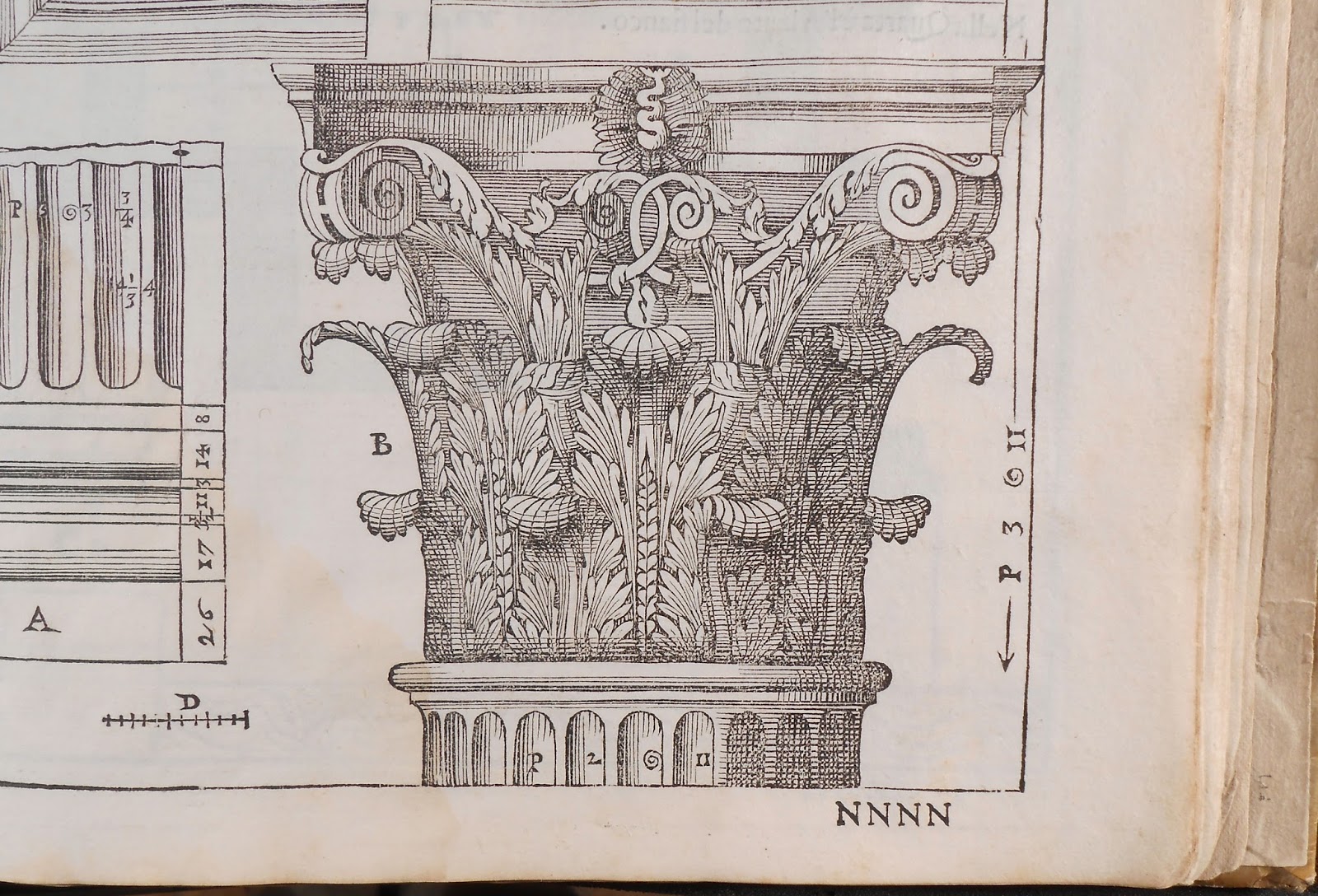
An illustration of the detail at the top of a column.

Friday, August 23, 2013

By Bread Alone

A title page for "Treatise on Bread and Bread-making."For those of you who have ever struggled with the rise on your sourdough or battled with making the perfect baguette, a study of Sylvester Graham's Treatise on Bread and Bread-making (Boston: Light & Stearns, 1837) may be in order. Published in 1837, Graham's treatise was the first book of its kind solely focused on the subject of bread and bread making. Graham, though best known for being the inventor of the Graham cracker, advocates strongly for the consumption of bread in the daily diet. "There are probably few people in civilized life," he writes, "who…would not say that they consider bread one of the most, if not the most important article of diet which enters into the food of man."

Split into eight parts, the treatise covers topics such as bread's long history, its properties, varieties, fermentation, and of course, the fine art of preparation. Because Graham believed strongly that the best bread makers were wives and mothers, his treatise was so controversial that heated bakers threatened to riot whenever he spoke. During a time in Britain where most recipes were passed down through word of mouth, Graham's Treatise on Bread and Bread-making takes the reader through a journey of the entire bread making process; from harvesting the wheat, to developing a strong yeast, and the first real technical instructions as to how to craft the best tasting breads. Want a sweeter, richer bread? Use fresh ground meal. A wholesome daily bread? Forgo the barley and prepare coarsely ground rye mixed with Indian meal. Though in age of pre-packaged baked goods and fast acting yeasts some of Graham's ideas may indeed seem obsolete, much can be learned from his precise history and attention to detail.

Come and take a look at the 1837 publication and view other tips Graham has for bread makers by asking for Rare Book TX 769 .G68.

Tuesday, August 20, 2013

A Child's Garden of Drafts

A handwritten page of text.Our manuscript collections are full of first tries. Drafts of novels, stories and poems abound. Many never got beyond the initial draft, others seem to have been born fully decked out and ready for the publisher. Here are two very different examples. The first is a short story from Frances Hodgson Burnett, an inspired writer if there ever was one. Her draft of "The Plain Miss Burnie" from 1911 almost matches the final published version in Munsey's Magazine. There was no need to leave space for changes because revision would be almost unnecessary.

A handwritten page of verse.
On the other end of the spectrum is Robert Louis Stevenson's draft of the poem "Historical Associations" which appeared in A Child's Garden of Verses. It is written out on paper that he reused. Whole stanzas are crossed out, and the ordering changes within the draft then again in publication.

Come see the contrasting styles by asking for Codex Ms 003180 and Codex MS 002473.

A printed page of verse.
For other interesting drafts see Aldous Huxley's introduction for Edna St. Vincent Millay and Mark Twain's A Tramp Abroad.

Friday, August 16, 2013

$300 Reward

A reward poster for a runaway man named Lewis.We just acquired a simple document that says so much. This broadside from 1857, printed in Washington, D.C., for a slave owner in nearby Prince George County, Maryland, offers a reward for the capture of the runaway slave Lewis. At first glance, you are struck by the paucity of details concerning Lewis's appearance: his height, "about" 5' 5"; his "stout and full" face; and his slowness of speech. It would be difficult for anyone to make a positive ID from such a description, but it speaks to how the owner could not see Lewis as a person with unique characteristics.

But it is the details of the reward that caught our attention. Issued well after the Fugitive Slave Law was enacted, the reward is graded to match the potential difficulty of recovering Lewis. The full $300 reward is contingent on his retrieval from a free state--a capture within Prince George County only warrants a $50 reward. Set next to a broadside posted in a free state warning fugitive slaves of the presence of a slave hunter (that we blogged last year), this document helps illustrate the divisive nature of the Fugitive Slave Law, an act originally designed as a compromise to preserve the union.

A notice regarding the presence of a slave-hunter.

Find this item under Broadside 001467.

Tuesday, August 13, 2013

Chinese Comics

The cover for the Chinese comic-book edition of "All Quiet on the Western Front."Erich Maria Remarque's 1929 antiwar novel All Quiet on the Western Front (Im Westen nichts Neues) became an international bestseller, selling nearly two million copies worldwide and translated into over 20 languages the year it was published. Pirated editions appeared in China, along with a stage play. When the American film of All Quiet on the Western Front was produced the following year, there was an effort to ban it in China because of a perception that its antiwar message would undermine national resistance to Japanese aggression. This is the cultural context for one of Rauner Library's newest acquisitions, Lianhuan huatu xixian wu zhansi, or "The Cartoon-Illustrated All Quiet on the Western Front," published in Shanghai in the 1930s.

Pages from the comic.

Despite the government's official intolerance of antiwar messages, there was some cultural resistance in urban areas of China during the 1930s. The visual arts were also flourishing in Shanghai during this time, and comics, or lianhuanhua, were enormously popular, particularly for younger and less educated readers. The lianhuanhua were sold at street bookstalls, and were issued serially, like many comics today. Readers could rent installments as they came out, rather than purchase copies. After a full run of a comic was completed, the publishers issued a box for the collection. Serialized comics usually don't survive well, because of the cheapness of their production and materials, and because they were often handled by many readers. Our copy of Lianhuan huatu xixian wu zhansi is in excellent shape, and came to us in its original box. Several of the parts, or fascicles, are stamped "Made in China," suggesting that the copy was exported to other markets, which may account for its preservation.
Pages from a comic.
The back cover of a paper booklet, with a stamp reading "Made in China."

After the Japanese invasion of China in 1937, the comics industry in Shanghai came to an end. Some comics magazines survived as war propaganda, but Remarque's story of young soldiers who face the futility of war was likely less popular.

To see this remarkable book, ask at the Rauner Reference Desk for Rare PN6790.C6 X59 1930z.

Friday, August 9, 2013

Lord Ruthven

A title page for Polidori's "The Vampyre."Though most people associate the modern vampire with Bram Stoker's Count Dracula, the less well known, but equally suave and predatory Lord Ruthven from John Polidori's The Vampyre (London: Sherwood, Neely, and Jones, 1819) predates the Count by almost eighty years. Polidori's Ruthven is the first depiction of the vampire figure as an aristocratic man possessed of an almost irresistible power over others, especially women.

Ruthven has all of the, by now stereotypical, traits of the vampire. He is pale, attractive to women, ruthless, murderous, and ultimately indifferent to rest of the world.
In spite of the deadly hue of his face, which never gained a warmer tint, either from the blush of modesty, or from the strong emotion of passion, though its form and outline were beautiful, many of the female hunters after notoriety attempted to win his attentions, and gain, at least, some marks of what they might term affection.
Polidori was Lord Byron's personal physician and accompanied him on several of his trips abroad, including the famous trip to Lake Geneva in 1816 where Mary Shelley's Frankenstein was conceived. Polidori was inspired by a story fragment that Byron wrote at the time and used this as a basis for his own tale of the supernatural. This is alluded to in the introduction in an extract of a letter from an unnamed person in Geneva.
It was afterwards proposed, in the course of conversation, that each of the company present should write a tale depending on some supernatural agency, which was undertaken by Lord B., the physician, and Miss M. W. Godwin.
An asterisk next to Godwin's name leads to the footnote: "Since published under the title of "Frankenstein: or, The Modern Prometheus."

Another interesting connection is the origin of the name "Ruthven" which was most likely borrowed wholesale from Lady Caroline Lamb's Glenarvon. The characters in Glenarvon were thinly disguised and often unflattering portraits of London society. The Glenarvon Ruthven is based on Lord Byron, with whom Lamb had a tumultuous affair in 1812 and about whom she coined the phrase "mad, bad, and dangerous to know."

Ask for Rare Book PR 5187 .P5 v36. Our earlier posts on the First Illustrated Frankenstein and A Dissertation Concerning Vampires may also be of interest.